
Opening your dashboard
Class 12 Physics Chapter 19 Wave Optics - Huygens' Principle: Practice Questions
78 questions on Chapter 19, each worked through on its own page with the AI tutor. Class 12 Physics, ICSE 2026-27.
78 questions
1–4 marks · Mixed difficulty
- 11 mark
Question 1
According to Maxwell's electromagnetic theory, a light wave travelling through empty space consists of
- 23 marks
Question 2
Maxwell's theory predicts that light travels through empty space with speed , and through a transparent non-magnetic material with speed , where is the relative permittivity of the material at the frequency of the light. Take and .
(i) Calculate .
(ii) For acrylic plastic, at the frequency of yellow light. Find the speed of yellow light in acrylic and the refractive index of acrylic for this light.
- 31 mark
Question 3
Huygens pictured light as a longitudinal wave in an 'ether', rather like sound in air. Which observation later showed that light waves are in fact transverse?
- 43 marks
Question 4
A titanium–sapphire laser gives very short pulses of light with a centre wavelength of in air. Each pulse lasts (). Take the speed of light in air as .
(i) Find the frequency of the light.
(ii) Find the length of one pulse in space.
(iii) How many wavelengths (oscillations) does one pulse contain?
- 53 marks
Question 5
In Newton's corpuscular theory, refraction at a water surface was explained by a force of attraction that acts on the light corpuscles only at the surface and only along the normal to it.
(i) Show that this theory gives , where and are the speeds of light in air and in water.
(ii) For water, . Taking the speed of light in air as , find the speed of light in water predicted by the corpuscular theory and by the wave theory, which gives .
(iii) State which prediction was confirmed by experiment.
- 61 mark
Question 6
Violet light of wavelength and red light of wavelength both travel through a vacuum. The ratio of the frequency of the violet light to the frequency of the red light is
- 72 marks
Question 7
(Hypothetical data.) In the wave theory, the intensity of light is proportional to the square of the amplitude of the wave. A filter reduces the amplitude of a light wave to of its value without changing anything else.
(i) What percentage of the incident intensity passes through the filter?
(ii) A second, identical filter is placed after the first. What percentage of the original amplitude, and what percentage of the original intensity, now passes?
- 83 marks
Question 8
(Hypothetical data.) The electric field of a light wave travelling along the -axis through a transparent liquid is
with in metres and in seconds. Find
(i) the wavelength of the light in the liquid,
(ii) the frequency of the light, and
(iii) the speed of the light in the liquid.
- 91 mark
Question 9
A plane light wave of wavelength travels through a uniform medium. Two of its plane wavefronts, and , are apart along the direction of travel. The phase difference between the wave at and the wave at is
- 103 marks
Question 10
(Hypothetical data.) A small lamp gives out of visible light equally in all directions.
(i) Find the intensity of the visible light at a distance of from the lamp.
(ii) The pupil of an eye at this distance has a diameter of . How much visible-light power enters the eye?
(iii) The same is instead sent out as a parallel beam (plane wavefronts) of cross-section . Find its intensity, and say how it changes with distance.
- 113 marks
Question 11
(Hypothetical data.) Close to the middle of a long, straight fluorescent tube, the tube acts as a line source and its wavefronts are cylinders with the tube as their axis. At from the tube the intensity of its visible light is .
(i) Explain why the intensity near a line source varies as , and find the intensity at from the tube.
(ii) Find the ratio of the amplitudes of the light wave at and at .
(iii) A small bulb (a point source) also gives at . What would its intensity be at ?
- 121 mark
Question 12
After passing through an ideal converging lens, light forms a spherical wavefront that is converging towards the focus . At one instant the radius of this wavefront is , as shown.
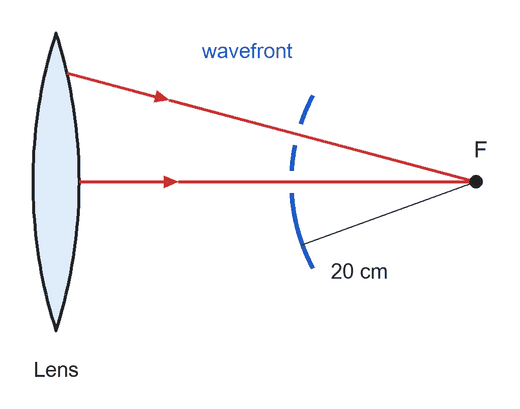
Taking the speed of light in air as , the wavefront later is
- 133 marks
Question 13
(Hypothetical data.) A point source is at the origin of a coordinate plane in which distances are in cm. It sends light through a uniform medium in which light travels at . At one instant a wavefront passes through the point . The figure also marks the points , and .
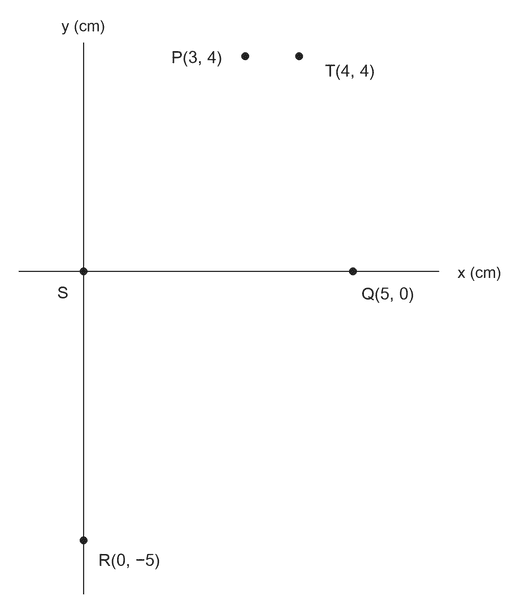
(i) Which of the points , and lie on the same wavefront as at that instant? Give a reason.
(ii) In which direction does the ray at travel? Give the angle it makes with the -axis.
(iii) Find the refractive index of the medium, and the radius the wavefront through had earlier.
- 141 mark
Question 14
In the figure, a plane wavefront falls on an ideal thin convex lens and comes out as a spherical wavefront converging towards the focus . Ray 1 travels along the axis, through the thickest part of the lens; ray 2 passes through the lens near its edge.

Light takes a time to go from to along ray 1. The time it takes from to along ray 2 is
- 154 marks
Question 15
Light from a star reaches a telescope whose objective lens has a diameter of . The nearest star (other than the Sun) is about away.
(i) A spherical wavefront of radius crosses a circular opening of radius . Using Pythagoras' theorem, show that the middle of the wavefront bulges ahead of its edge by a distance when is much smaller than .
(ii) Find across the objective for light from the star, and for light from a small lamp away.
(iii) Compare each value with the wavelength , and explain why light from a star is treated as plane wavefronts.
- 161 mark
Question 16
A small lamp sends light equally in all directions through clear air. At from the lamp the amplitude of the light wave is . Neglecting absorption, the amplitude at from the lamp is
- 173 marks
Question 17
(Hypothetical data.) In a dark hall, a small lamp hangs directly above a point on the level floor. is a point on the floor from , as shown. The lamp is switched on. Take the speed of light in air as .

(i) Which point of the floor does the wavefront from the lamp reach first?
(ii) How long after reaching does the wavefront reach ?
(iii) Is the floor a wavefront? Explain.
- 181 mark
Question 18
In Huygens' construction only the forward envelope of the secondary wavelets is taken as the new wavefront, and no wave is drawn travelling back towards the source. The later wave theory of Fresnel and Kirchhoff explains this by showing that
- 193 marks
Question 19
A point source in air sends out a short pulse of light at . At the wavefront is a sphere of radius centred on . Take the speed of light in air as .
(i) Using Huygens' principle, find the radius of the secondary wavelets that must be drawn from points on this wavefront to locate the wavefront at .
(ii) Describe the construction, and find the radius of the new wavefront.
(iii) Explain why the new wavefront is also a sphere centred on .
- 201 mark
Question 20
A plane wavefront travels through water, in which light travels at . To locate the wavefront later by Huygens' construction, the secondary wavelets must be drawn with a radius of
- 213 marks
Question 21
A plane wavefront travels through a large block of glass in which light travels at .
(i) Use Huygens' construction to find the position of the wavefront later. Explain each step and draw the construction.
(ii) Use your construction to show that, in this uniform medium, the ray at any point is perpendicular to the wavefront.
- 221 mark
Question 22
Which statement about Huygens' secondary wavelets in a uniform medium is NOT correct?
- 233 marks
Question 23
(Hypothetical data.) In a ripple tank, straight water waves of frequency travel at towards a barrier that has a gap wide, as shown.
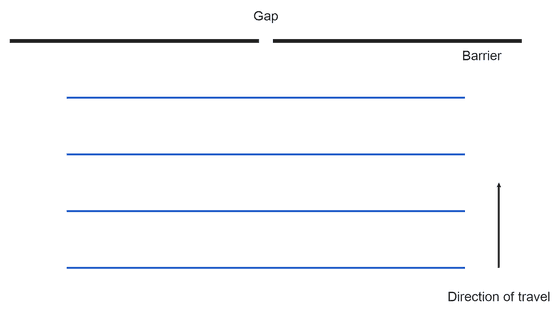
(i) Find the wavelength of the waves.
(ii) Use Huygens' principle to describe the shape of the wavefronts beyond the gap, and explain why they have this shape.
(iii) How far from the gap is a crest that passed through the gap earlier?
- 241 mark
Question 24
Huygens' construction can be used to find the new position of a wavefront for
- 251 mark
Question 25
In Huygens' construction for the reflection of a plane wavefront AB at a plane mirror, end A touches the mirror first. In the time that end B takes to reach the mirror at D, a secondary wavelet spreads out from A; C is the point where the reflected wavefront from D touches this wavelet.

Why is the radius AC of this wavelet taken equal to BD?
- 263 marks
Question 26
(Hypothetical data.) A parallel beam of light in air strikes a plane mirror obliquely. End A of a plane wavefront AB touches the mirror first, and end B reaches the mirror at point D, later. The distance AD along the mirror is . Take .
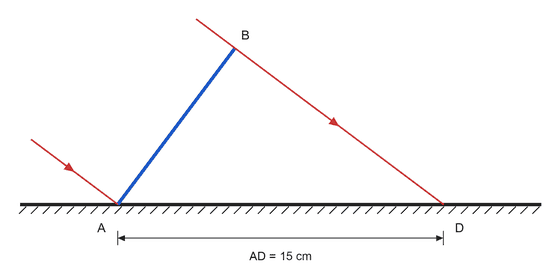
(a) How far does end B travel to reach D?
(b) Find the angle of incidence.
(c) Find the width AB of the wavefront. Using Huygens' construction, find the radius AC of the secondary wavelet from A at the instant B reaches D, and show that the reflected wavefront DC makes the same angle with the mirror as AB does.
- 271 mark
Question 27
A plane wavefront in air meets a plane mirror. At the instant its edge A touches the mirror, the wavefront is inclined at to the mirror surface, as shown.
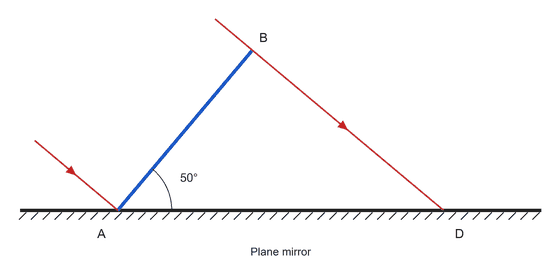
Through what angle is the light deviated by the reflection?
- 282 marks
Question 28
A plane wavefront travelling in air strikes a plane mirror at normal incidence. Using Huygens' principle, show that the reflected wavefront is also plane, is parallel to the mirror and travels straight back along the incident direction. Draw the construction.
- 291 mark
Question 29
A plane wavefront travelling parallel to the principal axis falls on a concave mirror of small aperture. Just after reflection, the wavefront is
- 301 mark
Question 30
A plane wavefront meets a plane mirror, inclined at to the mirror surface (figure (a)). The incident light is kept fixed, and the mirror is turned through so that the wavefront now meets it at (figure (b)).
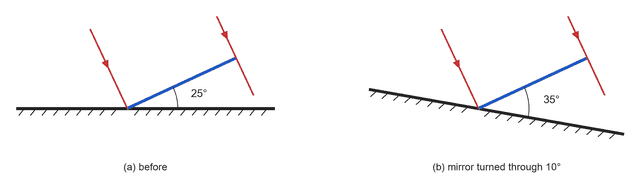
Through what angle does the reflected wavefront turn?
- 311 mark
Question 31
In Huygens' construction for refraction, a plane wavefront AB in air reaches the flat surface of glass of refractive index . End A touches the glass first. End B then travels in air to reach the surface at D, as shown.

In the same time, the secondary wavelet from A spreads into the glass to a radius of
- 323 marks
Question 32
(Hypothetical data.) A plane wavefront in air reaches the flat surface of a transparent plastic block. End A of the wavefront touches the surface first, and end B reaches the surface at D, later. The distance AD is . During this time the secondary wavelet from A spreads into the plastic to a radius . Take .

(a) Find BD and the angle of incidence.
(b) Find the angle of refraction.
(c) Find the refractive index of the plastic and the speed of light in it, and check that the two agree.
- 331 mark
Question 33
A plane wavefront passes obliquely from air into water. Which statement correctly explains, on Huygens' wave theory, why the refracted ray bends towards the normal?
- 343 marks
Question 34
A plane wavefront in air falls on a parallel-sided glass slab of refractive index . At the instant its edge touches the top face, the wavefront is inclined at to that face, as shown.
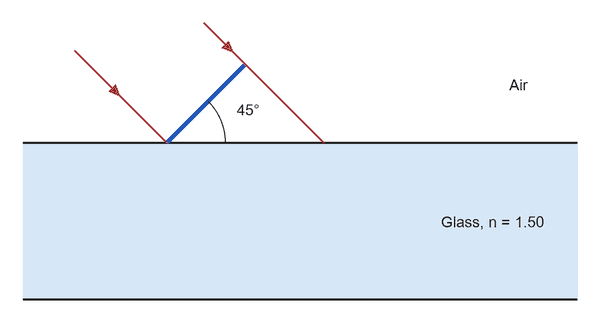
(a) Using the result of Huygens' construction for refraction, find the angle that the wavefront inside the glass makes with the faces of the slab.
(b) Find the angle that the wavefront makes with the bottom face after it has left the slab.
(c) Hence show that the emerging wavefront is parallel to the incident wavefront, and state how its speed and wavelength compare with those of the incident light.
- 351 mark
Question 35
(Hypothetical data.) A plane wavefront passes from water () into a transparent liquid L. In Huygens' construction, end B of the wavefront travels in the water while the secondary wavelet from the first point A spreads to a radius in liquid L, as shown.
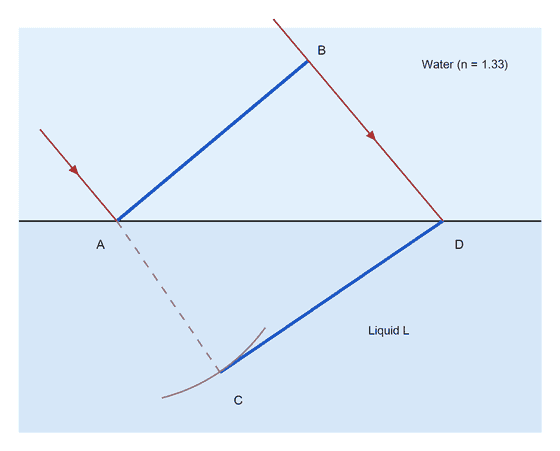
The refractive index of L is
- 363 marks
Question 36
(Hypothetical data.) Light of wavelength in air falls obliquely on a flat glass surface. The crests of the incident wave meet the surface along parallel lines apart. Inside the glass the wavelength is .
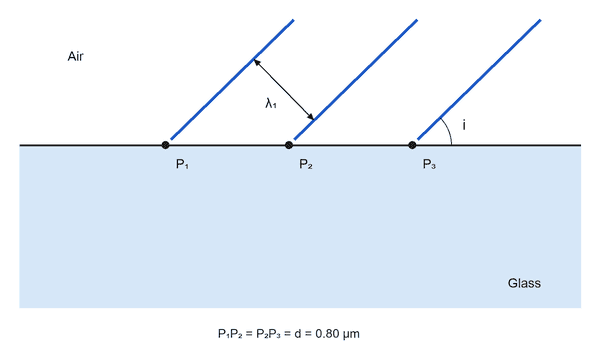
(a) Find the angle of incidence.
(b) In Huygens' picture each crest starts its secondary wavelets in the glass where it meets the surface, so the crests in the glass meet the surface along the same lines. Find the angle of refraction.
(c) Find the refractive index of the glass in two ways and show that Snell's law holds.
- 371 mark
Question 37
A plane wavefront in air strikes the flat surface of glass of refractive index . At the instant its edge A touches the glass, the wavefront is inclined at to the surface, as shown.

The refracted wavefront in the glass is inclined to the surface at
- 381 mark
Question 38
Which of the following layers has the greatest optical path for light crossing it normally?
- 393 marks
Question 39
(Hypothetical data.) Light of wavelength in vacuum passes normally through a thin transparent plastic layer of thickness and refractive index . Part of the same beam passes through an equal thickness of air beside the layer (take for air).
(a) Find the wavelength of the light inside the plastic.
(b) How many wavelengths fit in the plastic layer, and how many in the same thickness of air?
(c) Find the extra optical path introduced by the layer and the phase difference it causes between the two parts of the beam. Are the two parts in step when they leave?
- 401 mark
Question 40
A simple laser rangefinder works out a distance from the time a pulse takes to go out and back, assuming the pulse travels at , the speed of light in vacuum. For a target away through air (take ), the distance it gives is too large by about
- 413 marks
Question 41
(Hypothetical data.) A narrow beam of light crosses an aquarium normally. It passes through a glass wall thick, of water and another glass wall thick. Take for the glass, for the water and .
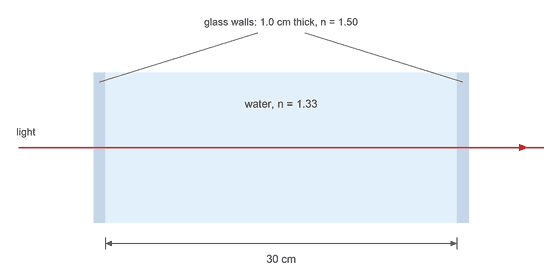
(a) Find the total optical path of the beam inside the tank, walls included.
(b) How long does the light take to cross the tank?
(c) How much later does it arrive than light crossing the same of air (take for air)?
- 421 mark
Question 42
(Hypothetical data.) The same monochromatic light has a wavelength of in liquid X and in liquid Y. The refractive index of Y with respect to X is
- 433 marks
Question 43
(Hypothetical data.) A beam of light of frequency passes through a transparent liquid. Exactly wavelengths of the light fit into a length of the liquid. Take .
(a) Find the wavelength of the light in the liquid and in vacuum.
(b) Find the refractive index of the liquid.
(c) Find the speed of light in the liquid, and check it against part (b).
- 443 marks
Question 44
(Hypothetical data.) To measure the refractive index of a new transparent plastic, a short laser pulse is sent through a long block of it, while another pulse travels through air beside it. A fast detector shows that the pulse through the plastic arrives later. Take and for air.
(a) Find the refractive index of the plastic.
(b) Find the optical path of the block and the speed of light in it.
(c) The laser's wavelength in air is . Find its wavelength in the plastic.
- 452 marks
Question 45
In a Huygens' construction for light passing from air into water (), end B of a plane wavefront AB travels in air while the secondary wavelet from A spreads to a radius in the water, as shown.

(a) Find the optical paths along BD and along AC.
(b) A ray from the mid-point of AB travels in air before reaching the surface. Using equal optical paths between the two wavefronts, find how far it travels in the water before reaching CD.
- 464 marks
Question 46
(Hypothetical data.) A narrow beam of white light passes normally through a glass block thick. For red light (wavelength in vacuum) the glass has , and for violet light ( in vacuum) . Take .
(a) Find how many wavelengths of each colour fit across the block.
(b) Find the speed of each colour in the glass. Which colour travels more slowly?
(c) Find the difference between the optical paths for the two colours and, using the speeds found in (b), the difference in the times the two colours take to cross the block.
- 472 marks
Question 47
On which factors does the speed of light in vacuum depend?
- 482 marks
Question 48
On which factors does the speed of light in a medium (say, glass or water) depend?
- 492 marks
Question 49
When monochromatic light is incident on a surface separating two media, the reflected and refracted light both have the same frequency as the incident frequency, why?
- 502 marks
Question 50
When light travels from a rarer medium to a denser medium, it loses some speed. Does the reduction in speed imply a reduction in the energy carried by the light wave?
- 511 mark
Question 51
In the wave picture of light, intensity of light is determined by the square of the amplitude of the wave. What determines the intensity of light in the photon picture of light?
- 522 marks
Question 52
A narrow pulse of light is sent through a medium. Will you expect the pulse to retain its shape as it travels through the medium?
- 532 marks
Question 53
The speed of light in still water is , where is the refractive index of water. What is the speed of light in a stream of water flowing at a speed of relative to the observer?
- 542 marks
Question 54
What is the geometrical shape of the wavefront in each of the following cases: (a) light diverging from a point source, (b) light emerging out of a convex lens, when a point source is placed at its focus and (c) the portion of the wavefront of light from a distant star, intercepted by the Earth?
- 553 marks
Question 55
The refractive index of ethyl alcohol is 1.361. The optical path of yellow light is the same if it travels through 10 cm of ethyl alcohol or 9.24 cm of glycerine. Find the refractive index of glycerine.
- 563 marks
Question 56
Calculate the speed of light in glass. Given that the refractive index of glass is 1.5 and that of water is 1.3. The speed of light in water is m/s.
- 573 marks
Question 57
The wavelength of sodium yellow light in vacuum is 589.3 nm. Calculate its frequency if the speed of light in vacuum is m/s.
- 583 marks
Question 58
Light propagates through a glass of thickness 10 mm. Calculate the optical path if the refractive index of glass is 1.5.
- 592 marks
Question 59
What do you understand by a wavefront? Name the shape of a wavefront originating from
(i) a point source and
(ii) a line source.
- 602 marks
Question 60
The refractive index of glass is 1.5 and that of water is 1.3. If the speed of light in water is m/s, what is the speed of light in glass?
- 612 marks
Question 61
What is the shape of wavefront for a beam of parallel waves? What for originating from a point source?
- 622 marks
Question 62
Light of wavelength 4500 Å in vacuum enters into a glass block of refractive index 1.5. What is the wavelength of light in the glass block?
- 632 marks
Question 63
The refractive indices of glass, diamond and water are 1.5, 2.0 and 1.33 respectively. In which of these will the speed of light be maximum? Justify your answer with a suitable reason.
- 641 mark
Question 64
What is internationally accepted value of velocity of light in vacuum? (All nine digits)
- 651 mark
Question 65
State any one postulate of Huygens' wave theory.
- 661 mark
Question 66
What is the shape of wavefront diverging from a point source of light?
- 671 mark
Question 67
With what type of source of light are cylindrical wavefronts associated?
- 681 mark
Question 68
What is the phase difference between any two points lying on the same wavefront?
- 691 mark
Question 69
Which of the following is not a property of light?
- 701 mark
Question 70
In Huygens' wave theory, the locus of all points in the same state of vibration is called
- 711 mark
Question 71
Huygens' wave theory allows us to know
- 721 mark
Question 72
Huygens' principle of secondary wavelets may be used to
- 731 mark
Question 73
Select the right option from the following.
- 741 mark
Question 74
For a wave propagating in a medium, identify the property that is independent of the others
- 751 mark
Question 75
Spherical wavefronts, emanating from a point source, strike a plane reflecting surface. What will happen to these wavefronts, immediately after reflection?

- 761 mark
Question 76
On a hot summer night, the refractive index of air is smallest near the ground and increases with height from the ground. When a light beam is directed horizontally, the Huygens' principle leads us to conclude that as it travels, the light beam,

- 771 mark
Question 77
Which colour of light has the longest wavelength?
- 781 mark
Question 78
Red light differs from blue light as they have