
Opening your dashboard
Class 12 Physics Chapter 17: Refraction through a Prism - Dispersion Solutions
71 textbook questions with step-by-step answers, free to read, for ISC 2026-27.
Get talked through Ch 17, not just shown the answer
Reading a finished solution is not the same as being able to do it. The AI tutor takes one question at a time and works it with you, in your own words, until you can.
- Ask it out loud, in your own words
- It gives you the next step, not the answer
- Stuck on part (ii)? Start there
71 questions with solutions
1–5 marks · Mixed difficulty
The first 56 solutions are on this page. This chapter is a long one, so the rest open on their own page to keep this one quick to load.
- 11 mark
Question 1
A ray of light is incident on an equilateral glass prism placed on a horizontal table as shown in the figure. For minimum deviation, which of the following is true?
 Solve with AI
Answer
(A) is horizontal
- Correct
(B) is horizontal
(C) is horizontal
(D) Either or is horizontal
Answer: (B) is horizontal
Concept: At minimum deviation the ray passes symmetrically through the prism, so the ray inside the prism is parallel to the base.
Step 1 — Path at minimum deviation. At minimum deviation the ray passes symmetrically through the prism: the two angles of refraction are equal, each . The refracted ray then makes equal angles with the two faces, so it is parallel to the base.
Step 2 — Relate it to the table. The base rests on the horizontal table, so is horizontal.
Step 3 — Check the other options. Each of the other options fails for a definite reason:
- (A) is inclined: for a 60° prism it makes with the normal, so it rises towards the prism.
- (C) is inclined downward by the same angle (since ), so it is not horizontal.
- (D) Neither nor is horizontal; only the ray inside is.
- 21 mark
Question 2
Under minimum deviation condition in a prism, if a ray is incident at an angle 30°, the angle between the emergent ray and the second refracting surface of the prism is
Solve with AIAnswer
(A) 0°
(B) 30°
(C) 45°
- Correct
(D) 60°
Answer: (D) 60°
Concept: At minimum deviation the angle of incidence equals the angle of emergence, and both are measured from the normal, not from the surface.
Step 1 — Angle of emergence. During minimum deviation , so .
Step 2 — Angle with the surface. is measured from the normal. The angle between the emergent ray and the surface is
Step 3 — Check the other options. Each of the other options fails for a definite reason:
- (A) 0° would mean the emergent ray grazes the surface ().
- (B) 30° is the angle with the normal, not with the surface.
- (C) 45° would need .
- 31 mark
Question 3
When white light enters a prism, it gets split into its constituent colours. This is due to
Solve with AIAnswer
(A) High density of prism material
- Correct
(B) Because is different for different
(C) Diffraction of light
(D) Velocity changes for different frequencies
Answer: (B) Because is different for different
Concept: Dispersion happens because the refractive index of a medium depends on the wavelength (colour) of light.
Step 1 — Cause of the splitting. The refractive index of glass depends on wavelength (). Each colour is therefore refracted through a different angle, and white light splits up — this is dispersion.
Step 2 — Check the other options. Each of the other options fails for a definite reason:
- (A) Density alone does not split light; a dense medium with the same for all colours would give no dispersion.
- (C) Diffraction is bending round obstacles or apertures, not the cause of a prism spectrum.
- (D) The speed in glass does change with frequency, and that is what makes depend on ; (B) names the cause directly in terms of refractive index, so (B) is the intended answer.
- 41 mark
Question 4
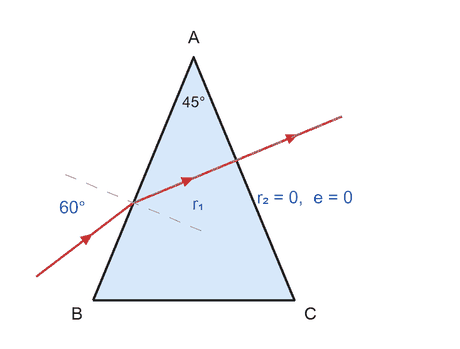
The light ray is incidence at angle of 60° on a prism of angle 45°. When the light ray falls on the other surface at 90°, the refractive index of the material of prism and the angle of deviation are given by
Solve with AIAnswer
(A) ,
(B) ,
(C) ,
- Correct
(D) ,
Answer: (D) ,
Concept: For a prism the angles of refraction add up to the prism angle, , and the deviation is . A ray meeting a face at 90° to the surface travels along the normal.
Step 1 — Angle of refraction at the first face. The ray meets the second face at 90° to the surface, i.e. along the normal: and .
Since is zero, this gives
Step 2 — Refractive index. Snell's law at the first face then gives the refractive index:
Step 3 — Deviation. The deviation is the angle of incidence plus the angle of emergence, minus the prism angle:
Step 4 — Check the other options. Each of the other options fails for a definite reason:
- (A) equal to would need , i.e. , not 45°; and is 15°, not 30°.
- (B) is right, but is not 1.5: Snell's law at the first face gives , which is about 1.22.
- (C) is impossible for glass, and is not 30°.
- 51 mark
Question 5
If the angle of prism is 60° and the angle of minimum deviation is 40°, the angle of refraction will be
Solve with AIAnswer
- Correct
(A) 30°
(B) 60°
(C) 100°
(D) 120°
Answer: (A) 30°
Concept: at minimum deviation the ray passes symmetrically through the prism, so the two angles of refraction are equal; call each of them . For every ray the two angles of refraction also add up to the angle of the prism.
Step 1 — Use the angle rule. Put for both and in the rule:
Step 2 — Solve for r. Divide by 2 and put :
- (B) 60° is the angle of the prism, , not .
- (C) 100° is , which equals , not .
- (D) 120° is ; an angle of refraction inside glass cannot exceed the critical angle (about 41° for this prism, ).
- 61 mark
Question 6
The angle of minimum deviation for a prism is 40° and the angle of the prism is 60°. The angle of incidence in this position will be
Solve with AIAnswer
(A) 30°
(B) 60°
- Correct
(C) 50°
(D) 100°
Answer: (C) 50°
Concept: At minimum deviation the angle of incidence equals the angle of emergence, so the deviation relation gives equal to .
Step 1 — Condition at minimum deviation. At minimum deviation , and :
Step 2 — Check the other options. Each of the other options fails for a definite reason:
- (A) 30° is the angle of refraction , not .
- (B) 60° is the angle of the prism.
- (D) 100° is , which is .
- 71 mark
Question 7
Pick the correct statement from the following.
Solve with AIAnswer
(A) Primary rainbow is a virtual image and secondary rainbow is a real image.
(B) Primary rainbow is a real image and secondary rainbow is a virtual image.
- Correct
(C) Both primary and secondary rainbows are virtual images.
(D) Both primary and secondary rainbows are real images.
Answer: (C) Both primary and secondary rainbows are virtual images.
Concept: A real image is formed where light rays actually meet and can be caught on a screen; a virtual image is a place from which rays only appear to come.
Step 1 — Is the rainbow real or virtual?. A rainbow cannot be caught on a screen. The coloured light only appears to come from the raindrops lying in particular directions (40.8°–42.8° and 50.8°–54.5° from the line joining the Sun to the eye). The light does not actually converge to form the bow anywhere, so both bows behave as virtual images.
Step 2 — Check the other options. Each of the other options fails for a definite reason:
- (A) The secondary bow is formed in the same way (with one more internal reflection), so it cannot be real while the primary is virtual.
- (B) Likewise the primary bow is not real: it is not formed on any screen.
- (D) Neither bow can be obtained on a screen, so neither is real.
Note: strictly, a rainbow is not an image of any object at all; the book's key treats it as virtual because it is seen only by looking in a certain direction.
- 81 mark
Question 8
Continuous emission spectrum is produced by
Solve with AIAnswer
- Correct
(A) Incandescent electric lamp
(B) Mercury vapour lamp
(C) Sodium vapour lamp
(D) The Sun
Answer: (A) Incandescent electric lamp
Concept: Hot solids and liquids give a continuous spectrum; hot gases or vapours in the atomic state give a line spectrum.
Step 1 — Which source is a white-hot solid?. A continuous spectrum is produced by white-hot solids and liquids. The filament of an incandescent lamp is a white-hot solid, so it emits all wavelengths without a break.
Step 2 — Check the other options. Each of the other options fails for a definite reason:
- (B) Mercury vapour is a gas in the atomic state; it gives a line spectrum.
- (C) Sodium vapour also gives a line spectrum (the two yellow D lines).
- (D) The spectrum of the Sun is a continuous background crossed by dark absorption (Fraunhofer) lines, so it is not a pure continuous emission spectrum.
- 91 mark
Question 9
Blue colour of sea water is due to
Solve with AIAnswer
(A) Image of sky in water
(B) Refraction of sunlight
(C) Interference of sunlight reflected from the water surface
- Correct
(D) Scattering of sunlight by the water molecules.
Answer: (D) Scattering of sunlight by the water molecules.
Concept: Particles much smaller than the wavelength scatter light with intensity (Rayleigh's law), so short wavelengths are scattered most.
Step 1 — Apply Rayleigh's law to water. Water molecules are much smaller than the wavelength of light, so they scatter light according to Rayleigh's law . Blue (short wavelength) is scattered much more than red, so the sea looks blue.
Step 2 — Check the other options. Each of the other options fails for a definite reason:
- (A) Reflection of the sky contributes a little, but the deep blue of the sea is seen even under a grey sky, so it is not the cause.
- (B) Refraction only bends light; it does not pick out blue.
- (C) Interference colours need thin films; the sea surface is not a thin film.
- 101 mark
Question 10
Which of the prism is used to see infrared spectrum of light?
Solve with AIAnswer
- Correct
(A) Rock salt
(B) Nicol
(C) Flint
(D) Crown
Answer: (A) Rock salt
Concept: To study a region of the spectrum, the prism must be made of a material that is transparent to those wavelengths.
Step 1 — Which material passes infrared?. Glass absorbs infrared, but rock salt is transparent to infrared. So for the study of the infrared spectrum, rock salt prisms are used.
Step 2 — Check the other options. Each of the other options fails for a definite reason:
- (B) A Nicol prism is made of calcite and is used to produce and analyse plane-polarised light, not to study infrared.
- (C) Flint glass absorbs infrared.
- (D) Crown glass also absorbs infrared.
- 111 mark
Question 11
Consider the following two statement A and B and identify the correct choice in the given answer.
A : Line spectra is due to atoms in gaseous state
B : Band spectra is due to molecules
Solve with AIAnswer
(A) Both A and B are false
(B) A is true and B is false
(C) A is false and B is true
- Correct
(D) Both A and B are true
Answer: (D) Both A and B are true
Concept: Line spectra come from atoms; band spectra come from molecules (groups of closely spaced lines due to molecular vibration and rotation).
Step 1 — Judge statement A. Line spectra are produced by substances in the atomic state (for example a gas or vapour of atoms), so statement A is true.
Step 2 — Judge statement B. Band spectra are produced by substances in the molecular state, so statement B is true.
Step 3 — Check the other options. Each of the other options fails for a definite reason:
- (A) Both statements are true, so "both false" is wrong.
- (B) Statement B is true, not false.
- (C) Statement A is true, not false.
- 121 mark
Question 12
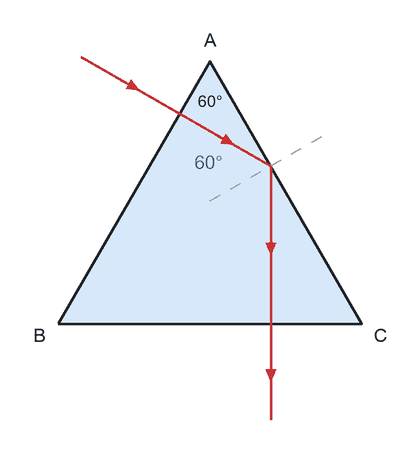
When a ray of light is incident normally on one refracting surface of an equilateral prism (Refractive index of the material of the prism = 1.5)
Solve with AIAnswer
(A) Emerging ray is deviated by 30°
(B) Emerging ray is deviated by 45°
(C) Emerging ray just grazes the second refracting surface
- Correct
(D) The ray undergoes total internal reflection at the second refracting surface
Answer: (D) The ray undergoes total internal reflection at the second refracting surface
Concept: A ray inside glass is totally reflected at a face if its angle of incidence there is greater than the critical angle , where .
Step 1 — Angle at the second face. At normal incidence the ray goes straight in, so ; since for every ray, the angle at the second face is
So the ray meets the second face at 60°.
Step 2 — Compare with the critical angle.
The critical angle is the angle of incidence in glass for which the emergent ray just grazes the surface; it is found from :
Since , total internal reflection takes place at the second surface.
- (A) A deviation of 30° would need the ray to come out of the second face, which it cannot.
- (B) 45° deviation also needs emergence from the second face.
- (C) Grazing emergence happens only when the angle inside is exactly , not 60°.
- 131 mark
Question 13
The dispersive power of crown and flint glasses are 0.02 and 0.04 respectively. In an achromatic combination of lenses, the focal length of flint glass lens is 40 cm. The focal length of crown glass lens will be
Solve with AIAnswer
- Correct
(A) −20 cm
(B) +20 cm
(C) −10 cm
(D) +10 cm
Answer: (A) −20 cm
Concept: An achromatic doublet cancels the dispersion of one lens with the opposite dispersion of the other, so one lens must be converging and the other diverging (focal lengths of opposite sign).
For an achromatic combination (no dispersion):
Here the crown lens has dispersive power and an unknown focal length .
The flint lens has dispersive power and focal length cm.
Step 1 — Put in the values. Substitute the two dispersive powers and the flint focal length into the achromatic condition:
Step 2 — Move the known term to the right-hand side. Subtract the flint-lens term from both sides so that only the unknown stays on the left:
Step 3 — Solve for by cross-multiplying:
- (B) +20 cm has the right size but the wrong sign; then .
- (C) −10 cm comes from multiplying 40 by twice; it gives .
- (D) +10 cm fails the condition in both size and sign.
- 141 mark
Question 14
Which one of the following alternative is FALSE for a prism, placed in a position of minimum deviation?
Solve with AIAnswer
(A)
(B)
- Correct
(C)
(D) All of these
Answer: (C)
Concept: At minimum deviation the path is symmetric ( and ); at the first face light entering glass bends towards the normal, so .
Step 1 — Angles of incidence and emergence. At minimum deviation the ray passes symmetrically, so the angle of incidence equals the angle of emergence, .
Step 2 — Angles of refraction. The two angles of refraction are also equal, .
Step 3 — Compare with . But at the first face light goes from air into glass, so it bends towards the normal and . Hence is false.
Step 4 — Check the other options. Each of the other options fails for a definite reason:
- (A) is true at minimum deviation.
- (B) is true at minimum deviation.
- (D) Only (C) is false, so "all of these" is wrong.
- 151 mark
Question 15
When a glass prism of refracting angle 60° is immersed in a liquid, its angle of minimum deviation is 30°. The critical angle of glass with respect of the liquid medium is
Solve with AIAnswer
(A) 42°
- Correct
(B) 45°
(C) 50°
(D) 52°
Answer: (B) 45°
Concept: The refractive index of glass relative to the liquid follows from the prism formula, and the critical angle for glass to that liquid is given by .
Step 1 — Refractive index of glass relative to the liquid. Refractive index of glass with respect to the liquid:
Step 2 — Critical angle. The critical angle for glass to the liquid then follows from :
Step 3 — Check the other options. Each of the other options fails for a definite reason:
- (A) 42° is the critical angle of glass of index 1.5 in air, not in this liquid.
- (C) 50° would need , about 1.31.
- (D) 52° would need , about 1.27.
- 161 mark
Question 16
Three prisms 1, 2 and 3 have the prism angle , but their refractive indices are respectively 1.4, 1.5 and 1.6. If , , be their respective angles of deviation then
Solve with AIAnswer
- Correct
(A)
(B)
(C)
(D)
Answer: (A)
Concept: For a given prism angle, a larger refractive index bends light more, so the deviation increases with (for a thin prism ).
Step 1 — Rule. For the same angle of prism, the deviation increases with the refractive index. To see this with numbers, compare the minimum deviations of the three prisms. For a 60° prism the prism formula gives
Step 2 — Work out each deviation. Put , then , then :
Step 3 — Order. So .
Step 4 — Check the other options. Each of the other options fails for a definite reason:
- (B) reverses the order: a larger bends light more, not less.
- (C) The deviations would be equal only if the refractive indices were equal.
- (D) puts prism 2 above prism 3, though prism 3 has the larger .
- 171 mark
Question 17
Is it possible that a light ray incident on a prism deviates away from the base of the prism?
Solve with AIWritten solution
Solution:
Concept: Light bends towards the base only when the prism is optically denser than the medium around it; if the surrounding medium is denser, the bending is reversed.
Step 1 — When light bends towards the base. Light bends towards the base because a glass prism is usually optically denser than the air around it.
Step 2 — When it can bend away. Yes — when the prism is immersed in a transparent liquid whose refractive index is greater than that of the material of the prism. The prism is then optically rarer than its surroundings, so light bends away from the base.
- 181 mark
Question 18
Mention two factors on which the angle of deviation produced by a prism depends.
Solve with AIWritten solution
Solution:
Concept: The deviation of a ray by a prism is , and the angle of emergence depends on the prism angle and the refractive index.
Step 1 — Deviation formula. The deviation is , so anything that changes or changes the deviation.
Step 2 — First factor. (i) The angle of the prism, .
Step 3 — Second factor. (ii) The refractive index of the material of the prism (which depends on the colour of light).
Step 4 — Also. (It also depends on the angle of incidence.)
- 191 mark
Question 19
Does the angle of deviation produced by a small-angled prism depend on the angle of incidence?
Solve with AIWritten solution
Solution:
Concept: For a small-angled prism and small angles, , so Snell's law becomes a simple proportion and the angle of incidence cancels out.
Step 1 — Short answer and formula. No. For a small-angled prism the deviation is
Step 2 — What the formula contains. where is the refractive index of the material of the prism and is the angle of prism. It does not depend on the angle of incidence (for small ).
- 201 mark
Question 20
What is a dispersive medium?
Solve with AIWritten solution
Solution:
Concept: In a material medium the speed of light, and so the refractive index, depends on the wavelength; this dependence is what spreads white light into colours.
Step 1 — What makes a medium dispersive. In glass or water the speed of light is slightly different for each wavelength, so each colour has its own refractive index.
Step 2 — Definition. A medium in which waves of different wavelengths travel with different speeds is called a dispersive medium. Examples are glass and water. A dispersive medium produces dispersion of white light.
- 211 mark
Question 21
Which colour is deviated most on passing through a glass prism?
Solve with AIWritten solution
Solution:
Concept: The deviation produced by a prism increases with the refractive index, and glass has the largest refractive index for the shortest wavelength.
Step 1 — Which colour has the largest refractive index. Glass has the largest refractive index for the shortest wavelength, which is violet.
Step 2 — Answer. Violet (it has the shortest wavelength and the largest refractive index).
- 221 mark
Question 22
Name one factor on which the dispersive power of a prism depends.
Solve with AIWritten solution
Solution:
Concept: Dispersive power is the angular dispersion divided by the mean deviation; for a thin prism both are proportional to the prism angle, so cancels.
Step 1 — Write the dispersive power. For a thin prism the dispersive power is the spread of the colours divided by the mean deviation, and the prism angle cancels out.
Step 2 — Answer. The refractive index of the material of the prism (for the different colours): . It does not depend on the angle of the prism.
- 231 mark
Question 23
In the absence of atmosphere, what will be the colour of sky?
Solve with AIWritten solution
Solution:
Concept: The sky looks blue because air molecules scatter sunlight (mainly blue) towards us; without air there is nothing to scatter the light.
Step 1 — Why the sky is blue now. Today the sky looks blue because air molecules scatter the blue part of sunlight towards us from every direction.
Step 2 — Without air. The sky will appear black, because there will be nothing to scatter sunlight. Then stars could be seen even during the day time.
- 241 mark
Question 24
For observing a rainbow, mention one important condition?
Solve with AIWritten solution
Solution:
Concept: A rainbow is formed by sunlight that is refracted, dispersed and internally reflected by raindrops, so the light comes back towards the side the Sun is on.
Step 1 — Where the light goes. Raindrops send the coloured light back towards the side the Sun is on, at about 40°–42° from the line through the Sun and the eye.
Step 2 — Condition. The observer must stand with his back towards the Sun (with raindrops in front of him).
- 251 mark
Question 25
What is the reason for the blue colour of ocean?
Solve with AIWritten solution
Solution:
Concept: Scattering by particles much smaller than the wavelength follows Rayleigh's law, .
Step 1 — Rayleigh scattering. Water molecules are much smaller than the wavelength of light, so Rayleigh's law applies.
Step 2 — Apply it. The ocean appears blue due to the scattering of light by the water molecules. The intensity of scattered light . The wavelength of blue is smaller than that of red, so blue is scattered most and the ocean appears blue.
- 261 mark
Question 26
What is the reason for the red colour during sunrise and sunset?
Solve with AIWritten solution
Solution:
Concept: Short wavelengths are scattered much more than long ones (), so light that travels a long path through air loses most of its blue.
Step 1 — Path length. When the Sun is low, its light crosses much more air before it reaches us.
Step 2 — Result. During sunrise and sunset, light has to travel a greater distance through the atmosphere. So the shorter wavelengths are scattered and removed. What we see is sunlight minus the scattered light, so the Sun looks reddish.
- 271 mark
Question 27
Refractive indices of glass for violet, yellow and red colours are , and respectively. Write these in decreasing order of value. Justify your answer.
Solve with AIWritten solution
Solution:
Concept: By Cauchy's relation, the refractive index of a material decreases as the wavelength increases.
Step 1 — Order.
Step 2 — Justify. The refractive index of a material is given by Cauchy's relation , where and are constants. Since , the refractive index is largest for violet and smallest for red.
- 281 mark
Question 28
What is dispersion of light?
Solve with AIWritten solution
Solution:
Concept: White light is a mixture of colours, and a prism has a slightly different refractive index for each colour.
Step 1 — Why it happens. A prism has a slightly different refractive index for each colour, so each colour is bent through a different angle.
Step 2 — Definition. The splitting up of white (polychromatic) light into its constituent colours on passing through a refracting medium such as a prism is called dispersion of light.
- 291 mark
Question 29
Out of red and blue lights, for which colour is the refractive index of glass greater?
Solve with AIWritten solution
Solution:
Concept: The refractive index of glass is larger for shorter wavelengths (Cauchy's relation).
Step 1 — Compare the wavelengths. Blue light has a shorter wavelength than red light.
Step 2 — Answer. Blue: because (from ).
- 301 mark
Question 30
Explain the terms angular dispersion and dispersive power. How are the two related?
Solve with AIWritten solution
Solution:
Concept: A prism deviates different colours through different angles; the spread between violet and red, compared with the deviation of the middle colour, measures how strongly a material disperses light.
Step 1 — Angular dispersion. Angular dispersion is the difference between the deviations of violet and red light: .
Step 2 — Dispersive power. Dispersive power is the ratio of the angular dispersion to the deviation of the mean (yellow) ray:
Step 3 — Relation in symbols. In symbols, with the deviation of the mean (yellow) ray:
- 312 marks
Question 31
Draw a graph to show the variation of angle of deviations with angle of incident when light is incident on a glass prism. What is minimum deviation?
Solve with AIWritten solution
Solution:
Concept: For a prism . As changes, changes too, and the deviation has one smallest value, reached when the ray passes symmetrically.
Step 1 — Graph. as the angle of incidence increases, the angle of deviation first decreases, reaches a minimum value (where ), and then increases again.

Step 2 — Minimum deviation. the smallest value of the angle of deviation for a given prism and for a given colour of light is called the angle of minimum deviation (). At this position the ray passes symmetrically through the prism (, ).
- 322 marks
Question 32
Show that the angle of deviation produced by a small angled prism does not depend on the angle of incidence.
Solve with AIWritten solution
Solution:
Key idea: for small angles, (in radians).
Step 1 — Prism relations. For any prism: and .
Step 2 — Small-angle Snell's law. For a small-angled prism and small angle of incidence, all the angles are small, so Snell's law at the two faces becomes
Step 3 — Substitute. Substitute these small-angle forms of Snell's law into , then use and take out the common factor:
Step 4 — Conclusion. The right-hand side contains only and , so the deviation does not depend on the angle of incidence.
- 332 marks
Question 33
What is dispersion? What is a spectrum?
Solve with AIWritten solution
Solution:
Concept: White light is a mixture of many colours, and the refractive index of glass is different for each colour.
Step 1 — Dispersion. the phenomenon of splitting up of a polychromatic beam of light (such as white light) into its constituent colours on passing through a prism is called dispersion.
Step 2 — Spectrum. the band of colours so obtained (violet, indigo, blue, green, yellow, orange, red — VIBGYOR) is called a spectrum.
- 342 marks
Question 34
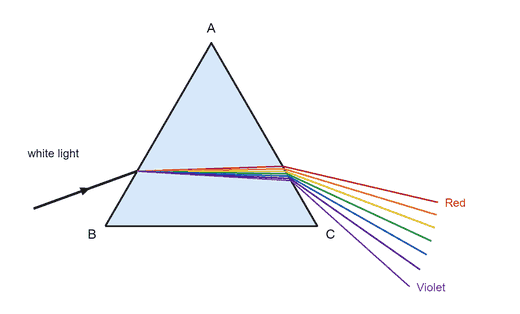
Draw a diagram to show that the splitting of white light into its constituent colours on passing through a prism.
Solve with AIWritten solution
Solution:
Concept: A prism deviates each colour by a different amount because its refractive index depends on wavelength; it is largest for violet.
Step 1 — What happens at the faces. A narrow beam of white light is refracted at both faces of the prism. Since the refractive index is different for different colours, each colour is deviated through a different angle: violet is deviated the most and red the least, and a spectrum VIBGYOR is obtained.
Step 2 — Diagram. The diagram shows the white beam entering the first face and the colours fanning out, red deviated least and violet most.
- 352 marks
Question 35
“When white light is passed through a glass prism, it splits up into seven colours”. Why?
Solve with AIWritten solution
Solution:
Key idea: refractive index depends on the speed of light, which depends on colour.
Step 1 — Refractive index and speed. Refractive index of the material of the prism
Step 2 — Speed depends on colour. where is the speed of light of a given colour in glass. In glass, is different for different colours, so is different for different colours.
Step 3 — Conclusion. Hence the angles of deviation of different colours are different, and white light splits into different colours.
- 362 marks
Question 36
Explain angular dispersion. Name the factors on which the angular dispersion depend.
Solve with AIWritten solution
Solution:
Concept: Each colour has its own refractive index, so the same prism deviates each colour through a different angle.
Step 1 — Definition. Angular dispersion is the difference between the angles of deviation suffered by two colours (usually violet and red) on passing through a prism; it is the angle between the violet and red emergent rays.
Step 2 — Thin-prism formula. For a small-angled prism and , so
Step 3 — Factors. It depends on (i) the angle of the prism and (ii) the material of the prism, through .
- 372 marks
Question 37
Define dispersive power of the material of the prism.
Solve with AIWritten solution
Solution:
Concept: Dispersive power compares how much a material spreads the colours (angular dispersion) with how much it deviates light on average (mean deviation).
Step 1 — Definition. The dispersive power of the material of a prism for two colours is the ratio of the angular dispersion between the two colours to the deviation produced by the mean colour.
Step 2 — In symbols. In symbols, with the deviation of the mean colour:
Step 3 — Thin prism. For a small-angled prism this becomes , where .
- 382 marks
Question 38
What is meant by scattering of light?
Solve with AIWritten solution
Solution:
Concept: When light meets particles of the medium, the particles take up the light and re-radiate it in all directions; how much is scattered depends on particle size and wavelength.
Step 1 — Definition. The process in which light is deflected in all directions by the particles of the medium through which it propagates is called scattering.
Step 2 — Rayleigh's law. According to Rayleigh, for particles smaller than the wavelength, the intensity of scattered light , so shorter wavelengths are scattered much more.
- 392 marks
Question 39
Explain why sky is blue.
Solve with AIWritten solution
Solution:
Key idea: Rayleigh's law, .
Step 1 — Rayleigh's law in air. Sunlight is scattered by the molecules of air, which are much smaller than the wavelength of light. The shortest wavelengths are scattered the most.
Step 2 — Why blue, not violet. Violet is scattered most, but the eye is not very sensitive to violet and there is less violet in sunlight; indigo is also little sensitive to the eye.
Step 3 — Conclusion. So the scattered light that reaches us from all over the sky is mainly blue, and the sky looks blue.
- 402 marks
Question 40
Explain why clouds are white.
Solve with AIWritten solution
Solution:
Concept: Rayleigh's law () holds only for particles much smaller than the wavelength; large particles scatter all colours about equally.
Step 1 — Size of cloud droplets. Clouds contain water droplets (and dust) whose size is much larger than the wavelength of light.
Step 2 — Scattering by large drops. Rayleigh's law does not apply to such large particles: they scatter all wavelengths nearly equally.
Step 3 — Conclusion. So the scattered light from a cloud contains all colours in nearly the same proportion as sunlight, and the cloud looks white.
- 412 marks
Question 41
How will you explain the red colour during sunrise and sunset?
Solve with AIWritten solution
Solution:
Concept: Short wavelengths are scattered much more than long ones (), so light that travels a long path through air loses most of its blue and violet.
Step 1 — Longer path. During sunrise and sunset the Sun is near the horizon, so sunlight has to travel a much longer path through the atmosphere than at noon.
Step 2 — Blue is scattered away. On this long path most of the shorter wavelengths (blue, violet) are scattered away ().
Step 3 — Conclusion. What reaches the eye is sunlight minus the scattered light — mainly red — so the Sun and the sky near it look red.
- 422 marks
Question 42
What is a rainbow? How is it produced?
Solve with AIWritten solution
Solution:
Concept: A raindrop acts like a small prism: it refracts, disperses and internally reflects sunlight, sending each colour back at its own angle.
Step 1 — Definition. A rainbow is a spectrum of sunlight seen in the sky as coloured arcs when the Sun shines on falling raindrops.
Step 2 — How it is produced. It is formed by the dispersion of sunlight into its constituent colours by raindrops. Each drop refracts sunlight on entering, reflects it internally and refracts it again on leaving, separating the colours. These colours fall on the eye of an observer standing with his back turned towards the Sun.
- 432 marks
Question 43
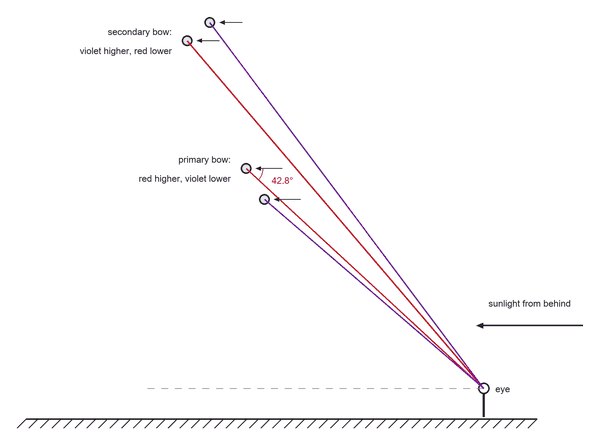
Draw a diagram to show the formation of primary rainbow.
Solve with AIWritten solution
Solution:
Concept: In a primary rainbow, light undergoes two refractions and one internal reflection in each drop; red leaves at a larger angle to the sunlight direction than violet.
Step 1 — Path of light in a drop. A ray of sunlight enters the upper part of a raindrop and is refracted (and dispersed), is reflected once at the back of the drop, and is refracted again as it leaves. Red light leaves at about 42.8° and violet at about 40.8° to the direction of the incident sunlight.

Step 2 — What the observer sees. An observer with his back to the Sun receives red light from drops higher in the sky (at 42.8°) and violet from lower drops (at 40.8°). So the primary rainbow is red on the outside and violet on the inside.
- 442 marks
Question 44
What is meant by secondary rainbow?
Solve with AIWritten solution
Solution:
Concept: Light can be internally reflected more than once inside a raindrop; each extra reflection reverses the order of the colours and loses some light.
Step 1 — Definition. The rainbow formed by light rays which have suffered two internal reflections (and two refractions) inside the raindrops is called the secondary rainbow.
Step 2 — Features. It is the outer, fainter bow (light is lost at each reflection). Its colours are reversed: red is on the inner edge (about 50.8° from the line joining the Sun to the eye, the axis of the bow) and violet on the outer edge (about 54.5°).
- 452 marks
Question 45
“The eye is most sensitive to yellow colour. But the danger signals are red”. Why?
Solve with AIWritten solution
Solution:
Key idea: Rayleigh's law, .
Step 1 — Rayleigh's law. According to Rayleigh, the intensity of scattered light is inversely proportional to the fourth power of wavelength. Red has a longer wavelength than yellow, so red is scattered less than yellow.
Step 2 — Conclusion. So red light can penetrate through fog without much loss of intensity; hence red is preferred in danger signals.
- 462 marks
Question 46
Refractive indices of glass for blue, red and yellow colours are , and respectively. Write these symbols in decreasing order of values.
Solve with AIWritten solution
Solution:
Concept: By Cauchy's relation, the refractive index of a material decreases as the wavelength increases.
Step 1 — Order. Arrange the three refractive indices from largest to smallest:
Step 2 — Reason. and , so the shortest wavelength (blue) has the largest refractive index.
- 472 marks
Question 47
Does a beam of white light give a spectrum on passing through a hollow prism?
Solve with AIWritten solution
Solution:
Concept: Dispersion needs a medium whose refractive index differs for different colours; for air the refractive index is practically the same for all colours.
Step 1 — What dispersion needs. Dispersion needs a medium whose refractive index is different for different colours.
Step 2 — Apply this to a hollow prism. No. A hollow prism contains air, for which the refractive index is (nearly) the same for all colours. The thin glass walls are like parallel-sided slabs and produce no net dispersion.
Step 3 — Conclusion. So a hollow prism containing air cannot produce dispersion of light.
- 482 marks
Question 48
Which colour deviates (i) the most and (ii) the least on passing through a prism?
Solve with AIWritten solution
Solution:
Concept: The deviation produced by a prism increases with the refractive index, and glass has the largest refractive index for violet and the smallest for red.
Step 1 — Most deviated. (i) The maximum deviation is for violet.
Step 2 — Least deviated. (ii) The deviation is least for red.
Step 3 — Reason. (Glass has the largest refractive index for violet and the smallest for red.)
- 492 marks
Question 49
Which glass has higher refractive index, crown glass or flint glass?
Solve with AIWritten solution
Solution:
Concept: Flint glass contains lead oxide, which makes it optically denser, so it has a higher refractive index (and a higher dispersive power) than crown glass.
Step 1 — Composition. Flint glass contains lead oxide, which makes it optically denser than crown glass.
Step 2 — Answer. Flint glass has the higher refractive index (about 1.6–1.7, compared with about 1.5 for crown glass).
- 502 marks
Question 50
What is the difference between a spectroscope and a spectrograph?
Solve with AIWritten solution
Solution:
Concept: Both instruments use a prism (or grating) to spread light into a spectrum; they differ only in how the spectrum is observed or recorded.
Step 1 — Spectroscope. A spectroscope is used to observe (see) the spectrum with the eye.
Step 2 — Spectrograph. In a spectrograph, the spectrum is photographed (recorded) and a permanent record is obtained.
- 512 marks
Question 51
Show that no ray can pass through a prism whose refracting angle is greater than twice the critical angle for the material of the prism.
Solve with AIWritten solution
Solution:
Key idea: the largest possible is the critical angle (at grazing incidence), and the ray can leave the second face only if .
Step 1 — Largest possible . When the angle of incidence (grazing incidence), the angle of refraction , the critical angle. For any smaller , .
Step 2 — Condition at the second face. For the ray to emerge from the second face, . When the refracted ray strikes the second face at exactly the critical angle, it emerges at 90°:
Step 3 — Largest prism angle. So the largest angle of prism through which a ray can just pass is
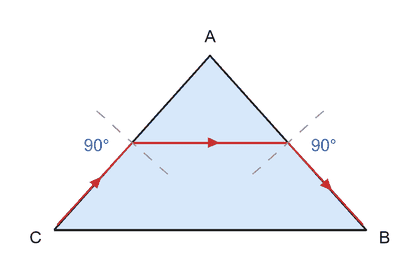
Step 4 — Conclusion. If , then for every ray is greater than , that is, greater than . The ray incident on the second face is then totally reflected and there is no emergent ray.
- 522 marks
Question 52
What is dispersion of light? Explain it with a ray diagram. Also explain the cause of dispersion of light.
Solve with AIWritten solution
Solution:
Concept: White light is a mixture of colours; the refractive index of a prism depends on wavelength, so each colour is deviated by a different amount.
Step 1 — Dispersion. the splitting of white light into its constituent colours on passing through a prism is called dispersion.
Step 2 — Ray diagram. The diagram shows white light entering the prism and the colours fanning out, red deviated least and violet most.
Step 3 — Cause. the refractive index of the material of the prism is different for different colours, i.e. . So the deviation is different for different colours, because (for a thin prism). The deviation for red is less than that for violet, i.e. .
Step 4 — Conclusion. So different colours in white light emerge from the prism in different directions.
- 533 marks
Question 53
For any prism, show that refractive index of its material is given by
where symbols have their usual meaning.
Solve with AIWritten solution
Solution:
Concept: At minimum deviation the ray passes symmetrically through the prism. Combining this with the angle relations of a prism and Snell's law at the first face gives the refractive index.
Figure: is the principal section of the prism with refracting angle . Ray is incident at at angle , refracted along at angle , meets the second face at at angle and emerges along at angle . The normals at and meet at . The incident ray produced and the emergent ray produced backwards meet at , and is the angle of deviation.
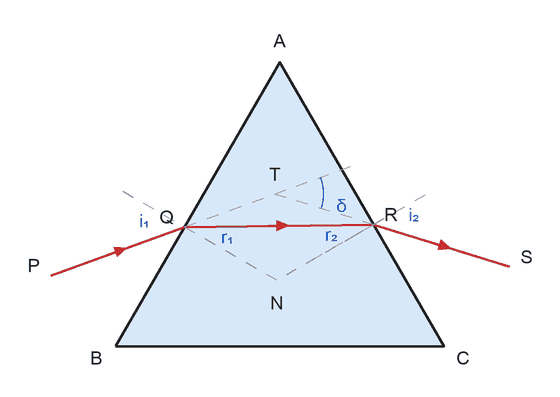
Step 1 — Angle of prism. In quadrilateral the angles at and are 90° each (the normals meet the faces at right angles). The four angles of a quadrilateral add up to 360°, so the other two angles add up to 180°:
The three angles of triangle also add up to 180°:
Comparing the two equations, hence
Step 2 — Deviation. The deviation at the first face is and at the second face , so
Step 3 — Minimum deviation. At minimum deviation the ray passes symmetrically through the prism. So the angle of incidence equals the angle of emergence (call both ), and the two angles of refraction are equal (call both ).
Putting for both angles of refraction into :
Putting for both and , and for , into :
Step 4 — Snell's law at the first face: Snell's law gives as the ratio of the two sines; then replace and by the expressions found in Step 3:
This is the required result.
- 543 marks
Question 54
Draw a ray diagram to illustrate the formation of primary rainbow (using single water drop only and a single incident ray, to show clearly refraction and total internal reflection, use atleast four arrows).
Solve with AIWritten solution
Solution:
Concept: In a primary rainbow, sunlight is refracted on entering a drop, reflected once at the back of the drop and refracted again on leaving; the colours separate because the refractive index of water depends on wavelength.
Step 1 — Trace the ray. A ray of sunlight (arrow 1) enters the upper part of the drop and is refracted, splitting into colours (arrow 2). At the back of the drop it is internally reflected (arrow 3). It is refracted again on leaving the drop (arrow 4): red emerges at about 42.8° and violet at about 40.8° to the incident sunlight.
Step 2 — Summary. Primary rainbow: two refractions and one internal reflection; red on the outside, violet on the inside.
Note: the question (and the book) calls the reflection inside the drop "total internal reflection". The angle at the back of the drop (about 40°) is a little less than the critical angle for water (about 49°), so strictly the reflection is partial; the diagram is the same.
- 553 marks
Question 55
(i) What is dispersion? Define dispersive power of the material of a prism.
(ii) What is scattering? Why sky is blue? Explain.
Solve with AIWritten solution
Solution:
Concept: Dispersion and scattering both depend on wavelength: the refractive index changes with colour (dispersion), and small particles scatter short wavelengths far more strongly (scattering).
Step 1 — Dispersion. (i) Dispersion is the splitting up of white light into its constituent colours when it passes through a prism (refracting medium), because the refractive index is different for different colours.
Step 2 — Dispersive power. Dispersive power of the material of a prism is the ratio of the angular dispersion between two colours (violet and red) to the deviation of the mean (yellow) colour:
Step 3 — Scattering. (ii) Scattering is the process in which light is deflected in all directions by the particles of the medium through which it passes.
Step 4 — Why the sky is blue. air molecules are much smaller than the wavelength of light, so by Rayleigh's law the shorter wavelengths are scattered much more than the longer ones. Violet is scattered most, but the eye is not very sensitive to violet and there is less of it in sunlight. So the scattered light reaching us from the sky is mainly blue, and the sky appears blue.
- 565 marks
Question 56
(i) What is angle of deviation? What is minimum deviation, when a light ray strikes on one face of a glass prism?
(ii) Draw a labelled graph showing the variation of angle of incidence with angle of deviation for the prism.
(iii) Derive an expression for the deviation produced by a small angled prism when a light ray falls on its surface.
Solve with AIWritten solution
Solution:
Concept: For any prism the angles of refraction add up to the prism angle, , and the deviation is ; for small angles, .
Step 1 — Define the angle of deviation. (i) Angle of deviation: the angle between the incident ray produced forward and the emergent ray is called the angle of deviation (). For a prism .
Step 2 — Minimum deviation. the smallest value of the angle of deviation for a given prism and a given colour of light is the angle of minimum deviation (). In this position the angle of incidence equals the angle of emergence (), and each angle of refraction is half the prism angle:
The ray inside the prism is then parallel to the base.
Step 3 — Graph of deviation. (ii) Graph of against : as increases, first decreases, becomes minimum () when , and then increases.
Step 4 — Derivation for a thin prism. (iii) Small-angled prism. For any prism and .
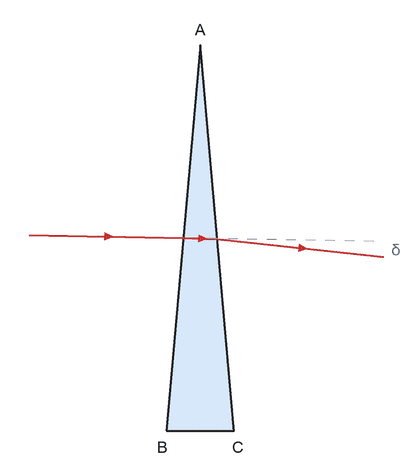
For a prism of small angle and a ray incident at a small angle, all the angles are small, and . Snell's law at the two faces gives
Substitute these into and use :
Step 5 — Conclusion. The deviation of a small-angled prism depends only on and , not on the angle of incidence.
- 575 marks
Question 57
(i) What is rainbow? Explain its formation.
(ii) Distinguish between primary rainbow and secondary rainbow. Explain with labelled diagrams.
(iii) Explain why the Sun appears reddish at sunset.
- 583 marks
Question 58
When a light ray strikes an equilateral prism, the emergent ray just grazes the other side. If the refractive index of the material of the prism is 1.5, find the angle of incidence.
- 593 marks
Question 59
A ray of light falling at an angle of incidence 38° is refracted through a prism in the minimum deviation position. The angle of prism is 40°. Find the angle of minimum deviation and the refractive index of the material of the prism.
- 603 marks
Question 60
A ray of light undergoes deviation of 30° when incident on an equilateral prism of refractive index . Calculate the angle made by the ray inside the prism with the base of the prism.
- 613 marks
Question 61
A ray of light incident on one face at grazing angle of incidence emerges the other face, grazing the surface. Find the angle of the prism. The refractive index of the material of the prism is 1.55.
- 623 marks
Question 62
A thin prism of 6° angle gives deviation of 3.3°. What is the refractive index of the material of the prism?
- 633 marks
Question 63
A ray of light is incident on one face of a prism at an angle of 50°. If the angle of prism is 60° and the ray is deviated through an angle of 42°, find the angle which the emergent ray makes with the second face of the prism.
- 643 marks
Question 64
For a prism whose refractive index is 1.5, what should be the angle of incidence at the first face so that the emergent ray will just graze the surface of separation of the two media on the other side? Angle of the prism is 60°.
- 653 marks
Question 65
The deviation produced by a crown glass prism for violet and red light rays are 4.56° and 4.45° respectively. Find the angular dispersion.
- 663 marks
Question 66
Find the angular dispersion between the red and the violet colours produced by a flint glass prism of refracting angle 60°. Refractive index of the prism for red and violet colours are 1.622 and 1.663 respectively.
- 673 marks
Question 67
The angular dispersion between violet and red colours produced by a small angled prism is 0.6°. The refractive index of the material of the prism for violet is 1.66 and that for red is 1.54. Find the angle of the prism.
- 683 marks
Question 68
The deviations produced by a prism for violet, yellow and red light colours are 4.35°, 4.05° and 3.75° respectively. Find the dispersive power of the material of the prism.
- 693 marks
Question 69
The refractive indices for red and violet colours for flint glass are 1.641 for red and 1.659 for violet. Find the dispersive power for flint glass.
- 703 marks
Question 70
The angle of minimum deviation for a prism is 40° and the angle of the prism is 60°. Calculate the angle of incidence.
- 713 marks
Question 71
The refractive indices of a prism for red, yellow and violet colours are 1.61, 1.63 and 1.65 respectively. Calculate the dispersive power of the prism.
What Class 12 Physics Ch 17 covers
The sections of the chapter, in the order the book takes them. Every question above comes from one of these.
- 01Refraction through a Prism
- 02Angle of Minimum Deviation
- 03Small Angled Prism
- 04Dispersion and Angular Dispersion
- 05Dispersive Power
- 06Scattering of Light
More ways to study this chapter
The same chapter asked three other ways. Practise it, revise it, and see what the board has set on Ch 17 before.
- Competency-Based Questions (CBQ)Case study questions: a situation, and the part of the chapter that answers it.46questionsOpen
- Previous Year QuestionsQuestions that have actually appeared in board papers, each tagged with its year.17questionsOpen
- Practice QuestionsExtra questions per chapter, for when one attempt at a method is not enough.91questionsOpen
Ch 17 in past ISC papers
The same chapter as the board has actually asked it. These are worded differently from the textbook exercise, which is the point of reading them.
- 11 mark
Board paper question 1
A monochromatic ray of light falls on a regular prism. What is the relation between angle of incidence and angle of emergence in the case of minimum deviation?
Solve with AIWritten solution
Solution:
Key idea: At minimum deviation a ray passes through a prism symmetrically: it meets the second face exactly as it left the first.
Step 1 — Recall how the deviation depends on the angle of incidence.
The deviation is . As the angle of incidence increases, first decreases, reaches a least value and then increases again.
Step 2 — Use the reversibility of light.
If a ray entering at angle leaves at angle , a ray entering at leaves at and suffers the same deviation. A single minimum is therefore possible only when the two angles are equal. The refracted ray inside then makes equal angles with both faces (), and in a prism with equal faces it runs parallel to the base.
Therefore, in the minimum deviation position the angle of incidence equals the angle of emergence ().
- 22 marks
Board paper question 2
What is chromatic aberration? How can it be minimised or eliminated?
Solve with AIWritten solution
Solution:
Key idea: The refractive index of glass depends on the wavelength of light (dispersion): it is greater for violet than for red. By the lens maker's formula, , so a lens has a slightly different focal length for each colour.
Step 1 — Say what chromatic aberration is.
Because is greater than , the focal length for violet light is shorter than that for red (). When white light from a point object passes through a lens, the violet image forms nearer the lens and the red image farther away, with the other colours in between. The image is blurred and has coloured fringes. This defect of a lens, its inability to bring light of all colours to the same focus, is called chromatic aberration. The difference measures it.
Step 2 — Find how the focal length changes with colour.
For a small change in refractive index between violet and red, the lens maker's formula gives a change in proportional to :
Here is the dispersive power of the glass.
Step 3 — Minimise it with an achromatic combination.
Two lenses of focal lengths and , made of glasses of dispersive powers and , are placed in contact, so . The focal length of the combination is the same for violet and red if the changes cancel:
Since dispersive powers are positive, and must have opposite signs. In practice a convex lens of crown glass (small ) is combined with a weaker concave lens of flint glass (larger ). The combination still converges but brings red and violet to the same focus. Such an achromatic doublet removes the aberration for these two colours and greatly reduces it for the rest.
Step 4 — Avoid it altogether with mirrors.
Reflection does not depend on wavelength, so a mirror has the same focal length for every colour. Using a concave mirror instead of a lens (as in reflecting telescopes) eliminates chromatic aberration.
Therefore, chromatic aberration is the failure of a lens to focus light of different colours at one point, because its focal length depends on colour; it is minimised by an achromatic combination of a crown-glass convex lens and a flint-glass concave lens in contact satisfying , and eliminated by using mirrors in place of lenses.
- 31 mark
Board paper question 3
Calculate dispersive power of a transparent material given:
Solve with AIWritten solution
Solution:
Key idea: The dispersive power of a material is , where , and are its refractive indices for violet, red and yellow (mean) light. It is a pure number with no unit.
Step 1 — Find the difference between the violet and red indices.
We subtract the red index from the violet index:
Step 2 — Find the mean value less one.
We subtract 1 from the index for yellow light:
Step 3 — Divide to get the dispersive power.
We divide the result of Step 1 by that of Step 2:
Therefore, the dispersive power of the material is about 0.036.
- 43 marks
Board paper question 4
Find the angle of incidence at which a ray of monochromatic light should be incident on the first surface AB of a regular glass prism ABC so that the emergent ray grazes the adjacent surface AC. (Refractive Index of glass ).
Solve with AIWritten solution
Solution:
Key idea: If the emergent ray grazes face AC, the angle of emergence is . By Snell's law the ray inside must then meet AC at the critical angle , where . The two angles of refraction add up to the angle of the prism, .
Step 1 — Write down the angle of the prism.
A regular prism has equal faces, so it is equilateral and .
Step 2 — Find the critical angle for this glass.
The critical angle depends only on the refractive index:
At face AC the angle of refraction inside is .
Step 3 — Find the angle of refraction at face AB.
Since :
Step 4 — Apply Snell's law at face AB.
The ray passes from air into glass at AB, so Snell's law gives the angle of incidence:

Watch out: For any smaller angle of incidence, is smaller, so is larger than the critical angle and the ray is totally reflected at AC. So is also the least angle of incidence for which light can come out of face AC.
Therefore, the ray must be incident on AB at an angle of about .
- 51 mark
Board paper question 5
In a regular prism, what is the relation between angle of incidence and angle of emergence when it is in the minimum deviation position ?
Solve with AIWritten solution
Solution:
Key idea: At minimum deviation a ray passes through a prism symmetrically: it meets the second face exactly as it left the first.
Step 1 — Recall how the deviation depends on the angle of incidence.
The deviation is . As the angle of incidence increases, first decreases, reaches a least value and then increases again.
Step 2 — Use the reversibility of light.
If a ray entering at angle leaves at angle , a ray entering at leaves at and suffers the same deviation. A single minimum is therefore possible only when the two angles are equal. The refracted ray inside then makes equal angles with both faces (), and in a prism with equal faces it runs parallel to the base.
Therefore, in the minimum deviation position the angle of incidence equals the angle of emergence ().
- 62 marks
Board paper question 6
State any two difference between primary rainbow and secondary rainbow.
Solve with AIWritten solution
Solution:
Key idea: A rainbow is formed when sunlight is refracted (and dispersed) on entering spherical raindrops, reflected inside them, and refracted again on leaving. The primary rainbow comes from rays reflected once inside each drop, the secondary rainbow from rays reflected twice.
Step 1 — Compare the number of internal reflections.
In the primary rainbow the light is reflected once inside each raindrop; in the secondary rainbow it is reflected twice.
Step 2 — Compare the order of colours.
The primary rainbow has red on the outside and violet on the inside. The second reflection reverses the order, so the secondary rainbow has violet on the outside and red on the inside.
Step 3 — Compare brightness and position.
Some light is lost at every reflection, so the secondary rainbow is fainter than the primary. The primary bow lies about to from the point directly opposite the sun, while the secondary bow is larger, about to , and lies outside it.
Therefore, any two of these: (1) the primary rainbow involves one internal reflection in each drop, the secondary two; (2) the primary has red outside and violet inside, the secondary the reverse order; (3) the primary is brighter and smaller (about 42°), the secondary fainter and larger (about 51°).
All 17 board paper questions for this chapter, solved the same way.
Class 12 Physics Ch 17 questions students ask
How many questions are there in Class 12 Physics Ch 17?
71 questions. Every one is solved step by step on this page.
Are these Class 12 Physics solutions free?
Yes. Every question and its full working is free to read, with no account needed.
Can I download the Class 12 Physics Ch 17 solutions as a PDF?
There is no PDF to download. Every solution is on this page instead, which means it is searchable, always the current syllabus, and readable on a phone. Use your browser's print option if you want it on paper.