
Opening your dashboard
Class 12 Physics Chapter 17 Refraction through a Prism - Dispersion: Previous Year Questions
17 questions on Chapter 17, each solved step by step. Class 12 Physics, ICSE 2026-27.
17 questions with solutions
1–3 marks · Mixed difficulty
- 11 mark
Question 1
A monochromatic ray of light falls on a regular prism. What is the relation between angle of incidence and angle of emergence in the case of minimum deviation?
Solve with AIWritten solution
Solution:
Key idea: At minimum deviation a ray passes through a prism symmetrically: it meets the second face exactly as it left the first.
Step 1 — Recall how the deviation depends on the angle of incidence.
The deviation is . As the angle of incidence increases, first decreases, reaches a least value and then increases again.
Step 2 — Use the reversibility of light.
If a ray entering at angle leaves at angle , a ray entering at leaves at and suffers the same deviation. A single minimum is therefore possible only when the two angles are equal. The refracted ray inside then makes equal angles with both faces (), and in a prism with equal faces it runs parallel to the base.
Therefore, in the minimum deviation position the angle of incidence equals the angle of emergence ().
- 22 marks
Question 2
What is chromatic aberration? How can it be minimised or eliminated?
Solve with AIWritten solution
Solution:
Key idea: The refractive index of glass depends on the wavelength of light (dispersion): it is greater for violet than for red. By the lens maker's formula, , so a lens has a slightly different focal length for each colour.
Step 1 — Say what chromatic aberration is.
Because is greater than , the focal length for violet light is shorter than that for red (). When white light from a point object passes through a lens, the violet image forms nearer the lens and the red image farther away, with the other colours in between. The image is blurred and has coloured fringes. This defect of a lens, its inability to bring light of all colours to the same focus, is called chromatic aberration. The difference measures it.
Step 2 — Find how the focal length changes with colour.
For a small change in refractive index between violet and red, the lens maker's formula gives a change in proportional to :
Here is the dispersive power of the glass.
Step 3 — Minimise it with an achromatic combination.
Two lenses of focal lengths and , made of glasses of dispersive powers and , are placed in contact, so . The focal length of the combination is the same for violet and red if the changes cancel:
Since dispersive powers are positive, and must have opposite signs. In practice a convex lens of crown glass (small ) is combined with a weaker concave lens of flint glass (larger ). The combination still converges but brings red and violet to the same focus. Such an achromatic doublet removes the aberration for these two colours and greatly reduces it for the rest.
Step 4 — Avoid it altogether with mirrors.
Reflection does not depend on wavelength, so a mirror has the same focal length for every colour. Using a concave mirror instead of a lens (as in reflecting telescopes) eliminates chromatic aberration.
Therefore, chromatic aberration is the failure of a lens to focus light of different colours at one point, because its focal length depends on colour; it is minimised by an achromatic combination of a crown-glass convex lens and a flint-glass concave lens in contact satisfying , and eliminated by using mirrors in place of lenses.
- 31 mark
Question 3
Calculate dispersive power of a transparent material given:
Solve with AIWritten solution
Solution:
Key idea: The dispersive power of a material is , where , and are its refractive indices for violet, red and yellow (mean) light. It is a pure number with no unit.
Step 1 — Find the difference between the violet and red indices.
We subtract the red index from the violet index:
Step 2 — Find the mean value less one.
We subtract 1 from the index for yellow light:
Step 3 — Divide to get the dispersive power.
We divide the result of Step 1 by that of Step 2:
Therefore, the dispersive power of the material is about 0.036.
- 43 marks
Question 4
Find the angle of incidence at which a ray of monochromatic light should be incident on the first surface AB of a regular glass prism ABC so that the emergent ray grazes the adjacent surface AC. (Refractive Index of glass ).
Solve with AIWritten solution
Solution:
Key idea: If the emergent ray grazes face AC, the angle of emergence is . By Snell's law the ray inside must then meet AC at the critical angle , where . The two angles of refraction add up to the angle of the prism, .
Step 1 — Write down the angle of the prism.
A regular prism has equal faces, so it is equilateral and .
Step 2 — Find the critical angle for this glass.
The critical angle depends only on the refractive index:
At face AC the angle of refraction inside is .
Step 3 — Find the angle of refraction at face AB.
Since :
Step 4 — Apply Snell's law at face AB.
The ray passes from air into glass at AB, so Snell's law gives the angle of incidence:

Watch out: For any smaller angle of incidence, is smaller, so is larger than the critical angle and the ray is totally reflected at AC. So is also the least angle of incidence for which light can come out of face AC.
Therefore, the ray must be incident on AB at an angle of about .
- 51 mark
Question 5
In a regular prism, what is the relation between angle of incidence and angle of emergence when it is in the minimum deviation position ?
Solve with AIWritten solution
Solution:
Key idea: At minimum deviation a ray passes through a prism symmetrically: it meets the second face exactly as it left the first.
Step 1 — Recall how the deviation depends on the angle of incidence.
The deviation is . As the angle of incidence increases, first decreases, reaches a least value and then increases again.
Step 2 — Use the reversibility of light.
If a ray entering at angle leaves at angle , a ray entering at leaves at and suffers the same deviation. A single minimum is therefore possible only when the two angles are equal. The refracted ray inside then makes equal angles with both faces (), and in a prism with equal faces it runs parallel to the base.
Therefore, in the minimum deviation position the angle of incidence equals the angle of emergence ().
- 62 marks
Question 6
State any two difference between primary rainbow and secondary rainbow.
Solve with AIWritten solution
Solution:
Key idea: A rainbow is formed when sunlight is refracted (and dispersed) on entering spherical raindrops, reflected inside them, and refracted again on leaving. The primary rainbow comes from rays reflected once inside each drop, the secondary rainbow from rays reflected twice.
Step 1 — Compare the number of internal reflections.
In the primary rainbow the light is reflected once inside each raindrop; in the secondary rainbow it is reflected twice.
Step 2 — Compare the order of colours.
The primary rainbow has red on the outside and violet on the inside. The second reflection reverses the order, so the secondary rainbow has violet on the outside and red on the inside.
Step 3 — Compare brightness and position.
Some light is lost at every reflection, so the secondary rainbow is fainter than the primary. The primary bow lies about to from the point directly opposite the sun, while the secondary bow is larger, about to , and lies outside it.
Therefore, any two of these: (1) the primary rainbow involves one internal reflection in each drop, the secondary two; (2) the primary has red outside and violet inside, the secondary the reverse order; (3) the primary is brighter and smaller (about 42°), the secondary fainter and larger (about 51°).
- 73 marks
Question 7
For any prism, prove that:
where the terms have their usual meaning.
Solve with AIWritten solution
Solution:
Key idea: Snell's law applies at each face of the prism, and the geometry of the normals links the two angles of refraction to the refracting angle . At minimum deviation the ray passes through the prism symmetrically.
Step 1 — Draw the ray through the prism and name the angles.
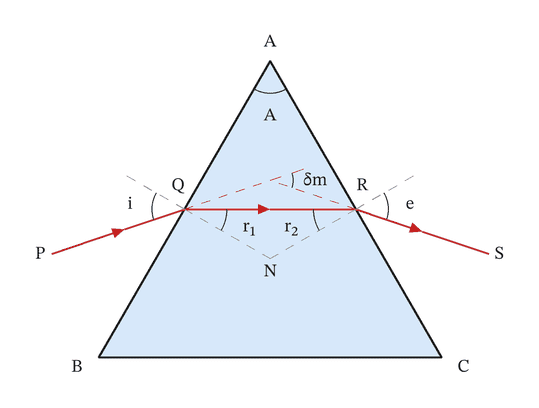
A ray PQ falls on face AB of a prism ABC (refracting angle ) at an angle of incidence . It is refracted along QR at an angle , meets face AC at an angle , and leaves along RS at an angle of emergence . The normals at Q and R meet at N. Let be the refractive index of the material of the prism.
Step 2 — Show that the two angles of refraction add up to A.
In the quadrilateral AQNR, the angles at Q and R are right angles, because QN and RN are normals to the faces. The four angles of a quadrilateral add up to , so
In triangle QNR the three angles also add up to :
Comparing the two equations gives
Step 3 — Write the total deviation.
The ray turns through at the first face and through at the second face, both towards the base. The total deviation is the sum:
Step 4 — Apply the condition of minimum deviation.
As is increased, the deviation first falls and then rises; it is least, , when the angle of emergence equals the angle of incidence. The ray then passes symmetrically, parallel to the base for an isosceles prism. So the angle of emergence equals the angle of incidence, and the two angles of refraction are equal; call each of them . From Step 2:
From Step 3 with and :
Step 5 — Apply Snell's law at the first face.
At Q the ray passes from air into the prism, so
Substituting the values of and from Step 4:
Therefore, , where is the angle of the prism and its angle of minimum deviation.
- 82 marks
Question 8
The deviation produced for violet, yellow and red lights for crown glass are , and respectively. Calculate the dispersive power of the crown glass.
Solve with AIWritten solution
Solution:
Key idea: For a thin prism of angle , the deviation is , so each deviation is proportional to . The dispersive power, defined from refractive indices as , is therefore also the angular dispersion divided by the mean deviation:
Step 1 — Find the angular dispersion.
The angular dispersion is the difference between the deviations of violet and red light:
Step 2 — Divide by the mean (yellow) deviation.
The dispersive power is the angular dispersion divided by the mean deviation:
The degrees cancel, so the dispersive power has no unit.
Therefore, the dispersive power of the crown glass is about 0.274.
- 93 marks
Question 9
A ray of light is incident on a prism whose refractive index is 1.52 at an angle of . If the angle of emergence is , calculate the angle of the prism.
Solve with AIWritten solution
Solution:
Key idea: Snell's law at each face gives the two angles of refraction inside the prism, and their sum is the angle of the prism: .
Step 1 — Find the angle of refraction at the first face.
The ray enters at , so
Step 2 — Find the angle inside at the second face.
The ray leaves at . By the reversibility of light, the angle inside the prism obeys
Step 3 — Add the angles to get the angle of the prism.
The two angles of refraction inside a prism add up to its refracting angle:
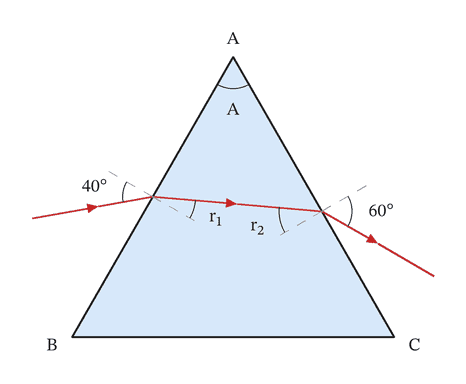
Therefore, the angle of the prism is about (practically ).
- 102 marks
Question 10
Draw labelled graph of angle of deviation () Versus angle of incidence (i) for a prism
Solve with AIWritten solution
Solution:
Key idea: For a prism the deviation is . As the angle of incidence increases, the deviation first decreases, becomes least (, the angle of minimum deviation) when , and then increases again.
Step 1 — Choose and label the axes.
The angle of incidence is plotted along the X axis and the angle of deviation along the Y axis.
Step 2 — Describe the shape of the curve.
The graph is a U-shaped curve. It starts at the smallest angle of incidence for which light can emerge (where the emergent ray grazes the second face), falls to a minimum, and then rises more slowly up to . Each value of above the minimum occurs for two angles of incidence ( and interchanged, by the reversibility of light).
Step 3 — Mark the minimum.
The lowest point of the curve gives the angle of minimum deviation ; at this point the angle of incidence equals the angle of emergence. The figure shows the graph, drawn for a prism of angle and refractive index 1.5.
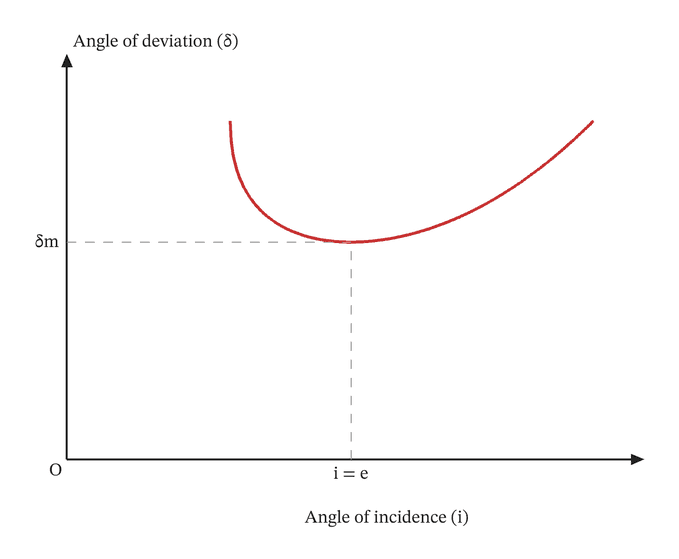
Therefore, the δ–i graph is a U-shaped curve whose lowest point is the angle of minimum deviation δm, reached when i = e.
- 112 marks
Question 11
Name any two phenomenon which takes place in the formation of a rainbow.
Solve with AIWritten solution
Solution:
Key idea: A rainbow is formed when sunlight is refracted (and dispersed) on entering spherical raindrops, reflected inside them, and refracted again on leaving. The primary rainbow comes from rays reflected once inside each drop, the secondary rainbow from rays reflected twice.
Step 1 — Name the first phenomenon.
Sunlight is refracted as it enters a raindrop, and because the refractive index of water depends on wavelength, the colours separate: this is dispersion of light (by refraction).
Step 2 — Name the second phenomenon.
The dispersed light is reflected from the back surface of the drop: this is internal reflection. It is then refracted again as it leaves the drop, which spreads the colours further.
Note: This reflection is often called total internal reflection. In fact the light meets the back of the drop at about , which is less than the critical angle of water (about ), so it is an ordinary (partial) internal reflection. This is one reason why rainbows are fairly faint.
Therefore, two phenomena involved are dispersion (by refraction) of sunlight in the raindrops and internal reflection inside them.
- 123 marks
Question 12
For any prism, obtain a relation between angle of the prism (A), angle of minimum deviation and refractive index of its material .
Solve with AIWritten solution
Solution:
Key idea: Snell's law applies at each face of the prism, and the geometry of the normals links the two angles of refraction to the refracting angle . At minimum deviation the ray passes through the prism symmetrically.
Step 1 — Draw the ray through the prism and name the angles.
A ray PQ falls on face AB of a prism ABC (refracting angle ) at an angle of incidence . It is refracted along QR at an angle , meets face AC at an angle , and leaves along RS at an angle of emergence . The normals at Q and R meet at N. Let be the refractive index of the material of the prism.
Step 2 — Show that the two angles of refraction add up to A.
In the quadrilateral AQNR, the angles at Q and R are right angles, because QN and RN are normals to the faces. The four angles of a quadrilateral add up to , so
In triangle QNR the three angles also add up to :
Comparing the two equations gives
Step 3 — Write the total deviation.
The ray turns through at the first face and through at the second face, both towards the base. The total deviation is the sum:
Step 4 — Apply the condition of minimum deviation.
As is increased, the deviation first falls and then rises; it is least, , when the angle of emergence equals the angle of incidence. The ray then passes symmetrically, parallel to the base for an isosceles prism. So the angle of emergence equals the angle of incidence, and the two angles of refraction are equal; call each of them . From Step 2:
From Step 3 with and :
Step 5 — Apply Snell's law at the first face.
At Q the ray passes from air into the prism, so
Substituting the values of and from Step 4:
Therefore, , where is the angle of the prism and its angle of minimum deviation.
- 131 mark
Question 13
When a ray of white light is incident obliquely on the first surface of a prism, then ______.
Solve with AIAnswer
(A) Red colour is deviated most.
(B) Green colour is deviated most.
(C) Yellow colour is deviated most.
- Correct
(D) Violet colour is deviated most.
Answer: (D) Violet colour is deviated most.
Key idea: The refractive index of glass is greatest for violet light and least for red light. The greater the refractive index, the more a ray bends at each face; for a thin prism the deviation is .
Step 1 — Compare the refractive indices.
Of the colours in white light, violet has the shortest wavelength and the largest refractive index in glass.
Step 2 — Compare the deviations.
Since the deviation increases with the refractive index, violet is deviated most and red least. This separation of colours is the dispersion of white light by the prism.
Why the others are wrong:
- (A) Red has the smallest refractive index, so it is deviated least, not most.
- (B) Green lies in the middle of the spectrum; it is deviated more than red but less than blue and violet.
- (C) Yellow is deviated less than green, blue and violet; its deviation is often taken as the mean deviation.
Therefore, violet colour is deviated most, option (D).
- 143 marks
Question 14
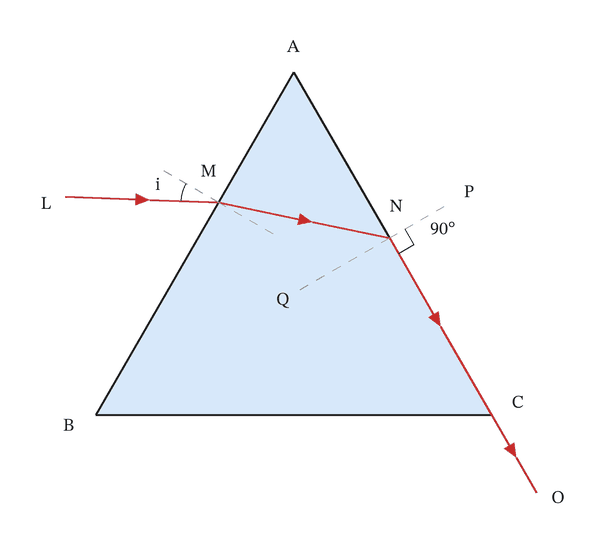
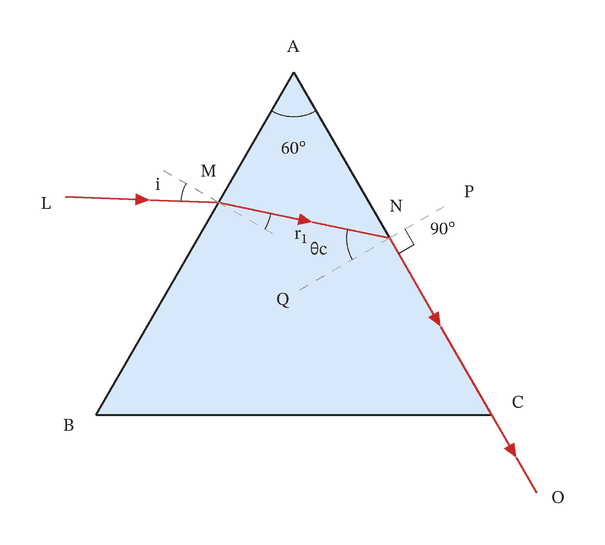
The Figure below shows a ray of monochromatic light LM incident on the first surface AB of a regular (equilateral) glass prism ABC. The emergent ray grazes the adjacent surface AC. Calculate the angle of incidence. (Refractive Index of glass = 1.5)
 Solve with AI
Written solution
Solution:
Key idea: If the emergent ray grazes face AC, the angle of emergence is (as marked at N). By Snell's law the ray inside must then meet AC at the critical angle , where . The two angles of refraction add up to the angle of the prism, .
Step 1 — Write down the angle of the prism.
The prism is equilateral, so .
Step 2 — Find the critical angle.
The critical angle depends only on the refractive index:
So at N the angle of refraction inside the prism is .
Step 3 — Find the angle of refraction at M.
Since :
Step 4 — Apply Snell's law at M.
The ray passes from air into glass at M, so Snell's law gives the angle of incidence:
Therefore, the angle of incidence is about .
- 151 mark
Question 15
State any one difference between a primary rainbow and a secondary rainbow.
Solve with AIWritten solution
Solution:
Key idea: A rainbow is formed when sunlight is refracted (and dispersed) on entering spherical raindrops, reflected inside them, and refracted again on leaving. The primary rainbow comes from rays reflected once inside each drop, the secondary rainbow from rays reflected twice.
Step 1 — Compare the number of internal reflections.
The primary rainbow is formed by light reflected once inside each raindrop, the secondary rainbow by light reflected twice.
Step 2 — See how this changes the colours.
The extra reflection reverses the order of colours: the primary rainbow has red on the outside and violet on the inside, the secondary rainbow violet outside and red inside. It also makes the secondary rainbow fainter.
Therefore, one difference: the primary rainbow is formed by one internal reflection in each drop (red outside, violet inside), while the secondary rainbow is formed by two internal reflections (violet outside, red inside, and fainter).
- 163 marks
Question 16
For any prism, show that refractive index '' of its material is given by:
where the terms have their usual meaning.
Solve with AIWritten solution
Solution:
Key idea: Snell's law applies at each face of the prism, and the geometry of the normals links the two angles of refraction to the refracting angle . At minimum deviation the ray passes through the prism symmetrically.
Step 1 — Draw the ray through the prism and name the angles.
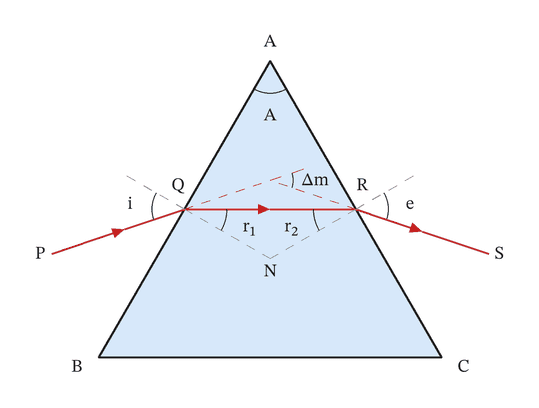
A ray PQ falls on face AB of a prism ABC (refracting angle ) at an angle of incidence . It is refracted along QR at an angle , meets face AC at an angle , and leaves along RS at an angle of emergence . The normals at Q and R meet at N. Let be the refractive index of the material of the prism.
Step 2 — Show that the two angles of refraction add up to A.
In the quadrilateral AQNR, the angles at Q and R are right angles, because QN and RN are normals to the faces. The four angles of a quadrilateral add up to , so
In triangle QNR the three angles also add up to :
Comparing the two equations gives
Step 3 — Write the total deviation.
The ray turns through at the first face and through at the second face, both towards the base. The total deviation is the sum:
Step 4 — Apply the condition of minimum deviation.
As is increased, the deviation first falls and then rises; it is least, , when the angle of emergence equals the angle of incidence. The ray then passes symmetrically, parallel to the base for an isosceles prism. So the angle of emergence equals the angle of incidence, and the two angles of refraction are equal; call each of them . From Step 2:
From Step 3 with and :
Step 5 — Apply Snell's law at the first face.
At Q the ray passes from air into the prism, so
Substituting the values of and from Step 4:
Therefore, , where is the angle of the prism and its angle of minimum deviation.
- 173 marks
Question 17
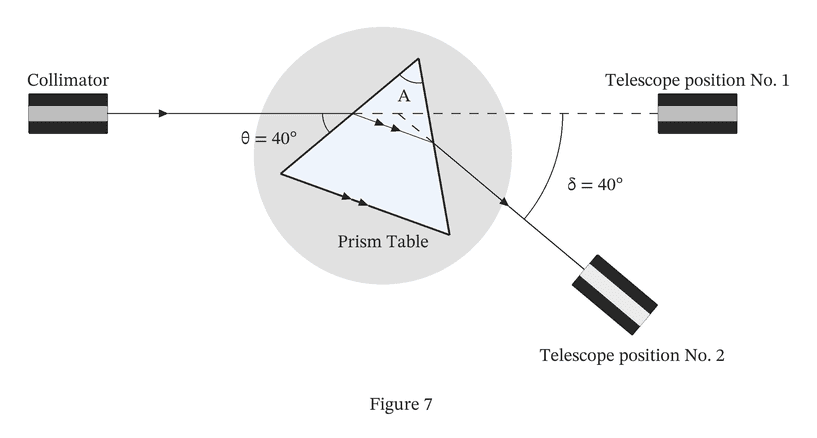
A monochromatic ray of light incident on one refracting surface of an equilateral prism, suffers a deviation as shown in the Figure 7 below:
(i) Calculate the refractive index of the material of the prism.
(ii) What is meant by dispersive power of a transparent material?
Solve with AIWritten solution
Solution:
Key idea: The figure shows the ray inside the prism parallel to the base, which is the condition of minimum deviation. Then . Note that in the figure is the angle between the ray and the face, not the normal.
Step 1 — Read the angles from the figure.
The prism is equilateral, so . The angle of incidence is measured from the normal, which is at right angles to the face:
The deviation shown between the two telescope positions is .
Step 2 — Check that this is minimum deviation.
The ray inside is parallel to the base, so it passes symmetrically and . As a check, at minimum deviation :
This agrees with the figure.
Step 3 — Calculate the refractive index for part (i).
We substitute and in the prism formula:
Step 4 — Define dispersive power for part (ii).
The dispersive power of a transparent material is the ratio of the angular dispersion between violet and red light to the mean deviation produced by a thin prism of that material. In terms of refractive indices:
Here is the refractive index for the mean (yellow) colour. It depends only on the material, not on the angle of the prism, and has no unit.
Therefore, (i) the refractive index of the prism is about 1.53; (ii) dispersive power is the ratio of the angular dispersion to the mean deviation, .