
Question 73 marksAsked 2018Medium
For any prism, prove that:
where the terms have their usual meaning.
Confirming your payment
Sign up now and get 250 free tokens.
Previous Year Questions · Question 7 of 17
For any prism, prove that:
where the terms have their usual meaning.
Solution:
Key idea: Snell's law applies at each face of the prism, and the geometry of the normals links the two angles of refraction to the refracting angle . At minimum deviation the ray passes through the prism symmetrically.
Step 1 — Draw the ray through the prism and name the angles.
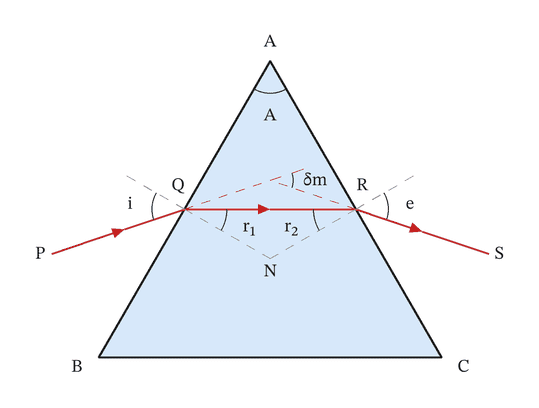
A ray PQ falls on face AB of a prism ABC (refracting angle ) at an angle of incidence . It is refracted along QR at an angle , meets face AC at an angle , and leaves along RS at an angle of emergence . The normals at Q and R meet at N. Let be the refractive index of the material of the prism.
Step 2 — Show that the two angles of refraction add up to A.
In the quadrilateral AQNR, the angles at Q and R are right angles, because QN and RN are normals to the faces. The four angles of a quadrilateral add up to , so
In triangle QNR the three angles also add up to :
Comparing the two equations gives
Step 3 — Write the total deviation.
The ray turns through at the first face and through at the second face, both towards the base. The total deviation is the sum:
Step 4 — Apply the condition of minimum deviation.
As is increased, the deviation first falls and then rises; it is least, , when the angle of emergence equals the angle of incidence. The ray then passes symmetrically, parallel to the base for an isosceles prism. So the angle of emergence equals the angle of incidence, and the two angles of refraction are equal; call each of them . From Step 2:
From Step 3 with and :
Step 5 — Apply Snell's law at the first face.
At Q the ray passes from air into the prism, so
Substituting the values of and from Step 4:
Therefore, , where is the angle of the prism and its angle of minimum deviation.