Solution:
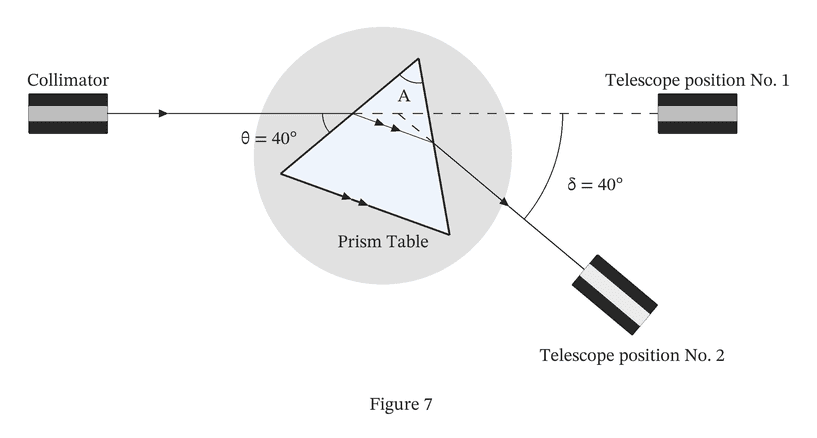
Key idea: The figure shows the ray inside the prism parallel to the base, which is the condition of minimum deviation. Then n=sin(2A)sin(2A+δm). Note that θ in the figure is the angle between the ray and the face, not the normal.
Step 1 — Read the angles from the figure.
The prism is equilateral, so A=60∘. The angle of incidence is measured from the normal, which is at right angles to the face:
i=90∘−40∘
i=50∘
The deviation shown between the two telescope positions is δ=40∘.
Step 2 — Check that this is minimum deviation.
The ray inside is parallel to the base, so it passes symmetrically and δ=δm. As a check, at minimum deviation δm=2i−A:
δm=2×50∘−60∘
δm=40∘
This agrees with the figure.
Step 3 — Calculate the refractive index for part (i).
We substitute A=60∘ and δm=40∘ in the prism formula:
n=sin30∘sin(260∘+40∘)
n=sin30∘sin50∘
n=0.50.7660
n≈1.53
Step 4 — Define dispersive power for part (ii).
The dispersive power ω of a transparent material is the ratio of the angular dispersion between violet and red light to the mean deviation produced by a thin prism of that material. In terms of refractive indices:
ω=n−1nv−nr
Here n is the refractive index for the mean (yellow) colour. It depends only on the material, not on the angle of the prism, and has no unit.
Therefore, (i) the refractive index of the prism is about 1.53; (ii) dispersive power is the ratio of the angular dispersion to the mean deviation, ω=n−1nv−nr.