Solution:
Concept: For any prism the angles of refraction add up to the prism angle, r1+r2=A, and the deviation is δ=i1+i2−A; for small angles, sinθ≈θ.
Step 1 — Define the angle of deviation. (i) Angle of deviation: the angle between the incident ray produced forward and the emergent ray is called the angle of deviation (δ). For a prism δ=i1+i2−A.
Step 2 — Minimum deviation. the smallest value of the angle of deviation for a given prism and a given colour of light is the angle of minimum deviation (δm). In this position the angle of incidence equals the angle of emergence (i1=i2), and each angle of refraction is half the prism angle:
r1=r2
r1=2A
The ray inside the prism is then parallel to the base.
Step 3 — Graph of deviation. (ii) Graph of δ against i: as i increases, δ first decreases, becomes minimum (δm) when i=e, and then increases.

Step 4 — Derivation for a thin prism. (iii) Small-angled prism. For any prism r1+r2=A and δ=i1+i2−A.
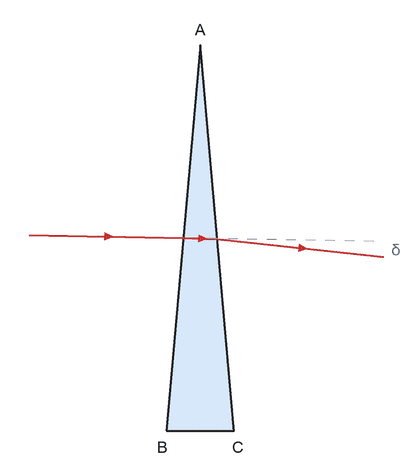
For a prism of small angle A and a ray incident at a small angle, all the angles are small, and sinθ≈θ. Snell's law at the two faces gives
i1=nr1,i2=nr2
Substitute these into δ=i1+i2−A and use r1+r2=A:
δ=nr1+nr2−A
δ=n(r1+r2)−A
δ=nA−A
δ=(n−1)A
Step 5 — Conclusion. The deviation of a small-angled prism depends only on n and A, not on the angle of incidence.
