
Question 575 marksMedium
(i) What is rainbow? Explain its formation.
(ii) Distinguish between primary rainbow and secondary rainbow. Explain with labelled diagrams.
(iii) Explain why the Sun appears reddish at sunset.
Confirming your payment
Sign up now and get 250 free tokens.
Refraction through a Prism - Dispersion · Question 57 of 71
(i) What is rainbow? Explain its formation.
(ii) Distinguish between primary rainbow and secondary rainbow. Explain with labelled diagrams.
(iii) Explain why the Sun appears reddish at sunset.
Solution:
Concept: A rainbow is formed by refraction, dispersion and internal reflection of sunlight in raindrops; the reddish Sun at sunset is explained by scattering ().
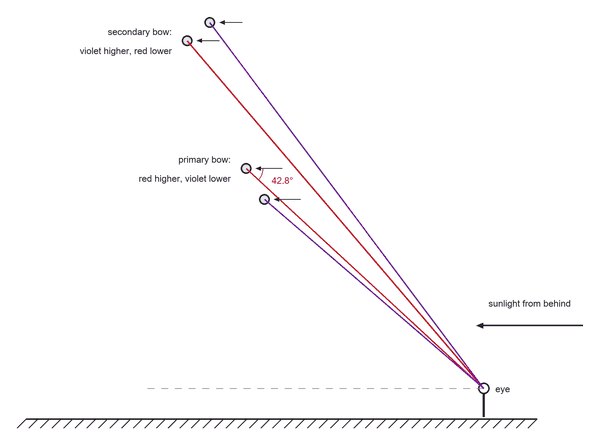
Step 1 — Rainbow. (i) Rainbow: a rainbow is a set of coloured arcs seen in the sky when sunlight falls on raindrops. It is formed by the dispersion of sunlight into its colours by the raindrops: light is refracted on entering a drop, reflected inside it and refracted again on leaving. The colours fall on the eye of an observer standing with his back towards the Sun. The centre of the bow, the observer's eye and the Sun lie on one line (the axis of the bow).
Step 2 — Compare the two bows. (ii) Primary and secondary rainbows:
Primary rainbow — formed by rays suffering two refractions and one internal reflection in the drops; it is the inner, brighter bow; red on the outside (at 42.8° to the axis) and violet on the inside (at 40.8°).

Secondary rainbow — formed by rays suffering two refractions and two internal reflections; it is the outer, fainter bow (more light is lost); its colours are reversed: red on the inside (at 50.8°) and violet on the outside (at 54.5°).
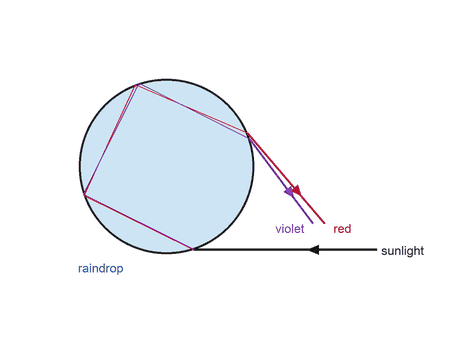
How an observer sees both bows:
Step 3 — Reddish Sun at sunset. (iii) Sun reddish at sunset: at sunset sunlight travels a much longer path through the atmosphere. The shorter wavelengths (violet, blue) are scattered away along this path (). What reaches the eye is sunlight minus the scattered light, which is mainly red, so the Sun appears reddish.