Opening your dashboard
Class 12 Physics Chapter 17 Refraction through a Prism - Dispersion: Practice Questions
91 questions on Chapter 17, each worked through on its own page with the AI tutor. Class 12 Physics, ICSE 2026-27.
91 questions
1–4 marks · Mixed difficulty
- 11 mark
Question 1
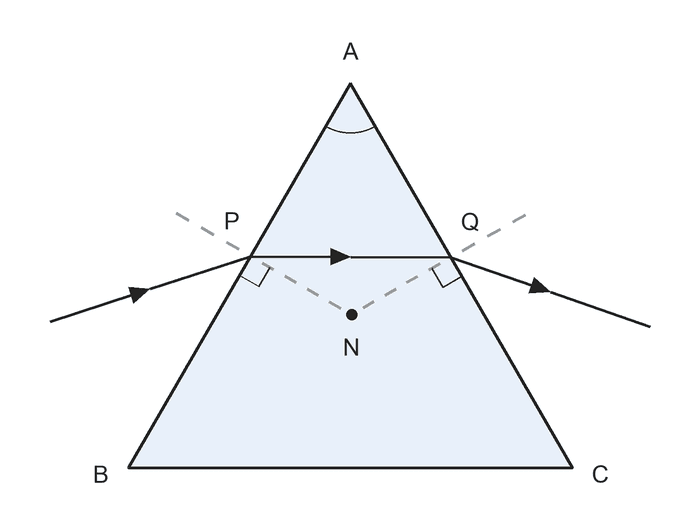
A ray passes through a glass prism of refracting angle . It enters face at and leaves face at . The normals to the two faces drawn at and meet at inside the prism. The angle of the quadrilateral is
- 23 marks
Question 2
A ray of light enters one face of a glass prism of refracting angle and refractive index . Inside the glass, the ray makes an angle of with the normal to the first face. Find
(i) the angle of incidence at the first face,
(ii) the angle at which the ray meets the second face inside the glass,
(iii) the angle of emergence, and
(iv) the angle of deviation.
- 33 marks
Question 3
A glass prism has a refracting angle of and refractive index . Two rays fall on the first face, one at an angle of incidence of and the other at , both on the side of the normal away from the base.
(i) Find the critical angle for the glass.
(ii) Show which of the two rays comes out of the second face and which does not.
(iii) For the ray that comes out, find the angle of deviation.
- 41 mark
Question 4
A ray falls on face of a prism at an angle of incidence of and leaves face at an angle of emergence of , with a deviation . A second ray is now sent into face from outside, at an angle of incidence of , so that it travels along the first path in the reverse direction. The second ray leaves face
- 53 marks
Question 5
In a laboratory, a student uses a prism of refracting angle . For an angle of incidence of , she measures the angle of deviation as . (Hypothetical data.)
(i) Find the angle of emergence.
(ii) Find the refractive index of the glass of the prism.
- 61 mark
Question 6
Light falls on the first face of a glass prism of refracting angle and refractive index at grazing incidence (angle of incidence very nearly ). The angle of emergence from the second face is about
- 73 marks
Question 7
A hollow prism with very thin glass walls has a refracting angle of . It is filled in turn with two clear liquids, X and Y, and the angle of minimum deviation is measured each time. For liquid X it is and for liquid Y it is . (Hypothetical data.) The speed of light in vacuum is .
(i) Find the refractive index of each liquid.
(ii) In which liquid does light travel faster, and by what factor?
- 81 mark
Question 8
For a certain prism, rays falling on the first face at angles of incidence of and are both deviated through the same angle, . The refracting angle of the prism is
- 92 marks
Question 9
In a spectrometer experiment with a prism of refracting angle , the telescope reads when it receives the direct (undeviated) light from the collimator. With the prism set for minimum deviation, the telescope reads for the same light. (Hypothetical data.) Find the angle of minimum deviation and the refractive index of the glass.
- 101 mark
Question 10
A prism on a spectrometer table is set exactly at the position of minimum deviation, and a spectral line is seen on the cross-wire of the telescope. The prism table is now turned slightly, while the telescope is kept fixed. Whichever way the table is turned, the spectral line
- 113 marks
Question 11
A student measures the angle of deviation produced by a prism of refracting angle for several angles of incidence . (Hypothetical data.)
(degrees) 30 35 40 45 50 55 60 (degrees) 37.4 35.9 35.2 35.2 35.7 36.8 38.3 (i) Describe how changes as increases.
(ii) Between which readings does the minimum deviation lie? Estimate the angle of incidence for minimum deviation, and hence the angle of minimum deviation.
(iii) Find the refractive index of the glass.
- 121 mark
Question 12
A ray passes through a glass prism (in air) of refracting angle in the position of minimum deviation. Which relation between the angle of incidence and is always true?
- 131 mark
Question 13
A thin glass prism of refracting angle and refractive index is completely immersed in water of refractive index . The deviation it now produces for a ray incident nearly normally is
- 142 marks
Question 14
Opticians describe the strength of a thin prism in prism dioptres: a prism of prism dioptre shifts a narrow beam by on a screen away. A spectacle prism of prism dioptres is to be made from glass of refractive index . Find
(i) the angle through which it deviates light, and
(ii) the refracting angle the prism must have.
- 153 marks
Question 15
The thin-prism formula is only an approximation. To test it, light falls normally on the first face of a glass prism of refractive index .
(i) Find the exact deviation when and compare it with the value from the formula.
(ii) Repeat for .
(iii) What do the results show?
- 161 mark
Question 16
A pencil held upright is viewed through a thin glass prism held close to the eye, with the refracting edge vertical. Compared with its true position, the pencil appears to be shifted
- 173 marks
Question 17
Light travels through a certain transparent plastic at . A thin prism of refracting angle is made of this plastic. A narrow laser beam passes through the prism and falls on a wall away. (Speed of light in vacuum .)
(i) Find the refractive index of the plastic.
(ii) Find the deviation produced by the prism.
(iii) By how much does the spot on the wall move when the prism is placed in the beam?
- 181 mark
Question 18
A thin prism of glass () and a thin prism of plastic () produce equal deviations of light. The ratio of the refracting angle of the glass prism to that of the plastic prism is
- 191 mark
Question 19
A narrow beam of white light enters a block of glass from air. Which statement about the light inside the glass is correct?
- 203 marks
Question 20
A thin prism of refracting angle is made of glass whose refractive indices for red and violet light are and . A narrow beam of white light passes through it and falls on a screen away.
(i) Find the deviations of the red and violet light.
(ii) Find the angular dispersion.
(iii) How wide (from red to violet) is the coloured patch on the screen?
- 213 marks
Question 21
Two thin prisms, each of refracting angle , are made of different glasses. (Hypothetical data.)
Glass for red for violet Crown 1.513 1.523 Flint 1.620 1.650 (i) Find the angular dispersion (between red and violet) produced by each prism.
(ii) How many times larger is the angular dispersion of the flint prism?
(iii) Which prism would you choose to spread the colours more in a simple spectroscope? Give a reason.
- 221 mark
Question 22
A narrow beam of white light passes through a glass prism and then through a second, identical prism placed close to it but turned upside down, so that the faces next to each other are parallel. The light that finally comes out is
- 233 marks
Question 23
The table gives the refractive index of a glass for light of different wavelengths (in air). (Hypothetical data.)
Wavelength in air (nm) 400 500 600 700 Refractive index 1.532 1.521 1.516 1.513 Speed of light in air .
(i) Which of these wavelengths travels fastest in the glass, and which slowest? Explain how this leads to dispersion by a prism.
(ii) Find the speed of the light in the glass.
(iii) Find the frequency and the wavelength of the light inside the glass.
- 241 mark
Question 24
The constringence of a certain glass is . A thin prism made of this glass produces a mean deviation of . The angular dispersion between violet and red light produced by this prism is
- 253 marks
Question 25
An optics student wants a thin prism that spreads violet and red light through an angle of exactly . She has a glass whose mean refractive index is and whose dispersive power is . (Hypothetical data.)
(a) What mean deviation must the prism produce?
(b) What refracting angle must she give the prism?
(c) Find the refractive indices of the glass for violet and red light, taking the mean refractive index as the average of the two.
- 264 marks
Question 26
A jeweller compares two thin prisms, each of refracting angle . One is cut from ordinary glass and the other from diamond. Their refractive indices are:
Material violet red Glass Diamond (Hypothetical data.) Take the mean refractive index as the average of the violet and red values.
(a) Find the angular dispersion (violet minus red) produced by each prism.
(b) Find the mean deviation and the dispersive power of each material.
(c) Diamond spreads the colours about three times as much as glass, yet its dispersive power is only slightly larger. Explain how both can be true.
- 273 marks
Question 27
For a certain glass, the refractive index varies with wavelength according to Cauchy's relation
(Hypothetical data.) Take violet light as and red light as .
(a) Find the refractive index of the glass for violet and for red light.
(b) Find the dispersive power of the glass for violet and red, taking the mean refractive index as the average of the two.
(c) Use the relation to explain why a glass prism deviates violet light more than red light.
- 281 mark
Question 28
A thin glass prism is used in air to produce a spectrum. Which one of the following changes will alter the dispersive power involved?
- 291 mark
Question 29
A thin prism of refracting angle produces an angular dispersion of between violet and red light. The dispersive power of its material is . The mean refractive index of the material is
- 303 marks
Question 30
A small instrument needs a thin prism that deviates the mean (yellow) ray through while spreading violet and red through not more than . Three glasses are available:
Glass Mean refractive index Dispersive power Crown Glass X Flint (Hypothetical data for glass X.)
(a) Find the angular dispersion each glass would give for a mean deviation of , and state which glass meets the requirement.
(b) Find the refracting angle of the prism that must be made from the suitable glass.
(c) For a different instrument that needs the widest possible spectrum for the same mean deviation, which glass should be chosen?
- 313 marks
Question 31
A student measures the mean deviation and the angular dispersion between violet and red, , for four thin prisms cut from the same glass. (Hypothetical data.)
Prism angle Mean deviation Angular dispersion (a) Use the readings to find the mean refractive index of the glass.
(b) Find the dispersive power for each prism, and state what the results show.
- 323 marks
Question 32
Starting from the deviation produced by a thin prism, show that the dispersive power of the material of a prism for violet and red light is
where is the mean refractive index. Hence explain why the dispersive power does not depend on the angle of the prism.
- 331 mark
Question 33
Light is scattered by air molecules according to Rayleigh's law. If the wavelength of the incident light is increased by (all else unchanged), the intensity of the scattered light falls by about
- 341 mark
Question 34
A beam of yellow light of wavelength from a sodium lamp passes through clean air. The light scattered sideways by the air molecules is
- 351 mark
Question 35
Seen from an aircraft cruising at about , the sky overhead looks a much darker blue than it does from the ground. The main reason is that
- 361 mark
Question 36
Rayleigh's law () applies only to scattering by particles much smaller than the wavelength of light. Which one of the following observations is not explained by this law?
- 373 marks
Question 37
Two kinds of tiny spherical particles, of radius and of radius , are suspended in air. Both are much smaller than the wavelength of visible light. According to the chapter, the intensity of light scattered by such a particle is proportional to the square of its volume and to . Assume equal incident intensities. (Hypothetical data.)
(a) In the same light, how many times more strongly does one particle of scatter than one particle of ?
(b) Particle is lit by blue light of and particle by red light of . Which one scatters more, and by what factor?
- 383 marks
Question 38
Visible light has wavelengths from about to . The table lists the typical size of some particles in the atmosphere.
Particle Typical size Nitrogen molecule Very fine smoke particle Fine dust grain Cloud droplet (a) Which of these particles scatter sunlight according to Rayleigh's law? Give a reason.
(b) What colour will light scattered sideways by each group of particles have? Explain.
(c) Why does a sky full of fine dust (after a dust storm) look whitish-grey instead of deep blue?
- 394 marks
Question 39
In a laboratory demonstration, a parallel beam of white light is passed through a long glass tank of water. A little sodium thiosulphate solution and a few drops of dilute hydrochloric acid are stirred in. Very fine particles of sulphur slowly form in the water, and they grow bigger with time. The beam leaving the far end of the tank falls on a white screen.
(a) A few minutes after mixing, what colour is the beam when viewed from the side of the tank? What colour is the patch on the screen? Explain both.
(b) How does the colour of the patch on the screen change if a longer tank is used at the same stage? Explain.
(c) Much later, the beam seen from the side looks white. Explain why.
(d) Which everyday sight does part (a) model?
- 402 marks
Question 40
On a clear day the sky straight overhead is a deep blue, but the sky just above the horizon looks much paler, almost whitish. Explain this difference using the scattering of light.
- 411 mark
Question 41
Take the angles at the observer's eye, measured from the line joining the Sun to the eye (extended), as: primary bow, violet and red ; secondary bow, red and violet . The angular width of the darker band of sky lying between the two bows is
- 421 mark
Question 42
Early on a showery morning, the Sun is shining low in the eastern sky. In which part of the sky should you look for a rainbow?
- 432 marks
Question 43
Riya and Kabir stand apart in a field, both with their backs to the late-afternoon Sun, and both see a bright rainbow over a distant line of trees.
(a) Kabir says, "We are both looking at the same rainbow." Is he right? Explain.
(b) Riya walks towards the rainbow to reach its end. What will she find, and why?
- 443 marks
Question 44
In the morning, the Sun is above the horizon and a shower is falling over level ground in front of an observer. Use these angles, measured at the eye from the line joining the Sun to the eye (extended): primary bow, violet and red ; secondary bow, red and violet .
(a) Where is the centre of the rainbow arc?
(b) Find the angular height above the horizon of the top of the primary bow and of the top of the secondary bow, and name the colour seen at the top edge of each.
(c) What is the greatest height of the Sun above the horizon for which some part of the primary bow can still be seen from level ground?
- 451 mark
Question 45
From an aircraft flying above a layer of falling rain, with the Sun behind, a passenger sees the primary rainbow as a complete circle. Taking the red edge of the primary bow at and the violet edge at from the antisolar line, the angular diameter of the outer (red) edge of the circle, measured at the passenger's eye, is
- 463 marks
Question 46
Just before sunset, with the Sun on the horizon behind him, a gardener sprays a fine curtain of water drops in a vertical plane in front of his eyes, perpendicular to his line of sight. He sees a coloured ring on the spray. Take the angles from the antisolar line as for red and for violet (primary bow).
(a) Where on the spray is the centre of the ring?
(b) Find the radius of the red circle and of the violet circle on the spray.
(c) How wide is the coloured band on the spray, and which colour is on the outside?
- 471 mark
Question 47
Use the angles measured from the antisolar line: primary bow, violet and red ; secondary bow, red and violet . The colour at the inner edge of the secondary bow, and its angle from the antisolar line, are
- 482 marks
Question 48
On a festival evening, a fountain throws a fine spray, and a strong white floodlight placed behind the spectators lights it. Spectators in front of the fountain see a coloured bow in the spray.
(a) Why must the floodlight be behind the spectators and not behind the fountain?
(b) The white floodlight is replaced by a sodium vapour lamp (yellow light of one wavelength) at the same place. Describe the bow now seen, and explain.
- 492 marks
Question 49
When white light is passed through a glass prism, it is dispersed into different colours. But when white light is passed through a rectangular glass slab, no colour is seen. Why?
- 502 marks
Question 50
People usually prefer light-coloured dresses during summer and dark dresses during winter. Why?
- 511 mark
Question 51
Why does one prefer, even in summer, a black umbrella?
- 522 marks
Question 52
How would a blue object appear under sodium lamp light?
- 532 marks
Question 53
Do materials always have the same colour whether viewed by reflected light or through transmitted light?
- 541 mark
Question 54
What does a welder protect against when he wears a mask?
- 551 mark
Question 55
What colours do you observe when white light passes through a blue and yellow filter?
- 562 marks
Question 56
“Eye is most sensitive to yellow, but danger signals are red”. Why?
- 572 marks
Question 57
What is the purpose of adding ‘blue’ to clothes?
- 581 mark
Question 58
“Ground glasses do not produce any image”. Why?
- 592 marks
Question 59
‘Dispersion is caused by refraction and not by reflection’. Why?
- 603 marks
Question 60
A thin prism of 2° angle gives a deviation of 1°. What is the value of refractive index of the material of the prism?
- 613 marks
Question 61
A monochromatic ray of light is made to fall on a normal 60° prism under minimum deviation condition. What is the relation between the angle of incidence and the angle of emergence?
- 622 marks
Question 62
The angle of an equilateral glass prism is 59.5°. The angle of minimum deviation is 38.5°. Without using the value of refractive index of the glass, calculate the angle of incidence for a ray of light suffering minimum deviation.
- 632 marks
Question 63
A ray of light is normally incident on one face of an equilateral triangle. Trace the course of the ray through the prism emerging from it.
- 641 mark
Question 64
Define dispersive power (for light) of a medium.
- 652 marks
Question 65
The refractive index of the prism for violet, yellow and red colours are 1.632, 1.620 and 1.613 respectively. Calculate the dispersive power of the material of the prism.
- 661 mark
Question 66
What is the angle of refraction made by a ray of light inside a regular (i.e., equilateral) glass prism in the minimum deviation case?
- 672 marks
Question 67
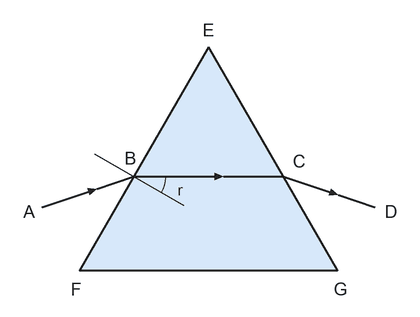
In the given figure, is a ray of light passing through an equilateral glass prism and suffering minimum deviation. Calculate the angle of refraction at and the angle . [Refractive index of glass is 1.5]
- 682 marks
Question 68
Calculate the minimum deviation () for a regular glass prism (refractive index of glass = 1.6)
- 691 mark
Question 69
A monochromatic ray of light falls on a regular prism under minimum deviation condition. What is the relation between the angle of incidence and the angle of emergence?
- 702 marks
Question 70
State two basic differences between primary and secondary rainbows.
- 712 marks
Question 71
The deviation produced for violet, yellow and red lights for crown glass are 3.75°, 3.25° and 2.86° respectively. Calculate the dispersive power of the crown glass.
- 722 marks
Question 72
Draw a properly labelled graph between the angle of incidence and the angle of deviation for a prism.
- 731 mark
Question 73
Name the phenomenon due to which the Sun appears reddish at sunset.
- 741 mark
Question 74
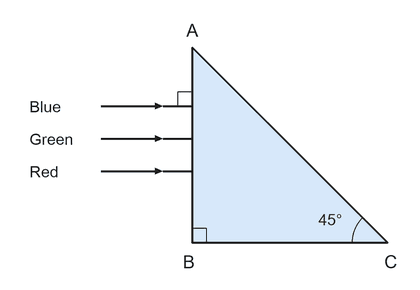
A beam of light consisting of red, green and blue colours is incident on a right-angled prism as shown in the figure. The refractive index of the material of the prism for the above red, green and blue wavelengths are 1.39, 1.44 and 1.47, respectively. The prism will
- 751 mark
Question 75
For the angle of minimum deviation of a prism to be equal to its refracting angle, the prism must be made of a material whose refractive index
- 761 mark
Question 76
Frequencies of light incident on a system of scattering particles are in the ratio of 1:2. Then, the intensity of scattered light in a particular direction is
- 771 mark
Question 77
If the refractive angles of two prisms made of crown glass are 10° and 20° respectively, then the ratio of their colour deviation powers will be
- 781 mark
Question 78
Why does the Sun have an elliptical shape on the time when rising and setting? It is due to
- 791 mark
Question 79
A ray of light is incident at an angle of incidence , on one face of a prism of angle (assumed to be small) and emerges normally from the opposite face. If the refractive index of the prism is , the angle of incidence , is nearly equal to
- 801 mark
Question 80
In an equilateral prism, if incident angle is 45°, then minimum deviation is
- 811 mark
Question 81
A ray of light is incident at an angle on a glass slab of refractive index . The angle between reflected and refracted light is 90°. Then the relationship between and is
- 821 mark
Question 82
When sunlight is scattered by atmospheric atoms and molecules, the amount of scattering of light of wavelength 440 nm is A. The amount of scattering for the light of wavelength 660 nm is approximately
- 831 mark
Question 83
The nature of Sun's spectrum is
- 841 mark
Question 84
Sir C.V. Raman was awarded Noble Prize for his work connected with which of the following phenomenon of radiation?
- 851 mark
Question 85
Angle of prism is and its one surface is silvered. Light rays falling at an angle of incidence on first surface return back through the same path after suffering reflection a second silvered surface. Refractive index of the material of prism is
- 861 mark
Question 86
A thin prism having refracting angle 10° is made of glass of refractive index 1.42. This prism is combined with another thin prism of glass of refractive index 1.7. This combination produces dispersion without deviation. The refracting angle of second prism should be
- 871 mark
Question 87
A prism of refractive index and angle is placed in the minimum deviation position. If the angle of minimum deviation is , then the value of in terms of is
- 881 mark
Question 88
A ray is incident at an angle of incidence '' on one surface of a small angled prism (with angle of prism ) and emerges normally from the opposite surface. If the refractive index of the material of the prism is , then the angle of incidence is nearly equal to
- 891 mark
Question 89
A monochromatic light is incident at a certain angle on an equilateral triangular prism and suffers minimum deviation. If the refractive index of the material of the prism is , then the angle of incidence is
- 901 mark
Question 90
Find the value of the angle of emergence from the prism. Refractive index of the glass is .

- 911 mark
Question 91
The angle of deviation through a prism is minimum when,
(A) Incident ray and emergent ray are symmetric to the prism.
(B) The refracted ray inside the prism becomes parallel to its base.
(C) Angle of incidence is equal to that of the angle of emergence.
(D) When angle of emergence is double the angle of incidence.
Choose the correct answer from the options given below.