Question 121 markMCQMedium
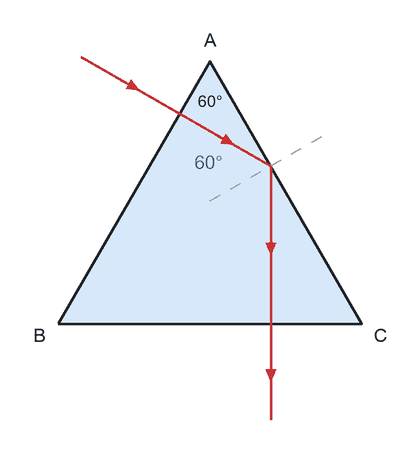
When a ray of light is incident normally on one refracting surface of an equilateral prism (Refractive index of the material of the prism = 1.5)
Confirming your payment
Sign up now and get 250 free tokens.
Refraction through a Prism - Dispersion · Question 12 of 71
When a ray of light is incident normally on one refracting surface of an equilateral prism (Refractive index of the material of the prism = 1.5)
(A) Emerging ray is deviated by 30°
(B) Emerging ray is deviated by 45°
(C) Emerging ray just grazes the second refracting surface
(D) The ray undergoes total internal reflection at the second refracting surface
Answer: (D) The ray undergoes total internal reflection at the second refracting surface
Concept: A ray inside glass is totally reflected at a face if its angle of incidence there is greater than the critical angle , where .
Step 1 — Angle at the second face. At normal incidence the ray goes straight in, so ; since for every ray, the angle at the second face is
So the ray meets the second face at 60°.
Step 2 — Compare with the critical angle.
The critical angle is the angle of incidence in glass for which the emergent ray just grazes the surface; it is found from :
Since , total internal reflection takes place at the second surface.