
Question 533 marksMedium
For any prism, show that refractive index of its material is given by
where symbols have their usual meaning.
Confirming your payment
Sign up now and get 250 free tokens.
Refraction through a Prism - Dispersion · Question 53 of 71
For any prism, show that refractive index of its material is given by
where symbols have their usual meaning.
Solution:
Concept: At minimum deviation the ray passes symmetrically through the prism. Combining this with the angle relations of a prism and Snell's law at the first face gives the refractive index.
Figure: is the principal section of the prism with refracting angle . Ray is incident at at angle , refracted along at angle , meets the second face at at angle and emerges along at angle . The normals at and meet at . The incident ray produced and the emergent ray produced backwards meet at , and is the angle of deviation.
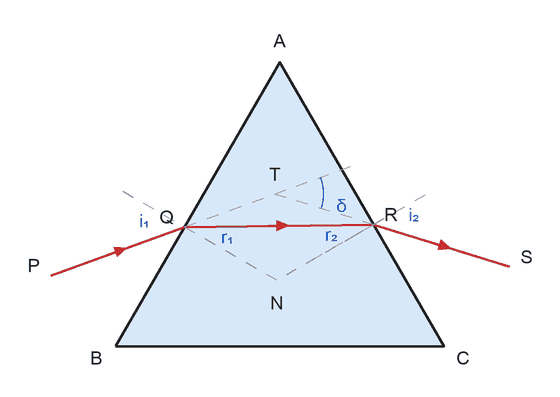
Step 1 — Angle of prism. In quadrilateral the angles at and are 90° each (the normals meet the faces at right angles). The four angles of a quadrilateral add up to 360°, so the other two angles add up to 180°:
The three angles of triangle also add up to 180°:
Comparing the two equations, hence
Step 2 — Deviation. The deviation at the first face is and at the second face , so
Step 3 — Minimum deviation. At minimum deviation the ray passes symmetrically through the prism. So the angle of incidence equals the angle of emergence (call both ), and the two angles of refraction are equal (call both ).
Putting for both angles of refraction into :
Putting for both and , and for , into :
Step 4 — Snell's law at the first face: Snell's law gives as the ratio of the two sines; then replace and by the expressions found in Step 3:
This is the required result.