
Opening your dashboard
Class 12 Physics Chapter 17 Refraction through a Prism - Dispersion: Competency-Based Questions (CBQ)
46 questions on Chapter 17, each worked through on its own page with the AI tutor. Class 12 Physics, ICSE 2026-27.
46 questions
1–4 marks · Mixed difficulty
- 13 marks
Question 1
Competency: Application
A student uses a wedge of acrylic (a prism of refracting angle ) to find the refractive index of acrylic. A narrow laser beam falls normally on the first face of the wedge. A wall stands beyond the wedge, perpendicular to the original beam. When the wedge is put in, the laser spot on the wall moves from where the beam hit without the wedge. The wedge is small compared with these distances. (Hypothetical data.)
(a) Find the angle of deviation of the beam.
(b) Find the angle of emergence and the refractive index of acrylic.
(c) The student now repeats the experiment with an acrylic wedge of refracting angle . Explain, with a calculation, what happens to the beam at the second face.
- 23 marks
Question 2
Competency: Analysis & Evaluation
A student traces rays through a glass prism of refracting angle . The maker states that the refractive index of the glass is . Her record of the angle of incidence , angle of emergence and angle of deviation is:
She concludes: "The minimum deviation of this prism is ." (Hypothetical data.)
(a) Use the relation between , , and to find which row contains an error.
(b) Using , calculate the angle of emergence for . Was her or her wrong in that row?
(c) Find the true angle of minimum deviation of the prism and explain why her conclusion cannot be right.
- 31 mark
Question 3
Competency: Analysis & Evaluation
A glass prism () is completely immersed in a tank of carbon disulphide, a clear liquid of refractive index . A ray of light from the liquid passes through the prism.
Assertion (A): Inside the liquid, the prism bends the ray towards its refracting edge (apex), not towards its base.
Reason (R): Compared with carbon disulphide the glass is optically rarer, so the ray bends away from the normal as it enters the glass and towards the normal as it leaves it.
- 41 mark
Question 4
Competency: Analysis & Evaluation
A narrow laser beam strikes face of a glass prism of refracting angle close to the refracting edge, at an angle of incidence of . It is deviated through . A second laser beam, parallel to the first, strikes the same face near the base, so it travels through a much longer path in the glass. The deviation of the second beam is
- 53 marks
Question 5
Competency: Application
A gem-testing laboratory polishes two flat facets on a transparent stone so that they meet at an angle of . The stone now acts as a small prism. With yellow sodium light, its angle of minimum deviation is measured as , with an uncertainty of . Refractive indices for sodium light are given below. (Hypothetical data.)
Material Quartz Glass imitation Spinel Sapphire Refractive index (a) Find the refractive index of the stone and identify it.
(b) Calculate the angle of minimum deviation that the same cut would give for the glass imitation and for sapphire.
(c) Is a measurement uncertain by good enough to tell the stone apart from its two nearest neighbours in the table? Explain.
- 63 marks
Question 6
Competency: Application
Tiny hexagonal ice crystals in thin high clouds act as prisms of refracting angle . On such days a bright ring of radius about , called a halo, is often seen around the Sun. Refractive index of ice: red , yellow , violet . (Hypothetical data.)
(a) Find the angle of minimum deviation for yellow light in a ice prism and compare it with the radius of the halo.
(b) Find the angles of minimum deviation for red and for violet light. Which colour forms the inner edge of the halo?
(c) The crystals face in all directions, so they deviate sunlight through many different angles. Explain why the light still gathers into a bright ring near the minimum deviation, and why the sky just inside the ring looks darker.
- 71 mark
Question 7
Competency: Analysis & Evaluation
A student sets a glass prism on a spectrometer, first for minimum deviation of red light and then for minimum deviation of violet light.
Assertion (A): The angle of incidence needed for minimum deviation is larger for violet light than for red light.
Reason (R): Violet light travels faster in glass than red light does.
- 81 mark
Question 8
Competency: Analysis & Evaluation
Using pins, a student finds that a ray falling at an angle of incidence of on a glass prism of refracting angle is deviated through . The refractive index of the glass is not known. (Hypothetical data.) From this single reading, which conclusion is correct?
- 91 mark
Question 9
Competency: Application
A student has two identical glass prisms, each of refracting angle and refractive index . One prism alone gives a minimum deviation of . She places the two prisms with one face of each in full contact (with a liquid of the same refractive index between them) and their refracting edges together, so that they form a single prism of refracting angle . The minimum deviation of this combined prism is about
- 103 marks
Question 10
Competency: Application
A laser-steering unit uses two identical thin glass prisms, each of refracting angle and refractive index , mounted close together, one behind the other, nearly normal to a laser beam. Each prism can be turned about the beam direction. Treat the deviation of each prism as a small angular shift of the beam towards that prism's base; two such small shifts add like vectors. The beam falls on a screen away. (Hypothetical data.)
(a) Find the deviation produced by one prism.
(b) Find the largest and smallest total deviations the pair can give, and say how the prisms must be set for each.
(c) One prism is turned so that the bases of the two prisms point in directions apart. Find the total deviation and the distance of the spot on the screen from the undeviated spot.
- 113 marks
Question 11
Competency: Application
A Fresnel biprism is a glass plate that behaves like two thin prisms joined base to base. Each half has a refracting angle of , and the glass has refractive index . A narrow slit lit by sodium light is placed in front of the biprism, on the line where the two bases meet. An observer looking through the biprism sees two images of the slit. (Hypothetical data.)
(a) Find the deviation produced by each half of the biprism.
(b) Each image appears shifted sideways from the slit by (distance of the slit) (deviation in radians). Find the separation of the two images, and say which way each one is shifted.
(c) Where must the slit be placed to make the two images apart?
- 121 mark
Question 12
Competency: Analysis & Evaluation
A student uses the general prism formula to obtain the result for a prism of very small refracting angle.
Assertion (A): For a thin prism, the angle of minimum deviation is .
Reason (R): For small angles, (with in radians), so becomes .
- 133 marks
Question 13
Competency: Analysis & Evaluation
A narrow beam of white light falls at an angle of incidence of on a parallel-sided glass block thick. The refractive index of the glass is for red light and for violet light. (Hypothetical data.)
(a) Find the angles of refraction of the red and the violet light inside the block.
(b) Find how far apart the red and the violet light reach the far face of the block.
(c) Find the angle of emergence of each colour from the far face. Hence explain why a screen placed far away shows white light, not a spread-out spectrum, even though the colours separated inside the block.
- 141 mark
Question 14
Competency: Analysis & Evaluation
A beam of white light passes through a glass prism and forms a spectrum on a screen.
Assertion (A): The glass prism deviates violet light more than red light.
Reason (R): Violet light has a shorter wavelength than red light, so air molecules scatter it more strongly.
- 151 mark
Question 15
Competency: Analysis & Evaluation
A student wants a wider spectrum from a thin glass prism and replaces it with a thin prism of the same glass but twice the refracting angle.
Assertion (A): The angular dispersion between violet and red light increases when the refracting angle of a thin prism made of the same glass is increased.
Reason (R): The angular dispersion produced by a thin prism depends only on the material of the prism.
- 161 mark
Question 16
Competency: Analysis & Evaluation
White light passes through a glass prism and forms a spectrum on a white screen. A green filter (which lets through only green light) is now placed in the white beam before it reaches the prism. What is seen on the screen?
- 173 marks
Question 17
Competency: Application
In a school laboratory, a thin glass prism of refracting angle is placed in turn in the beams of red (), green () and violet () laser pointers. Each beam falls almost normally on the prism. On a screen away, the spots are displaced from the undeviated position by: red , green , violet . Take green as the mean colour and use the thin-prism relation . (Hypothetical data.)
(a) Find the angle of deviation for each colour.
(b) Find the refractive index of the glass for each colour.
(c) Find the angular dispersion between violet and red, and the dispersive power of the glass.
- 181 mark
Question 18
Competency: Analysis & Evaluation
The table gives refractive indices of crown glass and of water. Take the mean refractive index as the average of the red and violet values. (Hypothetical data.)
Material Red Violet Crown glass Water Assertion (A): Crown glass, which has the larger refractive index, also has the larger dispersive power.
Reason (R): Dispersive power is , where is the mean refractive index.
- 191 mark
Question 19
Competency: Analysis & Evaluation
A laboratory has two unlabelled thin prisms, P and Q. One is crown glass and the other flint glass; flint glass has the larger dispersive power. With the same white light, a student measures: (Hypothetical data.)
Prism Mean deviation Angular dispersion (violet − red) P Q Which prism is made of flint glass?
- 203 marks
Question 20
Competency: Application
On a clear day, a trekker notices that a line of forested hills about away looks distinctly bluish, although the trees on them are green. On a hazy day, when the air is full of dust and tiny water droplets, the same hills look a dull greyish-white. Take blue light as and red light as . (Hypothetical data.)
(a) Explain why the distant hills look bluish on a clear day.
(b) How many times more strongly is the blue light scattered than the red light by the air molecules?
(c) Explain why the hills look greyish-white on the hazy day.
- 211 mark
Question 21
Competency: Analysis & Evaluation
A student reads that the intensity of scattered light is proportional to and draws a conclusion about the colour of the sky.
Assertion (A): The clear daytime sky looks violet to us.
Reason (R): Of all the colours of visible light, violet is scattered most strongly by air molecules.
- 221 mark
Question 22
Competency: Analysis & Evaluation
In a dark room lit by a single beam of white light, thin smoke rising from an incense stick looks bluish when seen from the side. The cloud of tiny water droplets above a boiling kettle, in the same beam, looks white. Which explanation is correct?
- 234 marks
Question 23
Competency: Application
A ray of sunlight enters a spherical raindrop at an angle of incidence of . It is refracted into the drop, reflected once from the back surface, and refracted out again. Take the refractive index of water as for yellow light. (Hypothetical data.)
(a) Find the angle of refraction as the ray enters the drop.
(b) Show that the ray meets the back surface at an angle of incidence equal to the angle of refraction found in (a), and find the total deviation of the ray (the sum of the deviations at entry, at the reflection and at exit).
(c) Find the angle between the emerging ray and the direction opposite to the incoming sunlight, and link it to the angle at which the primary rainbow is seen.
(d) Repeat (c) for red light () and violet light () at the same angle of incidence. Which colour is on the outer edge of the primary bow?
- 241 mark
Question 24
Competency: Analysis & Evaluation
After a shower, two rainbows are seen together: a bright primary bow and, outside it, a secondary bow.
Assertion (A): The secondary rainbow is fainter than the primary rainbow.
Reason (R): In the secondary rainbow the order of colours is reversed, with red on the inner edge.
- 251 mark
Question 25
Competency: Analysis & Evaluation
Road markings often contain tiny glass beads (refractive index about ). When sunlight falls on a road covered with such beads, a faint "bead bow" can be seen around the antisolar point, formed in the same way as a rainbow (one internal reflection in each bead). The chapter gives the primary rainbow in water drops as violet at and red at . Compared with the water-drop rainbow, the bead bow appears
- 263 marks
Question 26
A prism made of glass of refractive index produces a minimum deviation of . Find the refracting angle of the prism.
- 273 marks
Question 27
White light falls on the first face of a glass prism of refracting angle at a fixed angle of incidence of . The refractive indices of the glass for red and violet light are and . (Hypothetical data.)
(i) Find the angles of emergence of the red and the violet light.
(ii) Find the angle between the emergent red and violet rays.
(iii) Compare your answer with the value and comment.
- 283 marks
Question 28
A ray suffers minimum deviation while passing through a prism of refractive index 1.5 and refracting angle 60°. Calculate the angle of deviation and angle of incidence.
- 293 marks
Question 29
The minimum deviation produced by a glass prism having an angle of 60° is 30°. If the velocity of light in vacuum is m/s, calculate the velocity in glass.
- 303 marks
Question 30
An equilateral prism () is immersed in water (). Calculate the angle of deviation for a ray of light incident at 40° on one face of the prism.
- 313 marks
Question 31
A ray of light falls normally on refracting face of a prism of refractive index 1.6. If the refracted ray just grazes the surface of the prism. Find the angle of the prism.
- 323 marks
Question 32
Calculate the maximum value of the refracting angle of a prism made of a material with a refractive index of 1.55, if the emerging ray just grazes the surface of the prism.
- 333 marks
Question 33
A ray of light is incident on one face of a prism at an angle of 50°. If the angle of prism is 60° and the ray is deviated through an angle of 42°, find the angle which the emergent ray makes with the second face of the prism.
- 343 marks
Question 34
A ray of light strikes on one face of an equilateral glass prism of refractive index 1.5 at an angle of 41.4° with the surface of the prism. Find the angle of emergence and the angle of minimum deviation. Is the angle of deviation minimum?
- 353 marks
Question 35
Find the dispersive power for crown and flint glass from the following data. Given the refractive indices of crown and flint glass for and lines.
Crown 1.515 1.523 Flint 1.644 1.664 - 363 marks
Question 36
In a certain spectrum produced by a glass prism of dispersive power 0.305, it is found that the refractive index for the red ray is 1.645 and that for the blue ray is 1.665, what is the refractive index for the yellow ray?
- 373 marks
Question 37
A prism with a refracting angle of 60° gives angles of minimum deviation 53°, 51° and 52° for blue, red and yellow light respectively. What is the dispersive power of the material of the prism?
- 383 marks
Question 38
An object is placed in front of isosceles right-angled (45° – 90° – 45°) prism of crown glass with critical angle equal to 41°. Trace the path of two rays from and normal to the hypotenuse.
- 393 marks
Question 39
Calculate the dispersive power of glass accurately upto three decimal places from the following data
(i) Refractive index of glass for red colour = 1.60
(ii) Refractive index of glass for yellow colour = 1.61
(iii) Refractive index of glass for violet colour = 1.62
- 403 marks
Question 40
Deviation of 5° is observed from a prism whose angle is small and whose refractive index is 1.5. Calculate the angle of prism.
- 413 marks
Question 41
The ratio of amounts of scattering intensity of two light waves is 1:4. Calculate the ratio of their wavelengths.
- 423 marks
Question 42
is the cross-section of a right-angled prism with angles as shown in the figure. is a ray incident normally at . Complete the passage of the ray through the prism. Explain what happens at the interfaces between glass and air. Calculate , where is the angle of emergence in air, the critical angle of the glass-air is 42° and the refractive index of glass is 1.5.

- 433 marks
Question 43
The refractive index of a material for red, violet and yellow colour lights are 1.52, 1.62 and 1.59 respectively. Calculate the dispersive power of the material. If the mean deviation is 40°, what will be the angular dispersion produced by a prism of this material.
- 443 marks
Question 44
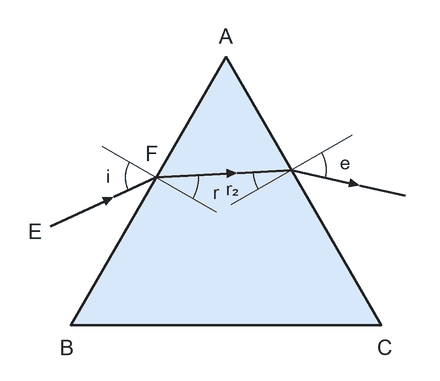
A ray of monochromatic light is incident on the refracting surface of a regular glass prism (refractive index = 1.5) at angle of incidence . If it emerges through the adjacent face , calculate the angle of emergence e.
[, ]
- 453 marks
Question 45
Find the angle of incidence at which a ray of monochromatic light should be incident on the first face of a regular prism , so that the emergent ray grazes the adjacent surface (Refractive index of glass = 1.56).
- 463 marks
Question 46
A ray of light is incident on a prism whose refractive index is 1.52 at an angle of 40°. If the angle of emergence is 60°. Calculate the angle of the prism.