
Opening your dashboard
Class 12 Maths Chapter 17: Vectors Solutions
52 textbook questions with step-by-step answers, free to read, for ISC 2026-27.
Get talked through Ch 17, not just shown the answer
Reading a finished solution is not the same as being able to do it. The AI tutor takes one question at a time and works it with you, in your own words, until you can.
- Ask it out loud, in your own words
- It gives you the next step, not the answer
- Stuck on part (ii)? Start there
52 questions with solutions
1–3 marks · Mixed difficulty
The first 10 solutions are on this page. This chapter is a long one, so the rest open on their own page to keep this one quick to load.
- 13 marks
Question 1
Simplify for triangles and :
(i)
(ii)
(iii)
Solve with AIWritten solution
Solution:
Key idea: By the triangle law of addition, : when the end of the first vector is the start of the second, the sum runs from the first starting point to the last end point. Also , because reversing a vector keeps its length and turns its direction round.
Step 1 — Simplify part (i).
The vector has the same length as but the opposite direction, so we can replace it by .
Step 2 — Simplify part (ii).
The vector ends at , which is where starts, so we first join these two by the triangle law.
The sum is now , which is a vector added to its own opposite.
Step 3 — Simplify part (iii).
Vector addition is commutative, so we reorder the terms to place them head to tail along the path .
Now we join the first two vectors by the triangle law.
The sum is now , again a vector and its opposite.
Watch out: A sum of vectors is always a vector, so the answer is the zero vector , not the number .
Therefore, the sums in (i), (ii) and (iii) are all equal to the zero vector .
- 23 marks
Question 2
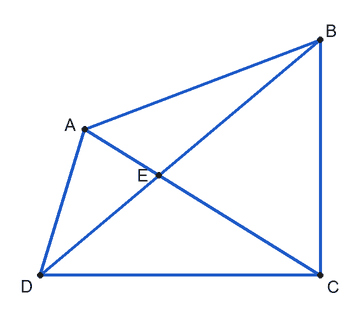
In the figure, is a quadrilateral whose diagonals and meet at . The various line segments are taken to be representatives of vectors. Find from the figure a single representative of each of the following sums:
(i)
(ii)
(iii)
(iv)
Solve with AIWritten solution
Solution:
Key idea: When vectors are joined head to tail (each one starts where the previous one ends), their sum is the single vector from the first starting point to the last end point. This is the triangle law, used again and again for more than two vectors.
Step 1 — Find the sum in part (i).
The vector ends at and starts at , so the path is and the sum runs from to .
Step 2 — Find the sum in part (ii).
The vector ends at and starts at , so the path is and the sum runs from to .
Step 3 — Find the sum in part (iii).
The path is . We first join the first two vectors, which meet at .
Next we add , which starts at , where ends.
Step 4 — Find the sum in part (iv).
The path is . We join the vectors one at a time, each time using the triangle law.
Therefore, (i) , (ii) , (iii) and (iv) .
- 33 marks
Question 3
In the figure ( is a quadrilateral whose diagonals and meet at ), simplify:
(i)
(ii)
(iii)
Solve with AIWritten solution
Solution:
Key idea: The negative of a vector has the same length and the opposite direction, so . After rewriting each negative this way, we join the vectors head to tail and use the triangle law .
Step 1 — Simplify part (i).
We rewrite as , which turns the subtraction into an addition.
The path is now , so the triangle law gives a single vector.
Step 2 — Simplify part (ii).
We rewrite as .
The path is , so the sum runs from to .
Step 3 — Simplify part (iii).
We rewrite as , and reorder the terms (addition is commutative) so that they join head to tail.
Now we join the vectors along the path .
Therefore, (i) , (ii) and (iii) .
- 43 marks
Question 4
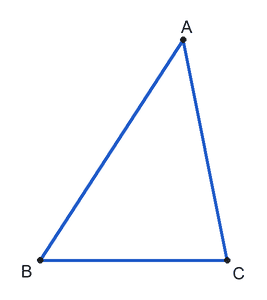
In the triangle shown, simplify:
(i)
(ii)
(iii)
(iv)
(v)
Solve with AIWritten solution
Solution:
Key idea: To subtract a vector we add its negative, and . Then we reorder the two vectors so that they join head to tail and use the triangle law .
Step 1 — Simplify part (i).
We replace by and write first, so the path is .
Step 2 — Simplify part (ii).
We replace by and write it first, so the path is .
Step 3 — Simplify part (iii).
We replace by and write it first, so the path is .
Step 4 — Simplify part (iv).
We replace by and write it first, so the path is .
Step 5 — Simplify part (v).
We replace by and write it first, so the path is .
Watch out: For two vectors drawn from the same point, the difference points from the end of the second vector to the end of the first, that is from to , never the other way.
Therefore, (i) , (ii) , (iii) , (iv) and (v) .
- 53 marks
Question 5
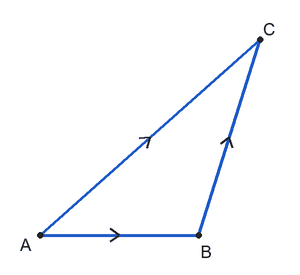
In (see the figure), which of the following is true?
(i)
(ii)
(iii)
Solve with AIWritten solution
Solution:
Key idea: By the triangle law, . Also a vector minus itself is , and .
Step 1 — Test statement (i).
We first replace by using the triangle law.
The vectors and are opposites, so their sum is the zero vector.
So statement (i) is true.
Step 2 — Test statement (ii).
Again we replace by .
So statement (ii) is true.
Step 3 — Test statement (iii).
We replace by , and write as .
Since and are different points, is not the zero vector, so is not either. So statement (iii) is false.
Therefore, statements (i) and (ii) are true, and statement (iii) is false.
- 63 marks
Question 6
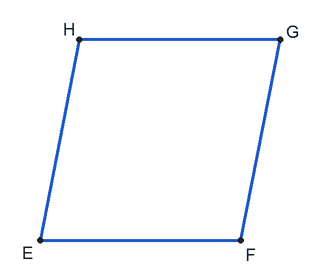
In the figure, is a parallelogram. Simplify:
(i)
(ii)
(iii)
(iv)
(v)
(vi)
(vii)
(viii)
Solve with AIWritten solution
Solution:
Key idea: In a parallelogram, opposite sides are equal in length, parallel and point the same way when taken in the same sense, so equal vectors can replace each other. Subtracting a vector means adding its negative, with , and vectors joined head to tail add by the triangle law .
Step 1 — Write down the equal vectors of the parallelogram.
In , side is opposite side and side is opposite side , so the vectors along them are equal.
Step 2 — Simplify part (i).
We replace by the equal vector , so that the two vectors join head to tail at .
This is the parallelogram law: the sum is the diagonal .
Step 3 — Simplify part (ii).
We write as and put it first, so the path is .
Step 4 — Simplify part (iii).
We write as and put it first, so the path is .
Step 5 — Simplify part (iv).
We reorder the sum so that the path is .
Step 6 — Simplify part (v).
We write as and put it first, so the path is again .
Step 7 — Simplify part (vi).
We replace by the equal vector from Step 1; the expression then matches part (ii).
Step 8 — Simplify part (vii).
We write as and put it first, so the path is .
Step 9 — Simplify part (viii).
We write as and put it first, so the path is .
Note: the book's answers print for part (iv) and for part (vi). As printed, part (iv) equals and part (vi) equals , as shown above; would be the value of .
Therefore, (i) , (ii) , (iii) , (iv) , (v) , (vi) , (vii) and (viii) .
- 71 mark
Question 7
If , what is the value of (i) and (ii) ?
Solve with AIWritten solution
Solution:
Key idea: For any scalar and vector , the magnitude of is times the magnitude of . In symbols, .
Step 1 — Find the magnitude in part (i).
Here , and , so we multiply the given magnitude by .
Step 2 — Find the magnitude in part (ii).
Here , and , so we multiply by .
Watch out: A magnitude is never negative. The minus sign in only reverses the direction; it does not make the length negative.
Therefore, (i) and (ii) .
- 83 marks
Question 8
If , interpret the following:
(i)
(ii)
(iii)
(iv)
Solve with AIWritten solution
Solution:
Key idea: For a scalar , the vector has magnitude . It points in the same direction as when and in the opposite direction when .
Step 1 — Interpret .
Here is positive, so the direction is that of . We find the magnitude.
So is a vector of magnitude in the direction of .
Step 2 — Interpret .
Here is negative, so the direction is opposite to , and the magnitude uses .
So is a vector of magnitude in the direction opposite to .
Step 3 — Interpret .
Here is positive, so the direction is that of .
So is a vector of magnitude in the direction of .
Step 4 — Interpret .
Here is negative, so the direction is opposite to , and the magnitude uses .
So is a vector of magnitude in the direction opposite to .
Therefore, has magnitude along , has magnitude opposite to , has magnitude along , and has magnitude opposite to .
- 93 marks
Question 9
Find the position vector of the point which divides the join of points with position vectors and internally in the ratio .
Solve with AIWritten solution
Solution:
Key idea: If and have position vectors and , the point dividing in the ratio has position vector when the division is internal and when it is external. The number always goes with the second point .
Step 1 — Name the points and the ratio.
We call the first point and the second point , and read off the ratio for internal division.
The ratio is .
Step 2 — Substitute into the internal section formula.
We put with and with .
Step 3 — Expand and simplify.
We remove the brackets in the numerator and collect the and terms.
Therefore, the required position vector is .
- 103 marks
Question 10
Find the position vector of the point which divides the join of points with the position vectors and externally in the ratio .
Solve with AIWritten solution
Solution:
Key idea: If and have position vectors and , the point dividing in the ratio has position vector when the division is internal and when it is external. The number always goes with the second point .
Step 1 — Name the points and the ratio.
We call the first point and the second point , and read off the ratio for external division.
The ratio is .
Step 2 — Substitute into the external section formula.
We put with and with , using a minus sign for external division.
Step 3 — Expand and simplify.
We remove the brackets, taking care that the minus sign changes both signs inside the second bracket.
Watch out: In the term becomes ; missing this sign gives the wrong answer .
Therefore, the required position vector is .
- 113 marks
Question 11
Find the position vector of a point which divides the line joining two points and , whose position vectors are and , respectively, externally in the ratio . Also, show that is the mid-point of the line segment .
- 123 marks
Question 12
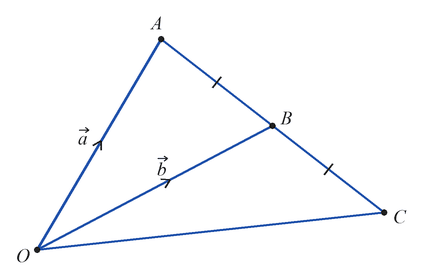
In a triangle , if is the mid-point of side and , , then what is ?
- 133 marks
Question 13
Consider two points and with position vectors and . Find the position vector of a point which divides the line joining and in the ratio ,
(i) internally and
(ii) externally.
- 143 marks
Question 14
Four points , , , with position vectors , , , , respectively are such that . Show that the four points are coplanar. Also, find the position vector of the point of intersection of lines and .
- 153 marks
Question 15
Let , , be position vectors of three distinct points , , . If there exist scalars , , (not all zero) such that and , then show that , and lie on a line.
- 161 mark
Question 16
If the position vector of a point be , find .
- 173 marks
Question 17
If and , express the vector in terms of unit vectors and . Also, determine the magnitude of .
- 183 marks
Question 18
If and , find the magnitude of .
- 193 marks
Question 19
If , and have components , and , respectively, find the components of .
- 203 marks
Question 20
Find a unit vector parallel to .
- 213 marks
Question 21
Find a unit vector in the direction of .
- 223 marks
Question 22
Find a vector of magnitude units which is parallel to the vector .
- 233 marks
Question 23
Prove (by vectors) that the points , and are collinear.
- 243 marks
Question 24
If and , find and determine a unit vector in the direction of the vector .
- 253 marks
Question 25
Prove that the vectors , and form a right-angled triangle.
- 263 marks
Question 26
If and , then find the vectors and .
- 273 marks
Question 27
If , , and , then find the value of .
- 283 marks
Question 28
Find sum of the vectors and and hence find the unit vector along the sum of these vectors.
- 293 marks
Question 29
If and are the end points of a vector , then find the unit vector in the direction of .
- 303 marks
Question 30
Find a vector of magnitude units parallel to the vector .
- 313 marks
Question 31
Find by vector method the perimeter of the triangle whose vectors are , and .
- 323 marks
Question 32
If the position vectors of the angular points , , and of a quadrilateral be , , and , respectively, then determine the lengths of its sides.
- 333 marks
Question 33
Prove by vector method that the triangle whose vertices are , and is an isosceles triangle.
- 343 marks
Question 34
The position vectors of two points and are and , respectively. Find the direction cosines of and show that is parallel to - plane.
- 353 marks
Question 35
Given that and , find the value of and , if .
- 363 marks
Question 36
Prove that the vectors , and form the sides of an equilateral triangle.
- 373 marks
Question 37
Prove that the points , , are the vertices of a right-angled triangle.
- 383 marks
Question 38
If the points , and are collinear, then find the value of .
[Hint. Let , , be the points, then use .]
- 393 marks
Question 39
If the vertices of a triangle are the points , , , what are the vectors determined by its sides? , , are unit vectors parallel to the axes of coordinates.
- 403 marks
Question 40
Find the length and direction cosines of where and .
- 413 marks
Question 41
Find the direction cosines of the vector joining the points and directed from to .
- 421 mark
Question 42
Write the direction ratios of the vector , where and .
- 433 marks
Question 43
The vertices of a triangle are , , . Find the lengths and direction cosines of the vectors and .
- 443 marks
Question 44
is the point , is , is .
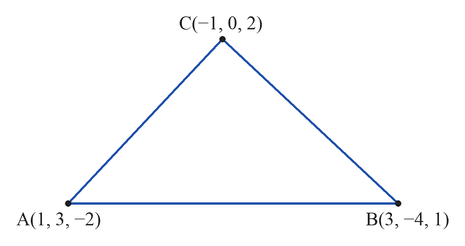
Find the lengths of the sides of the triangle and the cosines of the angles , , .
- 453 marks
Question 45
Prove that the triangle with vertices , and , is right-angled.
- 463 marks
Question 46
The position vectors of , and are , and , respectively, show that , and are collinear.
- 473 marks
Question 47
Show that the points , and are collinear.
- 483 marks
Question 48
Find all the vectors of magnitude which are collinear to vector .
- 493 marks
Question 49
The position vector of two points and are and , respectively. Find the position vector of a point which divides the line segment joining and in the ratio .
- 503 marks
Question 50
The two vectors and represent the two sides and , respectively of a . Find the length of the median through .
[Hint. Let be the origin .]

- 513 marks
Question 51
Find the position vector of a point which divides the line joining two points and in the ratio
(i) internally and
(ii) externally.
- 523 marks
Question 52
Find , if the vectors , , and are coplanar.
What Class 12 Maths Ch 17 covers
The sections of the chapter, in the order the book takes them. Every question above comes from one of these.
- 01Scalars, Vectors and Types of Vectors
- 02Addition, Subtraction and Scalar Multiples of Vectors
- 03Position Vector and Section Formula
- 04Linear Combination and Components of a Vector
- 05Direction Cosines and Direction Ratios of a Vector
- 06Collinearity and Coplanarity of Vectors
More ways to study this chapter
The same chapter asked three other ways. Practise it, revise it, and see what the board has set on Ch 17 before.
- Competency-Based Questions (CBQ)Case study questions: a situation, and the part of the chapter that answers it.40questionsOpen
- Previous Year QuestionsQuestions that have actually appeared in board papers, each tagged with its year.12questionsOpen
- Practice QuestionsExtra questions per chapter, for when one attempt at a method is not enough.49questionsOpen
Ch 17 in past ISC papers
The same chapter as the board has actually asked it. These are worded differently from the textbook exercise, which is the point of reading them.
- 15 marks
Board paper question 1
For any three vectors , show that are coplanar.
Solve with AIWritten solution
Solution:
Key idea: Three vectors are coplanar when one of them can be written as a combination of the other two (they are linearly dependent). An equivalent test is that their scalar triple product is zero.
Step 1 — Name the three vectors.
We give short names to the three vectors so that the working is easy to read.
Step 2 — Add the three vectors.
We add them term by term. Each of , and appears once with a plus sign and once with a minus sign, so everything cancels.
Step 3 — Write one vector as a combination of the other two.
We move and to the right-hand side of the result of Step 2.
So is a linear combination of and . A combination of two vectors always lies in the plane containing those two vectors, so all three vectors lie in one plane.
Step 4 — Check with the scalar triple product.
We also confirm the result with the triple-product test. We replace by and split the product.
A scalar triple product with a repeated vector is zero, so both terms vanish.
Watch out: If and happen to be parallel, then is parallel to them too. Parallel vectors are still coplanar, so the result holds in every case.
Therefore, , and are coplanar for any three vectors .
- 25 marks
Board paper question 2
Find the value of for which the four points with position vectors , , and are coplanar.
Solve with AIWritten solution
Solution:
Key idea: Four points are coplanar exactly when the three vectors , and are coplanar, that is, when their scalar triple product (the determinant of their components) is zero.
Step 1 — Write the position vectors as points.
We call the four points in the order given and read their coordinates from the position vectors.
Step 2 — Find the three vectors from A.
We subtract the position vector of from each of the others.
Step 3 — Set the scalar triple product equal to zero.
The points are coplanar when the determinant of these components is zero.
Step 4 — Expand the determinant along the first row.
We take each entry of the first row with its cofactor.
We simplify each bracket separately.
Step 5 — Solve for λ.
We divide both sides by .
Therefore, the four points are coplanar when .
- 34 marks
Board paper question 3
Show that the four points , , and with position vectors , , and respectively, are coplanar.
Solve with AIWritten solution
Solution:
Key idea: Four points are coplanar when , and are coplanar, that is, when their scalar triple product is zero.
Step 1 — Write the points as coordinates.
We read the coordinates from the position vectors. Note that .
Step 2 — Find the three vectors from A.
We subtract the position vector of from each of the other three.
Step 3 — Write the scalar triple product as a determinant.
The scalar triple product equals the determinant of the components.
Step 4 — Expand along the first row.
We work out the three cofactor terms one at a time.
Step 5 — Add the terms.
We add the three results.
Therefore, the scalar triple product is zero, so the points A, B, C and D are coplanar.
- 44 marks
Board paper question 4
If and are not collinear vectors, find the value of such that the vectors and are collinear.
Solve with AIWritten solution
Solution:
Key idea: Two vectors are collinear when one is a scalar multiple of the other. Because and are not collinear, we may compare the coefficients of and of on the two sides of a vector equation.
Step 1 — Write the collinearity condition.
Since is not the zero vector (its -coefficient is ), the vectors are collinear exactly when for some scalar .
Step 2 — Compare the coefficients of b.
We may compare coefficients because and are not collinear. The coefficients of give .
Step 3 — Compare the coefficients of a.
Now we compare the coefficients of and put .
We multiply both sides by to clear the fraction.
Step 4 — Check the answer.
We substitute back into both vectors.
So , and the two vectors are indeed collinear.
Therefore, .
- 52 marks
Board paper question 5
Write a vector of magnitude of 18 units in the direction of the vector .
Solve with AIWritten solution
Solution:
Key idea: A vector of magnitude in the direction of is , where is the unit vector along .
Step 1 — Name the direction vector.
We call the given direction vector , so .
Step 2 — Find the magnitude of the direction vector.
We use .
Step 3 — Scale the unit vector to magnitude 18.
We multiply the unit vector by .
Therefore, the required vector is .
- 62 marks
Board paper question 6
If and are the end points of a vector then find the unit vector in the direction of .
Solve with AIWritten solution
Solution:
Key idea: For points and , = (position vector of ) − (position vector of ). The unit vector in its direction is .
Step 1 — Find the vector AB.
We subtract the coordinates of from those of .
Step 2 — Find its magnitude.
We take the square root of the sum of the squares of the components.
Step 3 — Divide the vector by its magnitude.
We divide each component by .
Therefore, the unit vector in the direction of is .
All 12 board paper questions for this chapter, solved the same way.
Class 12 Maths Ch 17 questions students ask
How many questions are there in Class 12 Maths Ch 17?
52 questions. Every one is solved step by step on this page.
Are these Class 12 Maths solutions free?
Yes. Every question and its full working is free to read, with no account needed.
Can I download the Class 12 Maths Ch 17 solutions as a PDF?
There is no PDF to download. Every solution is on this page instead, which means it is searchable, always the current syllabus, and readable on a phone. Use your browser's print option if you want it on paper.