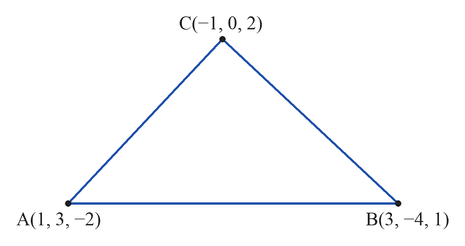
A is the point (1, 3, -2) , B is (3, -4, 1) , C is (-1, 0, 2) .
Question 443 marksMedium
A is the point (1,3,−2), B is (3,−4,1), C is (−1,0,2).
Find the lengths of the sides of the triangle ABC and the cosines of the angles A, B, C.
Solution:
Key idea: The side lengths come from the side vectors (AB=b−a, and so on). The cosine of each angle then follows from the cosine rule, for example cosA=2⋅AB⋅ACAB2+AC2−BC2, where the angle at a vertex is the angle between the two sides drawn from that vertex.
Step 1 — Find side AB.
We subtract the coordinates of A from those of B, then find the length.
AB=2i^−7j^+3k^
AB=4+49+9
AB=62
Step 2 — Find side AC.
We subtract the coordinates of A from those of C, then find the length.
AC=−2i^−3j^+4k^
AC=4+9+16
AC=29
Step 3 — Find side BC.
We subtract the coordinates of B from those of C, then find the length.
BC=−4i^+4j^+k^
BC=16+16+1
BC=33
Step 4 — Find cosA.
We use the cosine rule with the two sides AB and AC that meet at A, and simplify.
cosA=2622962+29−33
cosA=2622958
cosA=6229
Step 5 — Find cosB.
We use the cosine rule with the sides AB and BC that meet at B.
cosB=2623362+33−29
cosB=2623366
cosB=6233
Step 6 — Find cosC.
We use the cosine rule with the sides AC and BC that meet at C.
cosC=2293329+33−62
cosC=0
So the angle at C is 90∘. As a check, we add the squares of the other two cosines; the sum must be 1 when A+B=90∘.
cos2A+cos2B=6229+33
cos2A+cos2B=1
Note: the book's answer prints cosB=6232, a slip for 6233; with 32, cos2A+cos2B would not equal 1 although C=90∘.
Therefore, AB=62, AC=29, BC=33, and cosA=6229, cosB=6233, cosC=0.