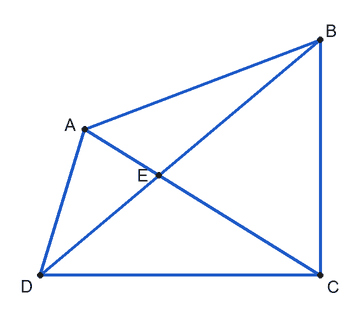
In the figure ( ABCD is a quadrilateral whose diagonals AC and BD meet at E ), simplify
Question 33 marksEasy
In the figure (ABCD is a quadrilateral whose diagonals AC and BD meet at E), simplify:
(i)DE+(−BE)
(ii)AC+(−BC)
(iii)CD+BA+(−BD)
Solution:
Key idea: The negative of a vector has the same length and the opposite direction, so −XY=YX. After rewriting each negative this way, we join the vectors head to tail and use the triangle law XY+YZ=XZ.
Step 1 — Simplify part (i).
We rewrite −BE as EB, which turns the subtraction into an addition.
DE+(−BE)=DE+EB
The path is now D→E→B, so the triangle law gives a single vector.
DE+EB=DB
Step 2 — Simplify part (ii).
We rewrite −BC as CB.
AC+(−BC)=AC+CB
The path is A→C→B, so the sum runs from A to B.
AC+CB=AB
Step 3 — Simplify part (iii).
We rewrite −BD as DB, and reorder the terms (addition is commutative) so that they join head to tail.