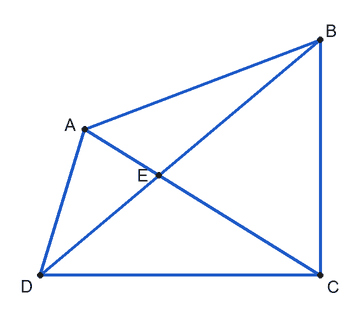
In the figure, ABCD is a quadrilateral whose diagonals AC and BD meet at E .
Question 23 marksEasy
In the figure, ABCD is a quadrilateral whose diagonals AC and BD meet at E. The various line segments are taken to be representatives of vectors. Find from the figure a single representative of each of the following sums:
(i)AE+EC
(ii)DB+BE
(iii)AD+DB+BC
(iv)CB+BE+EA+AD
Solution:
Key idea: When vectors are joined head to tail (each one starts where the previous one ends), their sum is the single vector from the first starting point to the last end point. This is the triangle law, used again and again for more than two vectors.
Step 1 — Find the sum in part (i).
The vector AE ends at E and EC starts at E, so the path is A→E→C and the sum runs from A to C.
AE+EC=AC
Step 2 — Find the sum in part (ii).
The vector DB ends at B and BE starts at B, so the path is D→B→E and the sum runs from D to E.
DB+BE=DE
Step 3 — Find the sum in part (iii).
The path is A→D→B→C. We first join the first two vectors, which meet at D.
AD+DB=AB
Next we add BC, which starts at B, where AB ends.
AB+BC=AC
Step 4 — Find the sum in part (iv).
The path is C→B→E→A→D. We join the vectors one at a time, each time using the triangle law.