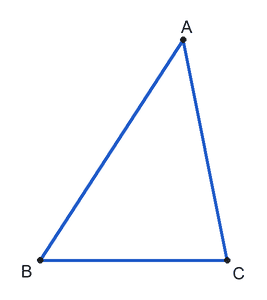
In the triangle ABC shown, simplify: (i) AC - AB (ii) BA - BC (iii) BC - BA (iv) CA - CB (v) CB - CA
Question 43 marksEasy
In the triangle ABC shown, simplify:
(i)AC−AB
(ii)BA−BC
(iii)BC−BA
(iv)CA−CB
(v)CB−CA
Solution:
Key idea: To subtract a vector we add its negative, and −XY=YX. Then we reorder the two vectors so that they join head to tail and use the triangle law XY+YZ=XZ.
Step 1 — Simplify part (i).
We replace −AB by BA and write BA first, so the path is B→A→C.
AC−AB=BA+AC
BA+AC=BC
Step 2 — Simplify part (ii).
We replace −BC by CB and write it first, so the path is C→B→A.
BA−BC=CB+BA
CB+BA=CA
Step 3 — Simplify part (iii).
We replace −BA by AB and write it first, so the path is A→B→C.
BC−BA=AB+BC
AB+BC=AC
Step 4 — Simplify part (iv).
We replace −CB by BC and write it first, so the path is B→C→A.
CA−CB=BC+CA
BC+CA=BA
Step 5 — Simplify part (v).
We replace −CA by AC and write it first, so the path is A→C→B.
CB−CA=AC+CB
AC+CB=AB
Watch out: For two vectors drawn from the same point, the difference XZ−XY points from the end of the second vector to the end of the first, that is from Y to Z, never the other way.
Therefore, (i) BC, (ii) CA, (iii) AC, (iv) BA and (v) AB.