
Opening your dashboard
Class 12 Maths Chapter 17 Vectors: Competency-Based Questions (CBQ)
40 questions on Chapter 17, each worked through on its own page with the AI tutor. Class 12 Maths, ICSE 2026-27.
40 questions
1–5 marks · Mixed difficulty
- 11 mark
Question 1
Competency: Analysis & Evaluation
At 10 a.m., three weather stations report the wind. At station (the airport) and at station (the harbour, 8 km away), the wind blows at 18 km/h towards the north-east. At station (in the hills), the wind blows at 18 km/h towards the south-west. Let , , be the wind velocity vectors at , , . (Hypothetical data.)
Which statement is correct?
- 21 mark
Question 2
Competency: Analysis & Evaluation
A robot vacuum cleaner leaves its charging dock, cleans a room along a winding path of total length 18 m, and returns to the same dock. (Hypothetical data.)
Assertion (A): The displacement of the robot for the whole trip is the zero vector, although it has travelled 18 m.
Reason (R): The magnitude of a displacement vector is equal to the distance travelled along the path.
- 33 marks
Question 3
Competency: Application
A survey drone flies a plan of five straight legs. Taking as 1 km due east and as 1 km due north, the legs are (Hypothetical data.)
(a) Which two legs are equal vectors?
(b) Which leg exactly undoes another leg? Write the relation between them.
(c) Name the legs that have the same direction as but are not equal to it, and compare their lengths with that of .
- 41 mark
Question 4
Competency: Analysis & Evaluation
On a harbour chart, the ferry route is 12 km long and the ferry route is 7 km long. The two routes are drawn on parallel lines, and they point in opposite directions. (Hypothetical data.)
Assertion (A): and are collinear vectors.
Reason (R): Vectors are collinear when they are parallel to the same line, whatever their magnitudes and directions along that line.
- 54 marks
Question 5
Competency: Application
A river with straight parallel banks is 0.8 km wide and flows due east at 3 km/h. A motor boat moves at 5 km/h relative to the water. Take as 1 km/h due east (downstream) and as 1 km/h due north (straight across, from the south bank to the north bank). The actual velocity of the boat is the sum of its velocity relative to the water and the velocity of the current. (Hypothetical data.)
(a) The boat is pointed due north. Find its actual velocity as a vector and its actual speed.
(b) In case (a), how far downstream of the starting point does the boat reach the north bank?
(c) Instead, the boat must reach the point directly opposite its starting point. Find the velocity it must have relative to the water, and the time it takes to cross.
- 61 mark
Question 6
Competency: Application
Three tugboats hold a large ship at rest in a harbour, so the sum of the three pulling forces is the zero vector. With and as 10 kN due east and due north, tug 1 pulls with and tug 2 with . (Hypothetical data.)
The force of tug 3 is
- 71 mark
Question 7
Competency: Analysis & Evaluation
Rain falls vertically downward at 6 m/s. A cyclist rides due east at 8 m/s on a level road. (Hypothetical data.)
Assertion (A): To the cyclist, the rain appears to fall at m/s.
Reason (R): The velocity of the rain relative to the cyclist is .
- 83 marks
Question 8
Competency: Application
A cleaning robot starts at its dock and moves along three straight legs: , and , where and are 1 m due east and 1 m due north. At its battery runs low. (Hypothetical data.)
(a) Find as a single vector and the straight-line distance .
(b) Write the vector the robot must follow to go straight back to the dock.
(c) How much shorter is the straight return than retracing the three legs? (Give the answer correct to two decimal places.)
- 93 marks
Question 9
Competency: Application
A crane lifts a light rigid lifting frame that carries a load of 3 tonnes at and a load of 2 tonnes at , with position vectors and (in metres) from a fixed corner . The hook must be attached at the balance point so that the frame does not tip. For two loads at and at , the balance point lies on and divides it internally in the ratio . (Hypothetical data.)
(a) Find the position vector of the balance point of the two loads.
(b) A 5-tonne load is added at , with . Treating the 5 tonnes already at as one load, find the new balance point .
(c) Show that .
- 104 marks
Question 10
Competency: Application
A delivery drone flies in a straight line from to ; co-ordinates are in metres, the -plane is the ground and the -axis points up. The boundary of a no-fly zone is the vertical plane (the -plane). (Hypothetical data.)
(a) Find the ratio in which the plane divides the segment .
(b) Find the position vector of the point where the drone crosses the boundary, and its height there.
(c) Using the same method, decide whether the straight path from to meets the ground anywhere between and .
- 111 mark
Question 11
Competency: Application
A straight guy wire supporting a mast runs from a ground anchor to a point on the mast, with position vectors and (in metres, vertically up). Four marker balls are clamped on the wire so that , the four markers and are equally spaced along it. (Hypothetical data.)
The position vector of the second marker from is
- 123 marks
Question 12
Competency: Application
A farm plot (corners taken in this order) is a parallelogram. From a reference post , the position vectors of three corners are , and , where and are 1 m due east and 1 m due north. The fourth corner marker is lost. (Hypothetical data.)
(a) Find the position vector of .
(b) A sprinkler is placed where the diagonals cross. Find its position vector.
(c) A water pipe is laid straight from to the mid-point of side . Find and the length of the pipe, correct to one decimal place.
- 131 mark
Question 13
Competency: Application
Three soil sensors on flat ground have position vectors , and (in metres) from a base station . A relay drone must hover 20 m above the centroid of the triangle formed by the sensors, with pointing vertically up. (Hypothetical data.)
The position vector of the drone is
- 143 marks
Question 14
Competency: Application
A shop sign of weight 30 N hangs from a ring at , which is held by two cables and fixed to a frame. In a vertical plane, take as the origin, horizontal and vertically up (unit: metre); then is and is . The ring is in equilibrium, so the tension in , the tension in and the weight add up to the zero vector. (Hypothetical data.)
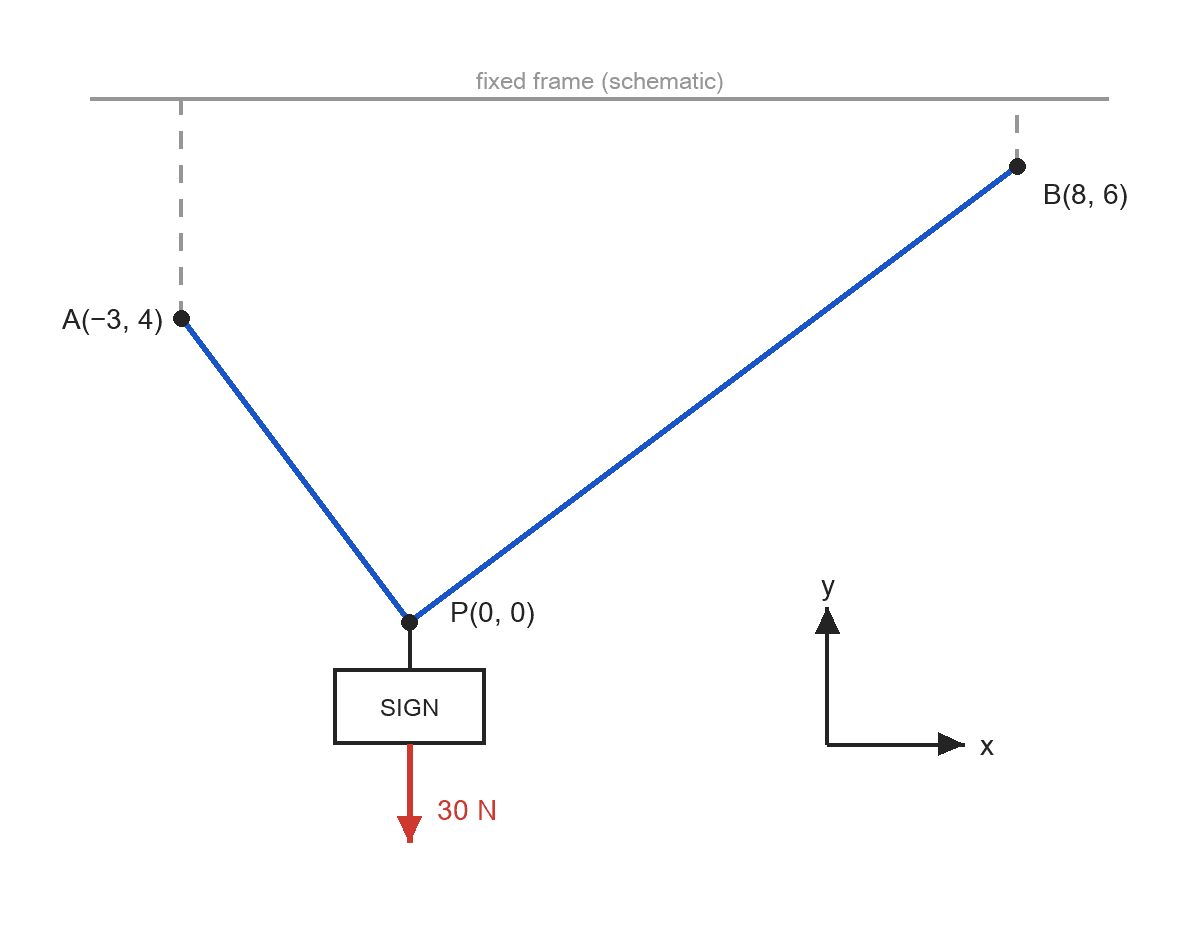
(a) Find the unit vectors along and .
(b) Writing the tensions as and (in newtons) times these unit vectors, write the two component equations for equilibrium.
(c) Find and .
- 153 marks
Question 15
Competency: Analysis & Evaluation
A trekking team packs two food mixes. One pack of Mix supplies 4 g protein, 10 g carbohydrate and 2 g fat; one pack of Mix supplies 6 g protein, 5 g carbohydrate and 3 g fat. Write these as vectors and (, , = 1 g of protein, carbohydrate, fat). (Hypothetical data.)
(a) A snack must supply exactly . Find the numbers of packs of and of with .
(b) Show that no amounts of and (whole or fractional) give exactly .
(c) In both mixes the fat content is half the protein content. Use this to explain, in terms of linear combinations, which nutrient targets can be met exactly with these two mixes.
- 161 mark
Question 16
Competency: Analysis & Evaluation
A warehouse robot moves on a flat floor (the -plane) only along two rail directions, and , forwards or backwards by any amount.
Assertion (A): Starting from the origin, the robot can reach every point of the floor.
Reason (R): Every vector of a plane can be written as a combination of any two non-zero vectors , of that plane.
- 171 mark
Question 17
Competency: Application
A drone's velocity has an eastward component of 2 m/s and a northward component of 3 m/s, and its speed is 7 m/s. The drone is descending. Take , , as 1 m/s due east, due north and vertically up. (Hypothetical data.)
The velocity of the drone is
- 183 marks
Question 18
Competency: Application
The boom of a construction crane runs straight from its pivot to its tip , with (in metres; east, north, vertically up). For safety, the boom must make an angle of at most with the vertical. (Hypothetical data.)
(a) Find the length of the boom and its direction cosines.
(b) Find the angle the boom makes with the vertical, to the nearest , and decide whether the boom is within the safety limit.
(c) The horizontal reach of the boom is the horizontal distance of from the vertical through . Show that it equals , where is the direction cosine with the -axis, and find it.
- 191 mark
Question 19
Competency: Application
At a solar farm, sunlight travels along a direction with direction ratios ( vertically up, so the light is coming down). A tracking panel must point its face towards the sun, and its controller needs the direction cosines of that direction. (Hypothetical data.)
The required direction cosines are
- 201 mark
Question 20
Competency: Analysis & Evaluation
A tug's tow rope runs along the vector (each unit 10 m). The crew lets out more rope along the same line and in the same sense, so the rope now runs along . (Hypothetical data.)
Assertion (A): The direction cosines of the rope have changed, because its length has doubled.
Reason (R): The direction cosines of a non-zero vector depend only on its direction, not on its magnitude.
- 211 mark
Question 21
Competency: Analysis & Evaluation
Two navigators plot the same two buoys and on charts that use different origins (but parallel axes), so they write different position vectors for and .
Assertion (A): Both navigators get the same direction cosines for .
Reason (R): The direction cosines of any vector satisfy .
- 223 marks
Question 22
Competency: Application
A train runs at constant speed on a straight track. On a map grid ( = 1 km east, = 1 km north), its GPS recorded the point at 9:00 a.m. and the point at 9:30 a.m. A third reading was saved without its time. (Hypothetical data.)
(a) Show by vectors that lies on the line .
(b) Decide whether lies between and , and find the ratio .
(c) At what time was the train at , and what is its speed?
- 231 mark
Question 23
Competency: Analysis & Evaluation
Three drones fly at a constant height above flat ground, with velocities , and (in m/s, vertically up; none of them has a -component). (Hypothetical data.)
Assertion (A): The three velocity vectors , , are coplanar.
Reason (R): Any two vectors are coplanar.
- 241 mark
Question 24
Competency: Analysis & Evaluation
At a joint of a steel space frame, three member forces , , act, and the joint is in equilibrium: . The engineer knows that and are not collinear.
Assertion (A): The three forces , , are coplanar.
Reason (R): If for some scalars and , then , , are coplanar.
- 251 mark
Question 25
Competency: Application
To drill a straight tunnel, engineers send a laser beam along the straight line through the markers and (co-ordinates in metres). Four sensors are placed at the points given below. (Hypothetical data.)
Which sensor lies on the line of the beam?
- 264 marks
Question 26
A vector makes angles , , with the positive -, - and -axes, where and . Find all possible values of , and the direction cosines of in each case.
- 271 mark
Question 27
Competency: Analysis
A tile designer works on a square grid. Take as one square to the right and as one square up. Her stencil makes the two strokes and , drawn from the point in the figure, and the long stroke must be built from them. The strokes are marked a, b and c. (Hypothetical data.)
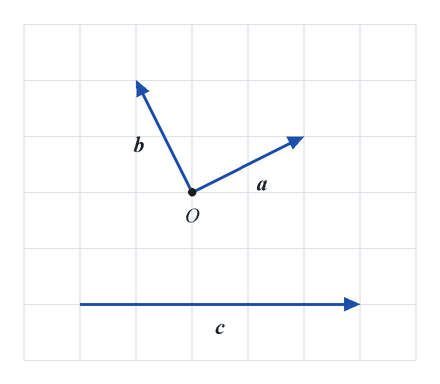
Which relation is correct?
- 281 mark
Question 28
Competency: Application & Analysis
A drone's camera is pointed along a line that makes an angle of with due east () and an angle of with due north (). The camera points below the horizontal, towards the ground; points vertically up. (Hypothetical data.)
The angle between the camera direction and the upward vertical is
- 291 mark
Question 29
Competency: Analysis & Evaluation
A metal ring lies on a smooth horizontal table and is pulled by three ropes in that horizontal plane, with forces of magnitudes 3 N, 4 N and 8 N. The ring stays at rest only if the three forces add up to the zero vector. (Hypothetical data.)
Assertion (A): The three ropes can be pointed in suitable directions so that the ring stays at rest.
Reason (R): If three vectors add up to the zero vector, then the magnitude of each of them is at most the sum of the magnitudes of the other two.
- 301 mark
Question 30
Competency: Application
A rescue drone hovers at the point with position vector (in metres) from the base ; points east, north and vertically up. A beacon signal tells it to fly 26 m in a straight line in the direction of the vector . (Hypothetical data.)
The position vector of the drone after this flight is
- 311 mark
Question 31
Competency: Analysis & Evaluation
A camera tripod stands on level ground. From the top joint , which is above the ground, the three legs run to the feet , , on the ground. So the leg vectors , and are non-coplanar.
Assertion (A): .
Reason (R): If , , are non-coplanar vectors and , then .
- 321 mark
Question 32
Competency: Analysis
A flat solar-panel frame must rest on the tops of four posts , , , on a hillside. Measured in centimetres from a fixed point, the tops of three posts are at , and , and the fourth post stands at the horizontal position , ; the -axis points vertically up. The frame fits only if the four tops are coplanar. (Hypothetical data.)
The height of the top of post must be
- 332 marks
Question 33
Competency: Understanding & Application
After a morning walk, a fitness app shows these readings: time taken 30 min; distance walked 2.4 km; displacement 1.1 km towards the north-east; air temperature . (Hypothetical data.)
(a) Classify each of the four readings as a scalar or a vector, giving the reason for the displacement.
(b) The app also shows the average velocity (displacement divided by time). Find its magnitude and direction, and explain why it is smaller than the average speed.
- 342 marks
Question 34
Competency: Application & Analysis
A robot arm in a factory moves its tool by the same displacement (in cm) at every step. After 4 steps, the tool is at the point with position vector from the base of the arm. (Hypothetical data.)
(a) Find the position vector of the point where the tool started.
(b) Find the straight-line distance between the start and the finish, correct to one decimal place.
- 352 marks
Question 35
Competency: Creativity
A camera crane on a film set can move its camera only by displacements of the form , where and are its two motor directions and , are any real numbers.
(a) Suggest one displacement that the crane can make, other than a multiple of or of , and one displacement that it cannot make.
(b) Justify both choices using linear combinations.
- 363 marks
Question 36
Competency: Application
A straight metro line runs from station to station , whose position vectors from the city centre are and (in km; east, north). The line is to be extended beyond , along the same straight line, to a new terminal such that . (Hypothetical data.)
(a) Find the position vector of .
(b) Find the length of the extension , and check that .
(c) A new station is to be built at the mid-point of . Find its position vector.
- 373 marks
Question 37
Competency: Application & Analysis
A rectangular hall has one floor corner at . From , the edge vectors are along the length of the floor, along the width of the floor, and vertically up to the ceiling. For a festival, a streamer is stretched in a straight line from the floor corner to the centre of the ceiling. (Hypothetical data.)
(a) Express as a linear combination of , and .
(b) Express as a linear combination of , and .
(c) The hall is 6 m long, 4 m wide and 3 m high, so that , and . Find the length of the streamer, correct to two decimal places.
- 383 marks
Question 38
Competency: Application & Evaluation
A survey drone must climb at a steady speed of 12 m/s along a straight path that makes equal acute angles with due east () and due north (), and an angle of with the upward vertical (). (Hypothetical data.)
(a) Find the direction cosines of the path.
(b) Find the velocity vector of the drone.
(c) The flight log shows the velocity (in m/s). Decide, with reasons, whether this matches the planned flight.
- 395 marks
Question 39
Competency: Analysis & Evaluation
A drone survey team records four straight flights, each as a displacement vector from its own starting point. The unit is 10 m; points east, north and vertically up. (Hypothetical data.)
Flight East () North () Up () (a) Find the length of each flight in metres. Which two flights are equally long, and are they equal vectors?
(b) Identify two flights that are collinear vectors. Say whether they are like or unlike, and write one as a multiple of the other.
(c) Show that , and are coplanar. A team member then claims that , and must also be coplanar. Decide whether the claim is correct.
- 405 marks
Question 40
Competency: Application & Analysis
The figure shows a triangular roof truss with a span of 8 m and its apex 3 m above the mid-point of . A strut joins to the point of with , and a second strut joins to the mid-point of . The two struts are bolted together where they cross, at . Take as the origin, and . (Hypothetical data.)
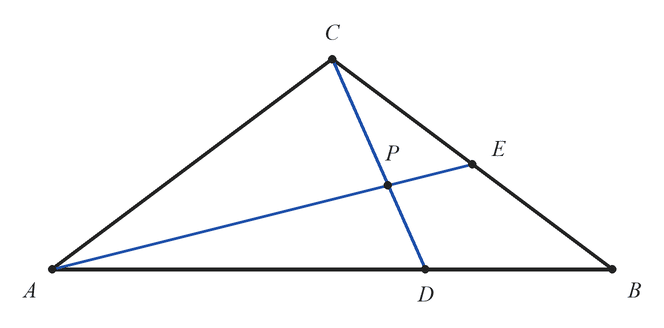
(a) Express , and in terms of and .
(b) Writing and also , find and , and hence the ratios and .
(c) Take along and vertically up, in metres. Find the position vector of the bolt and the length , correct to two decimal places.