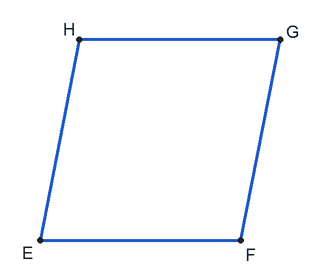
Key idea: In a parallelogram, opposite sides are equal in length, parallel and point the same way when taken in the same sense, so equal vectors can replace each other. Subtracting a vector means adding its negative, with −XY=YX, and vectors joined head to tail add by the triangle law XY+YZ=XZ.
Step 1 — Write down the equal vectors of the parallelogram.
In EFGH, side EF is opposite side HG and side EH is opposite side FG, so the vectors along them are equal.
EF=HG
EH=FG
Step 2 — Simplify part (i).
We replace EH by the equal vector FG, so that the two vectors join head to tail at F.
EF+EH=EF+FG
EF+FG=EG
This is the parallelogram law: the sum is the diagonal EG.
Step 3 — Simplify part (ii).
We write −EH as HE and put it first, so the path is H→E→F.
EF−EH=HE+EF
HE+EF=HF
Step 4 — Simplify part (iii).
We write −EF as FE and put it first, so the path is F→E→H.
EH−EF=FE+EH
FE+EH=FH
Step 5 — Simplify part (iv).
We reorder the sum so that the path is E→F→G.
FG+EF=EF+FG
EF+FG=EG
Step 6 — Simplify part (v).
We write −FE as EF and put it first, so the path is again E→F→G.
FG−FE=EF+FG
EF+FG=EG
Step 7 — Simplify part (vi).
We replace FG by the equal vector EH from Step 1; the expression then matches part (ii).
EF−FG=EF−EH
EF−EH=HF
Step 8 — Simplify part (vii).
We write −GH as HG and put it first, so the path is H→G→E.
GE−GH=HG+GE
HG+GE=HE
Step 9 — Simplify part (viii).
We write −HE as EH and put it first, so the path is E→H→G.
HG−HE=EH+HG
EH+HG=EG
Note: the book's answers print FH for part (iv) and GE for part (vi). As printed, part (iv) equals EG and part (vi) equals HF, as shown above; FH would be the value of FG−EF.
Therefore, (i) EG, (ii) HF, (iii) FH, (iv) EG, (v) EG, (vi) HF, (vii) HE and (viii) EG.