
Opening your dashboard
Class 12 Maths Chapter 17 Vectors: Practice Questions
49 questions on Chapter 17, each worked through on its own page with the AI tutor. Class 12 Maths, ICSE 2026-27.
49 questions
1–4 marks · Mixed difficulty
- 11 mark
Question 1
Which one of the following is a vector quantity?
- 21 mark
Question 2
Let be a non-zero vector and the unit vector in the direction of . Which of the following is not true?
- 31 mark
Question 3
Which one of the following statements is true?
- 43 marks
Question 4
State whether each statement is true or false. Give a reason or a counter-example.
(i) Any two vectors are coplanar.
(ii) Any three vectors are coplanar.
(iii) The sum of two unit vectors is always a unit vector.
- 53 marks
Question 5
Let be a non-zero vector. Find all real values of for which the vector is
(i) the zero vector;
(ii) a vector like (same direction as );
(iii) a vector unlike whose magnitude is twice the magnitude of .
- 61 mark
Question 6
is a parallelogram. Which pair of vectors are equal?
- 72 marks
Question 7
Given , find the vector reciprocal to , in terms of , and find its magnitude.
- 81 mark
Question 8
How many unit vectors are parallel to a given non-zero vector ?
- 91 mark
Question 9
, and are the mid-points of the sides , and of .

Then equals
- 103 marks
Question 10
Two vectors and have magnitudes and respectively. Find the greatest and the least possible values of and of , stating in each case whether and must then be like or unlike vectors.
- 112 marks
Question 11
The diagonals of a parallelogram meet at , and is any point.

Prove that
- 123 marks
Question 12
Using vectors, prove that the line segment joining the mid-points of two sides of a triangle is parallel to the third side and equal to half of it.
- 132 marks
Question 13
Find the vectors and , in terms of the given vectors and , if
- 141 mark
Question 14
If and are non-zero vectors such that , then and must be
- 153 marks
Question 15
In a quadrilateral , and are the mid-points of the diagonals and respectively.
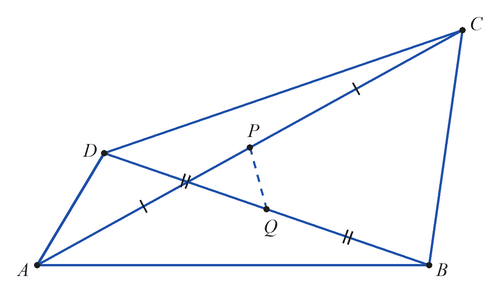
Prove that
- 163 marks
Question 16
In the figure, is a parallelogram with and (marked a and b). is the mid-point of , and is the point on such that .
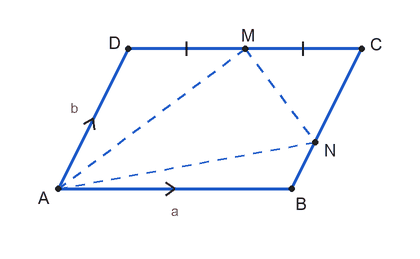
Express , and in terms of and .
- 171 mark
Question 17
Let be a non-zero vector and a real number. The vector is a unit vector if and only if
- 181 mark
Question 18
The position vectors of the points and are and respectively. Then is
- 193 marks
Question 19
The position vectors of the vertices , , of a triangle are , , .
(i) Using the section formula, show that the centroid of the triangle has position vector .
(ii) Hence prove that .
- 201 mark
Question 20
The points and have position vectors and . The point with position vector divides
- 213 marks
Question 21
Let and be non-collinear vectors. The points , and have position vectors , and respectively, and lies on the line . Find the ratio in which divides , and state whether the division is internal or external.
- 222 marks
Question 22
In , and . The point lies on with , and is the mid-point of .
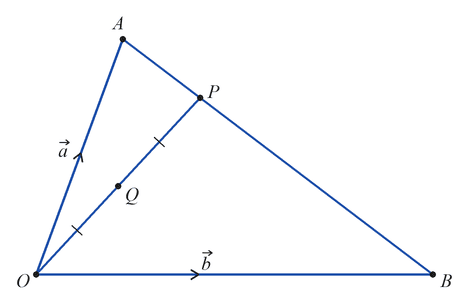
Express in terms of and .
- 231 mark
Question 23
The points and have position vectors and . divides internally and divides externally, both in the ratio . Then is
- 244 marks
Question 24
is a parallelogram and is the mid-point of . The line segment meets the diagonal at . Using vectors, prove that and .
- 253 marks
Question 25
Using position vectors, prove that the mid-points of the sides of any quadrilateral are the vertices of a parallelogram.
- 261 mark
Question 26
If and , then the vector written as a linear combination of and is
- 271 mark
Question 27
and are two non-collinear vectors such that . Then
- 283 marks
Question 28
Express the vector as a linear combination of the vectors , and .
- 293 marks
Question 29
and are non-collinear vectors, and , .
(i) Express and as linear combinations of and .
(ii) Hence express in terms of and .
- 301 mark
Question 30
A vector in the -plane has magnitude units and makes an angle of with the positive direction of the -axis (measured anticlockwise). Its scalar components along and are
- 313 marks
Question 31
is a regular hexagon with and . Express each of the following as a linear combination of and .
(i) (ii) (iii)
- 321 mark
Question 32
The scalar components of are , and , and is the point . Then the point and are
- 333 marks
Question 33
Let , and . Express the unit vector as a linear combination of , and .
- 341 mark
Question 34
Which of the following can be the direction cosines of a vector?
- 351 mark
Question 35
The angle that the vector makes with the positive direction of the -axis is
- 361 mark
Question 36
The direction cosines of a vector are , and , where . Then equals
- 372 marks
Question 37
Can a vector make the following angles with the positive -, - and -axes? Give reasons.
(i) , ,
(ii) , ,
- 382 marks
Question 38
Find the angles which the vector makes with the positive directions of the coordinate axes.
- 392 marks
Question 39
A vector makes angles , , with the positive -, - and -axes. Prove that .
- 403 marks
Question 40
The direction cosines of a vector satisfy and .
(i) Find the direction cosines of , given that makes an acute angle with the -axis.
(ii) If , find .
- 413 marks
Question 41
The direction ratios of are , the point is and units. Find the possible coordinates of .
- 421 mark
Question 42
is the origin and , are distinct points such that does not lie on the line . If and the points , , are collinear, then equals
- 431 mark
Question 43
Which of the following points lies on the line through and ?
- 443 marks
Question 44
and are non-collinear vectors. The points , , have position vectors , and respectively. Show that , , are collinear, and find the ratio .
- 452 marks
Question 45
and are non-collinear vectors. Find the value of for which the vectors and are collinear.
- 461 mark
Question 46
Which of the following sets of vectors is coplanar?
- 473 marks
Question 47
Show that the four points , , and are coplanar.
- 484 marks
Question 48
, , are three non-coplanar vectors.
(i) Show that the vectors , and are coplanar.
(ii) Show that the vectors , and are non-coplanar.
- 494 marks
Question 49
Let and .
(i) Show that is coplanar with and , and express as a linear combination of and .
(ii) Show that is not coplanar with and .