
Opening your dashboard
Class 11 Physics Chapter 8: Uniform Circular Motion Solutions
51 textbook questions with step-by-step answers, free to read, for ISC 2026-27.
Get talked through Ch 8, not just shown the answer
Reading a finished solution is not the same as being able to do it. The AI tutor takes one question at a time and works it with you, in your own words, until you can.
- Ask it out loud, in your own words
- It gives you the next step, not the answer
- Stuck on part (ii)? Start there
51 questions with solutions
1–5 marks · Mixed difficulty
The first 32 solutions are on this page. This chapter is a long one, so the rest open on their own page to keep this one quick to load.
- 11 mark
Question 1
A particle revolves round a circular path with uniform speed. The acceleration of the particle is
Solve with AIAnswer
(A) along the circumference of the circle
(B) along the tangent
- Correct
(C) along the radius
(D) zero
Answer: (C) along the radius
Concept: In uniform circular motion the speed is constant but the direction of the velocity changes all the time. The acceleration that produces this change, , points along the radius towards the centre.
Step 1 — Decide whether there is an acceleration. The direction of the velocity keeps changing, so the velocity changes and the particle has an acceleration.
Step 2 — Find its direction. The speed does not change, so the acceleration has no part along the path. It acts at right angles to the velocity, that is, along the radius towards the centre (the centripetal acceleration).
Step 3 — Check the other options. Each of the other options fails for a definite reason:
- (A) The circumference is the path itself; an acceleration along the path would change the speed, which stays uniform here.
- (B) The tangent gives the direction of the velocity, and an acceleration along it would speed the particle up or slow it down.
- (D) The velocity keeps changing direction, so the acceleration cannot be zero.
Therefore, the acceleration of the particle is along the radius, towards the centre of the circle.
- 21 mark
Question 2
A body of mass is moving in a circle of radius with a constant speed . The work done by the centripetal force in moving the body over half the circumference of the circle is
Solve with AIAnswer
(A)
- Correct
(B) zero
(C)
(D)
Answer: (B) zero
Concept: The work done by a force is , where is the angle between the force and the displacement. A force at right angles to the motion does no work.
Step 1 — Find the angle between force and motion. At every instant the centripetal force points along the radius, while the body moves along the tangent. So the angle between them is always .
Step 2 — Add up the work. For each small displacement along the path the work done is . Adding these zeros over half the circumference still gives zero.
Step 3 — Check the other options. Each of the other options fails for a definite reason:
- (A) The unit of is (joule metre), which is not a unit of work.
- (C) This is the size of the centripetal force itself, not the work it does.
- (D) This expression has the unit per joule, so it cannot be a work.
Watch out: Do not multiply the force by the diameter (the net displacement after half a turn). The force changes direction as the body moves and is at right angles to every small step.
Therefore, the work done by the centripetal force is zero.
- 31 mark
Question 3
A mass is supported on a frictionless horizontal surface. It is attached to a string and rotates about a fixed centre with an angular velocity . If the length of the string and angular velocity are doubled, the tension in the string which was initially is now
Solve with AIAnswer
(A)
(B)
(C)
- Correct
(D)
Answer: (D)
Concept: The tension in the string supplies the centripetal force. For a mass going round a circle of radius (the length of the string) with angular velocity , this force is .
Step 1 — Write the first tension. We put the length and the angular velocity into :
Step 2 — Write the new tension. We put for the length and for the angular velocity:
Step 3 — Check the other options. Each of the other options fails for a definite reason:
- (A) Both changes increase the tension, so it cannot stay at .
- (B) A smaller tension would need a shorter string or a slower rotation, but both are increased.
- (C) Doubling only gives ; this forgets that the length is doubled too.
Therefore, the new tension in the string is .
- 41 mark
Question 4
Certain extremely dense neutron stars are believed to be rotating at about 1 rev/s. If such a star has a radius of 20 km, the acceleration of an object in m/s on the equator of the star will be
Solve with AIAnswer
- Correct
(A)
(B)
(C)
(D)
Answer: (A)
Concept: An object on the equator moves round a circle of radius (the star's radius) with angular velocity , where is the number of revolutions per second. Its centripetal acceleration is .
Step 1 — Write the data in SI units. The star makes one revolution per second, so .
Its radius is 20 km, so in metres .
Step 2 — Substitute. We write the acceleration in terms of and then put in the values:
Taking , as such estimates often do, gives exactly , which is option (A).
Step 3 — Check the other options. Each of the other options fails for a definite reason:
- (B) This equals the radius in metres, ; it leaves out the factor .
- (C) This is about 15 times the value given by .
- (D) This is , which is not even in the units of an acceleration.
Therefore, the acceleration on the equator of the star is about .
- 51 mark
Question 5
A particle rests on the top of a hemisphere of radius . Find the smallest horizontal velocity that must be imparted to the particle if it is to leave the hemisphere without sliding down it
Solve with AIAnswer
- Correct
(A)
(B)
(C)
(D)
Answer: (A)
Concept: To move along the curved top of the hemisphere with speed , the particle needs a net downward (centripetal) force . Only its weight (down) and the normal reaction (up) act on it, and can never be negative.
Step 1 — Write the equation at the top. If the particle stays on the surface at the top, the net downward force is the centripetal force:
Step 2 — Find when it leaves the surface. The particle leaves the surface at once (instead of sliding down it) when no push from the surface is needed, that is, when or less. Setting gives the smallest such speed:
At this speed the weight alone just supplies the centripetal force, so the surface need not push at all; at any greater speed the weight is not enough to bend the path as sharply as the surface curves. Either way the particle moves off along a parabola that stays clear of the hemisphere, instead of sliding down it.
Step 3 — Check the other options. Each of the other options fails for a definite reason:
- (B) is the speed a body gains by falling freely through a height ; it is more than the smallest speed needed.
- (C) is also larger than needed; the particle leaves at already.
- (D) is the least speed a body on a string needs at the lowest point to complete a vertical circle, a different situation.
Therefore, the smallest horizontal velocity is .
- 61 mark
Question 6
A particle is moving in a circle with uniform speed. It has constant
Solve with AIAnswer
(A) velocity
(B) acceleration
- Correct
(C) kinetic energy
(D) displacement
Answer: (C) kinetic energy
Concept: In uniform circular motion only the magnitude of the velocity (the speed) stays constant; every vector quantity that points along the tangent or the radius keeps changing direction.
Step 1 — Find the constant quantity. The kinetic energy depends only on the speed, which is uniform, so it stays constant.
Step 2 — Check the other options. Each of the other options fails for a definite reason:
- (A) The velocity is along the tangent, and its direction keeps changing.
- (B) The acceleration always points to the centre, so its direction keeps changing as the particle goes round.
- (D) The displacement from the starting point keeps changing in both size and direction as the particle moves.
Therefore, the particle has constant kinetic energy.
- 71 mark
Question 7
A car moving on a horizontal road may be thrown out of the road in taking a turn
Solve with AIAnswer
(A) by the gravitational force
- Correct
(B) due to the lack of proper centripetal force
(C) due to the rolling frictional force between the tyre and road
(D) due to the reaction of the ground
Answer: (B) due to the lack of proper centripetal force
Concept: On a level road the centripetal force needed for a turn comes only from the sideways friction of the road on the tyres, and this friction cannot exceed its limiting value.
Step 1 — See when the car skids out. If the car is too fast or the turn too sharp, becomes larger than the friction the road can give. The force towards the centre is then not enough.
Step 2 — See what happens. Without enough force towards the centre, the car cannot follow the curve; by its inertia it moves off along a wider path and is thrown out of the road.
Step 3 — Check the other options. Each of the other options fails for a definite reason:
- (A) Gravity acts vertically downwards, so it has no sideways part that could push the car off the road.
- (C) Rolling friction acts along the path, against the rolling of the tyres, so it only slows the car down and has no outward part. The sideways friction that does act on a turn points towards the centre and holds the car on the curve rather than throwing it out.
- (D) The normal reaction of a level road acts vertically upwards, so it also has no sideways part.
Therefore, the car is thrown out of the road because of the lack of proper centripetal force.
- 81 mark
Question 8
A particle is taken round a circle by the application of force. The work done by the force is
Solve with AIAnswer
(A) positive non-zero
(B) negative non-zero
- Correct
(C) zero
(D) none of the above
Answer: (C) zero
Concept: The force that takes a particle round a circle at steady speed is the centripetal force, directed along the radius. The work is zero when the force is at right angles to the displacement, because is zero.
Step 1 — Find the angle between the force and the motion. The force points to the centre, while each small displacement is along the tangent, so the angle between them is at every point.
Step 2 — Find the work. Since , the force does no work on any small step, and so none over the whole circle. This also agrees with the speed, and so the kinetic energy, staying the same.
Step 3 — Check the other options. Each of the other options fails for a definite reason:
- (A) Positive work would increase the kinetic energy, but the speed does not change.
- (B) Negative work would decrease the kinetic energy, which also does not happen.
- (D) Option (C) is correct, so "none of the above" cannot be.
Therefore, the work done by the force is zero.
- 91 mark
Question 9
The rider in circus rides along a circular track in a vertical plane. The minimum velocity at the highest point of the track will be
Solve with AIAnswer
(A)
(B)
(C)
- Correct
(D)
Answer: (D)
Concept: At the highest point of a vertical loop of radius , both the rider's weight and the push of the track act downwards, towards the centre. Together they supply the centripetal force , and cannot be negative.
Step 1 — Write the equation at the top. At the highest point:
Step 2 — Find the least speed. The speed is least when the track just stops pushing, ; then the weight alone supplies the centripetal force:
At any lower speed the weight would be more than the force needed, and the rider would fall away from the track.
Step 3 — Check the other options. Each of the other options fails for a definite reason:
- (A) is the speed gained by falling freely through a height ; it is more than the least speed at the top.
- (B) is the speed the rider has at the level of the centre when the speed at the top is the minimum .
- (C) is the least speed needed at the lowest point of the loop, not at the highest.
Therefore, the minimum velocity at the highest point of the track is .
- 101 mark
Question 10
A particle is moving in a circular path with a constant speed . If is the angular displacement, then starting from , the maximum and minimum changes in the momentum will occur, when value of is respectively
Solve with AIAnswer
(A) and
(B) and
- Correct
(C) and
(D) and
Answer: (C) and
Concept: The momentum keeps the same size but turns with the particle. After an angular displacement the two momentum vectors, each of size , are at angle to each other, so the size of the change is .
Step 1 — Find the largest change. is largest (equal to 1) when , that is, . Then the momentum has reversed:
Step 2 — Find the smallest change. After one full turn, , the particle is back with the same momentum, so :
Step 3 — Check the other options. Each of the other options fails for a definite reason:
- (A) At the change is about and at about ; neither is the largest () or the smallest (zero).
- (B) At the change is about , not the largest; at it is the largest, not the smallest.
- (D) At and at the change is the same, about , which is neither the largest nor the smallest.
Therefore, the change in momentum is greatest at and least at .
- 111 mark
Question 11
For traffic moving at 60 km/hour along a circular track of radius 0.1 km, the correct angle of banking is
Solve with AIAnswer
(A)
- Correct
(B)
(C)
(D)
Answer: (B)
Concept: On a road banked at angle , the horizontal part of the normal reaction supplies the centripetal force when , with in , in m and in .
Step 1 — Convert the data to SI units. The speed is :
The radius is (0.1 km).
Step 2 — Substitute. We put these values into :
This is about .
Step 3 — Check the other options. Each of the other options fails for a definite reason:
- (A) This uses km/h and km without converting, leaves out and , and gives the number 36,000, which is not an angle.
- (C) This turns the ratio upside down. The angle is the complement of the banking angle, about instead of .
- (D) This takes the square root of a product of the speed, radius and instead of the ratio , and gives about , far too steep.
Therefore, the correct angle of banking is , about .
- 121 mark
Question 12
A 1 kg stone at the end of 1 m long string is whirled in a vertical circle at constant speed of 4 m/s. The tension in the string is 6 N when the stone is at ()
Solve with AIAnswer
- Correct
(A) top of the circle
(B) bottom of the circle
(C) half way down
(D) none of the above
Answer: (A) top of the circle
Concept: At every point the net force towards the centre must equal , and this stays the same all round the circle because the speed is constant.
Step 1 — Find the force needed towards the centre. We put , and into :
Step 2 — Find the tension at the top. At the top, the tension and the weight both point down, towards the centre:
This matches the given tension.
Step 3 — Check the other options. Each of the other options fails for a definite reason:
- (B) At the bottom the tension must balance the 10 N weight and also supply the 16 N towards the centre, so it is 26 N.
- (C) Half way down the string is horizontal and the weight acts along the tangent, so the tension alone supplies the centripetal force, .
- (D) The tension is at the top, so (A) is correct.
Therefore, the tension is 6 N when the stone is at the top of the circle.
- 131 mark
Question 13
A car when passes through a convex bridge, the force exerted by the road on the car at the highest point is equal to
Solve with AIAnswer
(A)
(B)
- Correct
(C)
(D) none of these
Answer: (C)
Concept: At the top of a convex (upward-curved) bridge of radius , the centre of the curve is below the car. The net force on the car must point down, towards that centre, and equal .
Step 1 — Write the equation at the top. The weight acts down and the reaction of the road acts up, so the net downward force is the centripetal force:
Step 2 — Find the reaction. We make the subject:
So the road pushes up with less than the weight, and the car presses less on the bridge than on a level road.
Step 3 — Check the other options. Each of the other options fails for a definite reason:
- (A) is the reaction at the lowest point of a dip (a concave road), where the centre of the curve is above the car.
- (B) is the net force on the car, not the force exerted by the road.
- (D) Option (C) gives the force correctly, so "none of these" is wrong.
Therefore, the force exerted by the road on the car at the highest point is .
- 141 mark
Question 14
Two particles of equal masses are revolving in circular paths of radii and respectively with the same period. The ratio of their centripetal force is
Solve with AIAnswer
- Correct
(A)
(B)
(C)
(D)
Answer: (A)
Concept: The centripetal force is , and the angular velocity is fixed by the period through . With the same mass and the same period, is proportional to .
Step 1 — Write the two forces. We put into the force formula for each particle:
Step 2 — Divide. Dividing the first by the second, , and cancel:
Step 3 — Check the other options. Each of the other options fails for a definite reason:
- (B) No square root appears: with the period fixed, is simply proportional to , and this option also has the radii the wrong way round.
- (C) This would need to be proportional to , but is proportional to itself.
- (D) This would make the force smaller on the larger circle; with equal periods the larger circle needs the larger force.
Therefore, the ratio of their centripetal forces is .
- 151 mark
Question 15
A particle of mass is moving in a horizontal circle of radius with uniform speed . When it moves from one point to a diametrically opposite point, its
Solve with AIAnswer
(A) kinetic energy change by
(B) momentum does not change
- Correct
(C) momentum changes by
(D) kinetic energy changes by
Answer: (C) momentum changes by
Concept: At diametrically opposite points of a circle the tangents are parallel, and a particle going round moves in opposite directions there. Momentum is a vector, while kinetic energy depends only on the speed.
Step 1 — Find the change in momentum. The momentum changes from in one direction to in the opposite direction. Taking the first direction as positive:
Step 2 — Find the change in kinetic energy. The speed is at both points, so the kinetic energy is the same, and its change is zero.
Step 3 — Check the other options. Each of the other options fails for a definite reason:
- (A) The speed is the same at both points, so the kinetic energy does not change at all, by or by any other amount.
- (B) The momentum reverses its direction, so it does change.
- (D) The kinetic energy is at both points, so its change is zero, not .
Therefore, the momentum changes by .
- 161 mark
Question 16
Can a body have a constant speed and variable acceleration?
Solve with AIWritten solution
Solution:
Concept: Acceleration is the rate of change of velocity, and velocity has both size and direction. It can change even when the speed stays the same.
Step 1 — Take uniform circular motion. A body going round a circle at constant speed has an acceleration that always points towards the centre.
Step 2 — See that this acceleration varies. Its size stays the same, but its direction turns as the body goes round, so the acceleration is variable.
Therefore, yes; a body in uniform circular motion has a constant speed and a variable acceleration.
- 171 mark
Question 17
What provides the centripetal force (i) to satellite revolving round the Earth and (ii) for the electrons going round the nucleus?
Solve with AIWritten solution
Solution:
Concept: The centripetal force is not a new kind of force; it is supplied by some real force that pulls the body towards the centre of its path.
Step 1 — Find the force on the satellite. The satellite is pulled towards the centre of the Earth by the Earth's gravity, and this pull keeps it on its orbit.
Step 2 — Find the force on the electron. The negatively charged electron is attracted towards the positively charged nucleus (a single proton in a hydrogen atom) by the electrostatic force.
Therefore, (i) the gravitational pull of the Earth on the satellite and (ii) the electrostatic force of attraction between the nucleus and the electron provide the centripetal forces.
- 181 mark
Question 18
What provides the centripetal force to a car taking a turn on a level road?
Solve with AIWritten solution
Solution:
Concept: On a level road the normal reaction and the weight are both vertical, so the only horizontal force on the car is the sideways friction of the road on the tyres.
Step 1 — Find the horizontal force. When the car turns, its tyres tend to slide outwards; the road opposes this with a sideways static friction force on the tyres, directed towards the centre of the curve.
Therefore, the force of friction between the tyres and the road provides the centripetal force.
- 191 mark
Question 19
A pilot does not fall down when his aeroplane loops the loop. Why?
Solve with AIWritten solution
Solution:
Concept: At the top of a vertical loop of radius , the pilot needs a net downward force to stay on the circle. The pilot's weight and the push of the seat both act downwards there.
Step 1 — Write the equation at the top. At the highest point the pilot is upside down, and both forces point towards the centre of the loop:
Step 2 — See why the pilot does not fall. The plane flies fast enough that is at least . Then the whole of the pilot's weight is used up in providing the centripetal force, and the seat may even have to push the pilot down as well; nothing is left over to pull the pilot away from the seat.
Step 3 — Describe it in the frame of the plane. In the frame of the plane, an outward centrifugal force acts on the pilot. It is at least as large as the weight, so it balances the weight together with the push of the seat, and the pilot stays pressed into the seat.
Note: the book's hint says that "the weight of the pilot is balanced by the centripetal force"; it means that the weight is fully used as the centripetal force, since no separate centripetal force acts besides the weight and the push of the seat.
Therefore, the pilot does not fall because at the highest point the pilot's weight is used up in providing the centripetal force needed to move in the loop (the plane's speed makes ).
- 201 mark
Question 20
Which region of the Earth experiences maximum centripetal force?
Solve with AIWritten solution
Solution:
Concept: Every point on the Earth goes round the Earth's axis once a day with the same angular velocity , on a circle whose radius is its distance from the axis. The centripetal force is .
Step 1 — Compare the radii. The distance from the axis is largest at the equator (equal to the Earth's radius) and falls to zero at the poles.
Step 2 — Compare the forces. With the same , the force is largest where is largest.
Therefore, the region at the equator experiences the maximum centripetal force.
- 211 mark
Question 21
Which has greater angular velocity: (i) rotation of the hour hand of watch; (ii) rotation of the Earth around its axis?
Solve with AIWritten solution
Solution:
Concept: For uniform rotation, angular velocity is , so the body with the shorter period has the greater angular velocity.
Step 1 — Compare the periods. The hour hand goes round once in 12 hours. The Earth turns once about its axis in about 24 hours.
Step 2 — Compare the angular velocities. We divide by each period:
So the hour hand turns twice as fast as the Earth.
Therefore, (i) the hour hand of the watch has the greater angular velocity, because its period (12 hours) is half that of the Earth's rotation (about 24 hours).
- 221 mark
Question 22
What is the direction of the angular velocity of the minute hand of a clock?
Solve with AIWritten solution
Solution:
Concept: The angular velocity vector lies along the axis of rotation. Its sense is given by the right-hand rule: curl the fingers of the right hand in the sense of rotation, and the thumb points along .
Step 1 — Find the sense of rotation. Seen from the front, the minute hand turns clockwise.
Step 2 — Apply the right-hand rule. With the fingers curled clockwise as seen from the front, the thumb points away from the viewer, into the clock face.
Therefore, the angular velocity of the minute hand is perpendicular to the plane of the clock face, pointing into the clock (away from a person looking at it).
- 232 marks
Question 23
What is the difference between uniform circular motion and non-uniform circular motion?
Solve with AIWritten solution
Solution:
Concept: In any circular motion the direction of the velocity changes all the time. What separates the two kinds is whether the speed also changes.
Step 1 — Describe uniform circular motion. In uniform circular motion the particle moves with constant speed, so it covers equal distances along the circle in equal intervals of time. Its only acceleration is the centripetal acceleration towards the centre.
Step 2 — Describe non-uniform circular motion. In non-uniform circular motion the speed of the particle is different at different points of the path, so it covers unequal distances in equal times. Besides the centripetal acceleration it has a tangential acceleration along the path (for example, a stone whirled in a vertical circle).
Therefore, in uniform circular motion the speed is constant (equal distances in equal times), while in non-uniform circular motion the speed changes from point to point, giving a tangential acceleration as well as the centripetal one.
- 242 marks
Question 24
A particle in a circular motion covers a distance of , where is the radius of the circular path. What is the angular displacement?
Solve with AIWritten solution
Solution:
Concept: The angular displacement (in radians) is the arc length divided by the radius: . The figure shows the arc and the angle it makes at the centre.
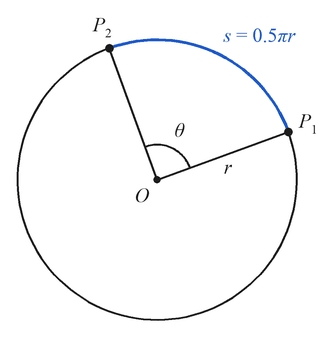
Step 1 — Substitute. We put the given arc length, , in place of in this formula:
Step 2 — Convert to degrees. Since , we have .
Therefore, the angular displacement is radian ().
- 252 marks
Question 25
Why do we express the angular displacement in radian?
Solve with AIWritten solution
Solution:
Concept: One radian is the angle at the centre made by an arc equal in length to the radius. So, in radians, the angle is simply arc divided by radius: .
Step 1 — Write the link between arc and angle. With in radians, the length of an arc is
The figure shows the arc and the angle .
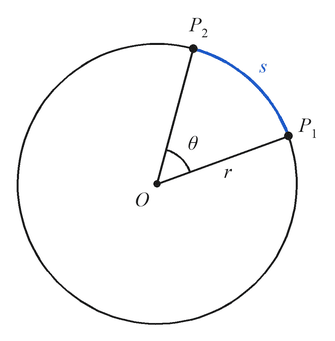
Step 2 — See why radians are needed. This simple relation holds only when is in radians. In degrees an extra factor would be needed, . Using radians keeps the relations between linear and angular quantities simple: , and .
Therefore, we express angular displacement in radians because only then does the plain relation (and so ) hold, letting us convert angular displacement directly into linear displacement.
- 262 marks
Question 26
Define angular velocity? Is it scalar or vector, give its direction?
Solve with AIWritten solution
Solution:
Concept: Angular velocity tells how fast the radius vector of a particle turns about the centre of its path.
Step 1 — Define it. The angular velocity of a particle is the rate of change of its angular displacement with time:
For uniform motion this is . Its SI unit is .
Step 2 — Say whether it is a vector. Angular velocity is a vector. It acts along the axis of rotation, perpendicular to the plane of the circle. Its sense is given by the right-hand rule: if the fingers of the right hand curl in the sense of rotation, the thumb points along , as the figure shows.

Therefore, angular velocity is the rate of change of angular displacement, ; it is a vector directed along the axis of rotation, perpendicular to the plane of rotation, in the sense given by the right-hand rule.
- 272 marks
Question 27
What is the relation connecting linear displacement and angular displacement?
Solve with AIWritten solution
Solution:
Concept: When a particle moves along a circle of radius , the distance it covers along the arc (its linear displacement along the path) and the angle turned by its radius (in radians) are linked through the definition of the radian.
Step 1 — Use the definition of the radian. An angle in radians is the arc divided by the radius:
Step 2 — Rearrange. Multiplying both sides by gives the relation:
Therefore, linear displacement = radius × angular displacement, that is, (with in radians).
- 282 marks
Question 28
Define period and frequency of a body in uniform circular motion.
Solve with AIWritten solution
Solution:
Concept: In uniform circular motion the body repeats its motion after every complete revolution.
Step 1 — Define the period. The time period is the time taken by the body to complete one revolution. Its SI unit is the second.
Step 2 — Define the frequency. The frequency is the number of revolutions the body completes in one second. Its SI unit is (revolutions per second, or hertz).
Step 3 — Link the two. One revolution takes seconds, so the number of revolutions per second is:
Since one revolution is radians, the angular velocity is then .
Therefore, the period is the time taken for one complete revolution, and the frequency is the number of revolutions made in one second; .
- 292 marks
Question 29
What is the relation connecting linear velocity and angular velocity?
Solve with AIWritten solution
Solution:
Concept: For a particle on a circle of radius , the arc covered and the angle turned are linked by , with in radians.
Step 1 — Start from the arc relation. As the particle moves, the arc it has covered and the angle turned by its radius are related by:
Step 2 — Differentiate with respect to time. The radius is constant, so:
Here is the linear speed along the tangent and is the angular velocity :
The figure shows the radius , the angle , the arc and the velocity along the tangent.
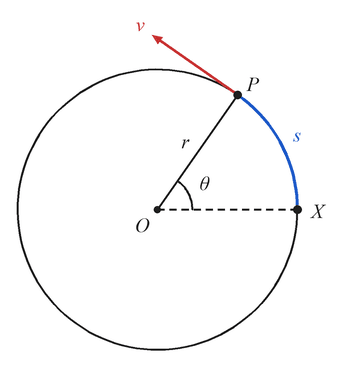
Therefore, linear velocity = radius × angular velocity, ; the linear velocity is directed along the tangent to the circle.
- 302 marks
Question 30
Define angular acceleration. Give its S.I. unit.
Solve with AIWritten solution
Solution:
Concept: Angular acceleration describes how quickly the angular velocity of a rotating body changes.
Step 1 — Define it. The angular acceleration is the rate of change of angular velocity with time:
Step 2 — Find its unit. Angular velocity is in and time in seconds, so is in .
Therefore, angular acceleration is the rate of change of angular velocity with time, and its S.I. unit is .
- 312 marks
Question 31
What is the angular velocity of the minute hand of a clock?
Solve with AIWritten solution
Solution:
Concept: For uniform rotation, . In one full turn the angle turned is radians.
Step 1 — Find the period. The minute hand makes one full turn in 60 minutes:
Step 2 — Find the angular velocity. We divide radians by this time:
Note: the book's printed answer is ; that is the angular velocity of the second hand (one turn in 60 s). The minute hand takes 3600 s for one turn, so its angular velocity is . The book's number would be right in radians per minute.
Therefore, the angular velocity of the minute hand is , about .
- 322 marks
Question 32
What is centripetal acceleration? Why is it called so?
Solve with AIWritten solution
Solution:
Concept: A particle moving round a circle at constant speed keeps changing the direction of its velocity, so it has an acceleration even though its speed is constant.
Step 1 — Define it. The acceleration of a particle moving along a circular path with constant speed is called centripetal acceleration. For a speed on a circle of radius , its magnitude is:
Since , where is the angular velocity, the same magnitude can also be written as:
Step 2 — Explain the name. This acceleration is always directed along the radius towards the centre of the circle. "Centripetal" means "centre-seeking", so the name describes its direction.
Therefore, centripetal acceleration is the acceleration of a particle moving round a circle with constant speed; it is called so because it is always directed towards the centre of the circle.
- 332 marks
Question 33
What is centripetal force? Give its direction.
- 342 marks
Question 34
Define centripetal force. What is the work done by the centripetal force on a body moving along a circular path?
- 352 marks
Question 35
A passenger in a car moving round a curved road is thrown towards the outside of the curve. What force throws him in this direction?
- 362 marks
Question 36
Give a probable reason for the bulging of the Earth at the equator.
- 372 marks
Question 37
"A mass is attached to one end of a spring and by holding the other end in hand, the spring is whirled in a horizontal circle". What happens to the length of the spring?
- 382 marks
Question 38
A bucket of water can be swung in a vertical circle without spilling water. Why does the water stay in even when the bucket is above your head?
- 392 marks
Question 39
Centrifuges are used to separate the cream from the milk. What remains near the axis of rotation?
- 402 marks
Question 40
"A cyclist wants to go round a curve at higher speed". If he wants to avoid overturning, what should he do?
- 412 marks
Question 41
What is meant by banking of road? Why should we do that?
- 422 marks
Question 42
On what values does the angle of banking depend?
- 432 marks
Question 43
Why does a child in merry-go-round press the sides of his seat radially outwards?
- 442 marks
Question 44
Why is it more difficult to rotate a stone by tying it to a longer string than a shorter string?
- 453 marks
Question 45
Define angular displacement, angular velocity and angular acceleration. Is angular velocity scalar or vector? If vector show its direction.
- 463 marks
Question 46
Derive the relation connecting (i) linear velocity and angular velocity and (ii) linear acceleration and angular acceleration. What is the value of the tangential component of the linear acceleration for a body in uniform circular motion?
- 473 marks
Question 47
Explain banking of rails. Obtain an expression for the maximum speed with which a train can move on the banked rails. By what height should the outer rail be raised to avoid flange pressure?
- 483 marks
Question 48
Discuss the motion of a body in a vertical circle. Show that the difference in the tensions at the lowest and highest point is , where is the mass of the body.
- 495 marks
Question 49
(a) Show that a body moving along a circular path with uniform speed has an acceleration. Derive an expression for the centripetal acceleration.
(b) Define centripetal force. Derive an expression for it.
- 505 marks
Question 50
(a) Discuss the motion of a cyclist on a level road. Obtain an expression for the maximum speed with which the cyclist can move without skidding.
(b) To prevent overturning at a curved road, what should a cyclist do? By how much angle should he lean from the vertical? Derive an expression for it.
- 515 marks
Question 51
(a) What is meant 'banking of the road'?
(b) Discuss the motion of a car on a banked road.
(c) Obtain an expression for the maximum speed with which a car can turn safely on a banked road.
What Class 11 Physics Ch 8 covers
The sections of the chapter, in the order the book takes them. Every question above comes from one of these.
- 01Circular Motion and Angular Displacement
- 02Angular Velocity and Angular Acceleration
- 03Relation Between Linear and Angular Velocity
- 04Centripetal Acceleration
- 05Centripetal Force
- 06Centrifugal Force
More ways to study this chapter
The same chapter asked three other ways. Practise it, revise it, and see what the board has set on Ch 8 before.
Class 11 Physics Ch 8 questions students ask
How many questions are there in Class 11 Physics Ch 8?
51 questions. Every one is solved step by step on this page.
Are these Class 11 Physics solutions free?
Yes. Every question and its full working is free to read, with no account needed.
Can I download the Class 11 Physics Ch 8 solutions as a PDF?
There is no PDF to download. Every solution is on this page instead, which means it is searchable, always the current syllabus, and readable on a phone. Use your browser's print option if you want it on paper.