
Question 483 marksMedium
Discuss the motion of a body in a vertical circle. Show that the difference in the tensions at the lowest and highest point is , where is the mass of the body.
Confirming your payment
Sign up now and get 250 free tokens.
Uniform Circular Motion · Question 48 of 51
Discuss the motion of a body in a vertical circle. Show that the difference in the tensions at the lowest and highest point is , where is the mass of the body.
Solution:
Concept: A body of mass whirled on a string of length in a vertical circle moves under its weight and the tension of the string. Its speed changes from point to point, because kinetic energy changes into potential energy as it rises; at every point the net force towards the centre must be .
Step 1 — Describe the motion. The figure shows the body at the lowest point , with speed , and at the highest point , with speed . The body is fastest at and slowest at , so this is a non-uniform circular motion.
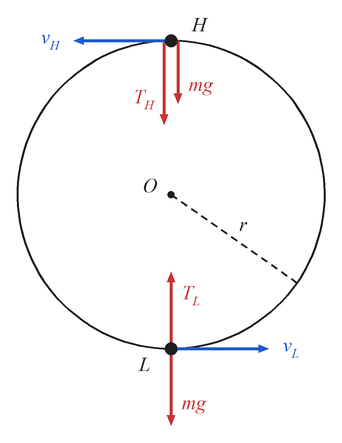
Step 2 — Write the equation at the lowest point. At the tension acts upwards (towards the centre ) and the weight acts downwards, so the net force towards the centre is:
Step 3 — Write the equation at the highest point. At both the tension and the weight act downwards, towards :
Step 4 — Relate the two speeds by energy conservation. Going from to the body rises through . The tension is always at right angles to the motion and does no work, so the loss of kinetic energy equals the gain of potential energy:
Step 5 — Subtract the two tensions. We subtract the expression for from that for :
Step 6 — Note the critical speeds. The string stays tight at the top only if the tension there is not negative:
Putting in the expression for from Step 3, this needs:
From Step 4, . With the least allowed speed at the top this gives:
So the body must have a speed of at least at the lowest point to complete the circle.
Therefore, in a vertical circle the speed is greatest at the lowest point and least at the highest point, and the tension at the lowest point exceeds that at the highest point by .