
Question 473 marksMedium
Explain banking of rails. Obtain an expression for the maximum speed with which a train can move on the banked rails. By what height should the outer rail be raised to avoid flange pressure?
Confirming your payment
Sign up now and get 250 free tokens.
Uniform Circular Motion · Question 47 of 51
Explain banking of rails. Obtain an expression for the maximum speed with which a train can move on the banked rails. By what height should the outer rail be raised to avoid flange pressure?
Solution:
Concept: A train going round a curve of radius at speed needs a centripetal force towards the centre. On level rails this force can only come from the outer rail pressing sideways on the flanges of the wheels, which wears the rails and the wheels.
Step 1 — Explain banking of rails. On a curve the outer rail is laid a little higher than the inner rail, so that the track is tilted at an angle to the horizontal. This is called banking of the rails. The normal reaction of the rails, at right angles to the track, then tilts towards the centre of the curve, as the figure shows.
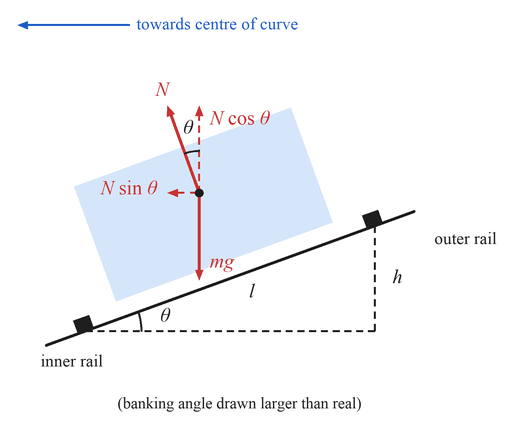
Step 2 — Resolve the normal reaction. The vertical part of balances the weight of the train, because the train does not rise or fall:
The horizontal part, towards the centre, supplies the centripetal force:
Step 3 — Find the speed. We divide the second equation by the first; and cancel:
At this speed the reaction of the rails alone supplies the centripetal force, so neither rail presses sideways on the flanges. If the train goes faster, the outer rail must press on the flanges to supply the extra force. So this is the greatest speed at which the train can go round without flange pressure on the outer rail:
Step 4 — Find the height of the outer rail. Let be the distance between the two rails (the gauge) and the height of the outer rail above the inner one. From the figure:
The angle of banking is small, so :
Therefore, banking of rails is raising the outer rail above the inner rail on a curve; the train can move without flange pressure up to , and, for the small angles of banking used on railways, the outer rail should be raised by , where is the distance between the rails.