Solution:
Concept: For a particle on a circle of radius r, the arc s measured from a fixed point X and the angle θ (in radians) turned by its radius are linked by s=rθ. The figure shows O, X, the particle at P, the arc s and the velocity v along the tangent.
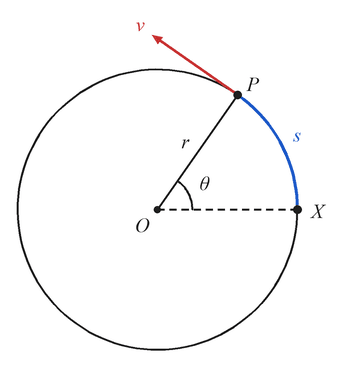
Step 1 — Write the arc relation. By the definition of the radian:
s=rθ
Step 2 — Derive the relation for velocities (part i). We differentiate with respect to time; r is constant:
dtds=rdtdθ
The rate dtds is the linear speed v along the tangent, and dtdθ is the angular velocity ω:
v=rω
The linear velocity is directed along the tangent at P.
Step 3 — Derive the relation for accelerations (part ii). We differentiate v=rω once more with respect to time:
dtdv=rdtdω
Here dtdv is the rate of change of speed along the path, the tangential acceleration aT, and dtdω is the angular acceleration α:
aT=rα
Step 4 — Find the tangential acceleration in uniform circular motion. In uniform circular motion the angular velocity ω is constant, so:
α=0
aT=r×0
aT=0
The body still has the centripetal acceleration rω2 towards the centre, but nothing along the tangent.
Therefore, (i) v=rω and (ii) aT=rα; for a body in uniform circular motion the tangential component of the linear acceleration is zero.
