
Question 453 marksMedium
Define angular displacement, angular velocity and angular acceleration. Is angular velocity scalar or vector? If vector show its direction.
Confirming your payment
Sign up now and get 250 free tokens.
Uniform Circular Motion · Question 45 of 51
Define angular displacement, angular velocity and angular acceleration. Is angular velocity scalar or vector? If vector show its direction.
Solution:
Concept: For a particle moving on a circle of radius about a centre , its position is fixed by the angle that its radius vector (the line from to the particle) makes with a fixed line. Angular quantities describe how this angle changes.
Step 1 — Define angular displacement. The angular displacement of a particle is the angle turned through by its radius vector in a given time. In the figure the particle moves from to along the arc , and the radius vector turns through the angle .
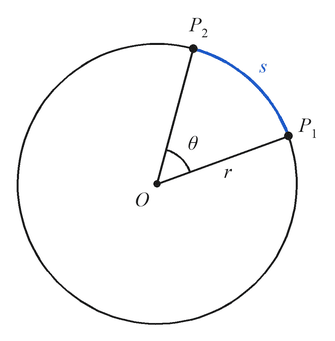
Measured in radians, the angle is the arc divided by the radius:
Its SI unit is the radian.
Step 2 — Define angular velocity. The angular velocity is the rate of change of angular displacement with time:
For uniform circular motion this is . Its SI unit is .
Step 3 — Define angular acceleration. The angular acceleration is the rate of change of angular velocity with time:
Its SI unit is .
Step 4 — State whether angular velocity is a vector. Angular velocity is a vector. It is directed along the axis of rotation, perpendicular to the plane of the circle. Its sense follows the right-hand rule: curl the fingers of the right hand in the sense in which the particle goes round; the stretched thumb then points along . For a particle going anticlockwise as seen from above, points upwards along the axis, as the figure shows.

Note: a very small angular displacement can also be treated as a vector along the axis; large angular displacements do not add like vectors.
Therefore, angular displacement is the angle turned by the radius vector, angular velocity is and angular acceleration is ; angular velocity is a vector directed along the axis of rotation, perpendicular to the plane of rotation, in the sense given by the right-hand rule.