
Question 495 marksMedium
(a) Show that a body moving along a circular path with uniform speed has an acceleration. Derive an expression for the centripetal acceleration.
(b) Define centripetal force. Derive an expression for it.
Confirming your payment
Sign up now and get 250 free tokens.
Uniform Circular Motion · Question 49 of 51
(a) Show that a body moving along a circular path with uniform speed has an acceleration. Derive an expression for the centripetal acceleration.
(b) Define centripetal force. Derive an expression for it.
Solution:
Concept: Acceleration is the rate of change of velocity. Velocity is a vector, so it changes when its direction changes, even if its magnitude (the speed) stays the same.
Step 1 — Show that there is an acceleration (part a). A body moving round a circle with uniform speed moves along the tangent at every point, and the tangent turns as the body goes round. So the direction of the velocity changes all the time. A change of velocity means an acceleration, so the body is accelerated even though its speed is constant.
Step 2 — Set up the velocity vectors. Let the body move from to on a circle of radius and centre in a short time , while the radius turns through a small angle . Its velocity changes from at to at , each of size and each along the tangent, as in panel (a) of the figure. Each velocity is perpendicular to its radius, so the angle between and is also .
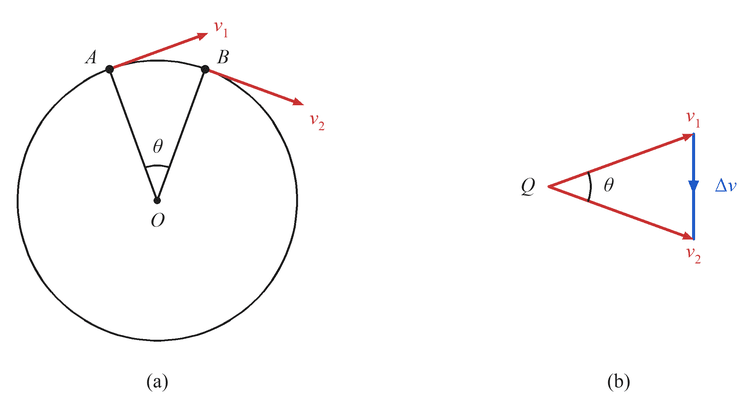
Step 3 — Find the change in velocity. In panel (b), and are drawn from one point . The vector joining their tips is the change in velocity . For a small angle , the side of this narrow triangle is nearly an arc of radius , so:
Step 4 — Express the angle through the time. In time the body covers the arc , and the arc equals :
Step 5 — Find the acceleration. We put this into :
As the approximation becomes exact, so the magnitude of the acceleration is:
Using , this is also .
Step 6 — Find its direction. In panel (b), is perpendicular to the bisector of the angle between and . As comes closer to , this direction becomes perpendicular to the velocity and points along the radius towards . So the acceleration is directed towards the centre: it is the centripetal acceleration.
Step 7 — Define centripetal force (part b). The centripetal force is the force that must act on a body to keep it moving on a circular path with uniform speed. It is directed along the radius towards the centre.
Step 8 — Derive its expression. By Newton's second law, force = mass × acceleration, and the force acts in the direction of the acceleration. For a body of mass with the centripetal acceleration :
With , this is also .
Therefore, (a) a body in uniform circular motion has an acceleration because the direction of its velocity keeps changing; this centripetal acceleration is (or ), directed towards the centre; (b) the centripetal force, the force needed to keep a body moving uniformly on a circle, is (or ), directed towards the centre.