
Opening your dashboard
Class 11 Physics Chapter 8 Uniform Circular Motion: Competency-Based Questions (CBQ)
46 questions on Chapter 8, each worked through on its own page with the AI tutor. Class 11 Physics, ICSE 2026-27.
46 questions
1–4 marks · Mixed difficulty
- 13 marks
Question 1
Competency: Application
A school science club builds an equatorial sundial. A flat circular dial plate is set parallel to the plane of the Earth's equator, and a thin rod through its centre O points towards the celestial pole. The shadow of the rod on the plate then turns steadily about O, making one full turn in 24 hours of solar time. The hour marks are painted on the rim of the plate, from O, as shown. (Hypothetical data.)

(a) Find the angular displacement of the shadow between 9:00 a.m. and 11:40 a.m., in degrees and in radians.
(b) The club also wants marks for every 10 minutes. How far apart, along the rim, must these marks be?
(c) One afternoon a student finds that the shadow has turned through since noon. What time does the dial show?
- 21 mark
Question 2
Competency: Analysis & Evaluation
A toy train runs on a circular track of radius . Starting from a station on the track, it travels along the track. (Hypothetical data.)
Assertion (A): The angular displacement of the train about the centre of the track is .
Reason (R): Angular displacement in radians is equal to the length of the arc travelled divided by the radius of the circle.
- 31 mark
Question 3
Competency: Application
A cook wants to cut a round pizza of radius into slices from the centre, so that the crust along the edge of every slice is exactly long, the same as the radius. (Hypothetical data.) How many such slices can be cut from the pizza?
- 44 marks
Question 4
Competency: Analysis & Evaluation
In a laboratory, a motor turns a black disc with one white line painted along a radius. The room is dark, and the disc is lit only by a stroboscope, a lamp that gives very short flashes at a rate that can be set. The motor runs at a steady speed. The students find that the highest flash rate at which they see a single white line standing still is 25 flashes per second. (Hypothetical data.)
(a) Explain why the disc must make exactly one turn between two flashes at this rate, and find its angular velocity in and in revolutions per minute.
(b) At 50 flashes per second the students see two white lines standing still, on opposite sides of the centre. Explain why.
(c) The flash rate is set to 24 flashes per second. Find the angle through which the disc turns between two flashes, and describe what the students see.
- 51 mark
Question 5
Competency: Analysis & Evaluation
The electric motor of a water pump runs steadily, and a tachometer shows that its shaft turns at a constant 2880 revolutions per minute.
Assertion (A): The angular acceleration of the motor's shaft is zero.
Reason (R): The shaft makes 48 revolutions every second.
- 61 mark
Question 6
Competency: Application
The drum of a concrete-mixer truck turns at 12 revolutions per minute in one direction while it mixes. To unload, the driver reverses it, and 10 s later the drum turns at 6 revolutions per minute in the opposite direction. (Hypothetical data.) What is the average angular acceleration of the drum during these 10 s?
- 74 marks
Question 7
Competency: Application
Rockets that carry satellites towards the geostationary orbit are launched eastward from Sriharikota, on India's east coast, at latitude about N. Because the Earth spins from west to east, a rocket standing on the launch pad is already moving eastward with the ground. Treat the Earth as a sphere of radius that turns once in relative to the stars. The figure shows a section of the Earth through its axis NS, with the launch pad at P.
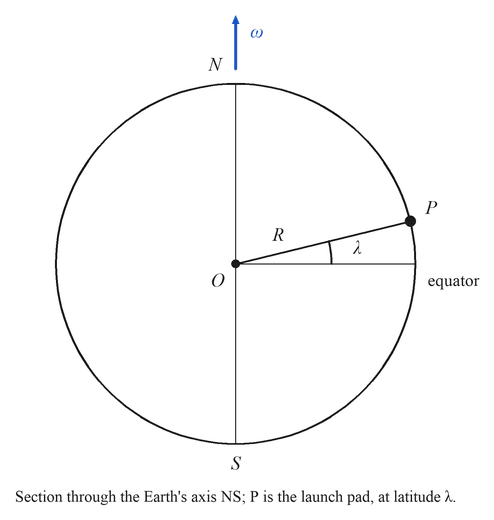
(a) Find the angular velocity of the Earth, and the radius of the circle in which the launch pad moves.
(b) Find the eastward speed of the launch pad.
(c) To orbit close to the Earth, a rocket needs a speed of about relative to the Earth's centre. What fraction of this does the launch pad's own motion supply? How large would this speed be for a launch pad at latitude ? Why are such rockets launched towards the east?
- 84 marks
Question 8
Competency: Application
A wind turbine has three blades, each reaching from the axis of the hub to the tip. It works best when the speed of its blade tips is 7 times the wind speed. On one day the wind blows steadily at , and the turbine turns at this best rate. Take . (Hypothetical data.)
(a) Find the speed of the blade tips, and the angular velocity of the rotor in and in revolutions per minute.
(b) Find the speed of a point on a blade from the axis, and the centripetal acceleration of a blade tip as a multiple of .
(c) To limit noise, the tip speed must never be more than . Find the greatest wind speed at which the turbine can still turn at its best rate.
- 91 mark
Question 9
Competency: Analysis & Evaluation
The horizontal jib of a tower crane turns slowly about the vertical mast. Two trolleys, P and Q, are held at fixed places on the jib: P is from the mast and Q is from it. (Hypothetical data.)
Assertion (A): Q has a greater angular velocity about the mast than P, because Q moves faster.
Reason (R): For points of a rigid body turning about a fixed axis, , so a point farther from the axis moves faster.
- 101 mark
Question 10
Competency: Application
A spin bowler releases a cricket ball spinning at 30 revolutions per second about an axis through its centre. The radius of the ball is . (Hypothetical data.) Relative to the centre of the ball, how fast does a point on its surface farthest from the spin axis move?
- 114 marks
Question 11
Competency: Analysis & Evaluation
Students fix a smartphone flat on the turntable of a record player and use a sensor app to record the acceleration of the phone's sensor towards the centre. They place the sensor at different distances from the axis and run the turntable at its revolutions per minute setting each time. Their record is given below. (Hypothetical data.)
(cm) 4.0 8.0 12.0 14.0 () 0.49 1.78 1.46 1.71 (a) Find the angular velocity of the turntable in .
(b) Calculate the acceleration expected at each distance, and find the reading that does not fit. Show that this reading would fit if the turntable had been left at its other setting, 45 revolutions per minute.
(c) One student argues: "Since , the acceleration should be smaller farther from the axis." Explain what is wrong with this argument.
- 121 mark
Question 12
Competency: Analysis & Evaluation
On a hill road, a car goes round a sharp hairpin bend and, a little later, round a gentle curve. It moves at the same steady speed of on both.
Assertion (A): The centripetal acceleration of the car is greater on the hairpin bend than on the gentle curve.
Reason (R): At the same speed, the car would take more time to go once round the small circle of the hairpin bend than round the large circle of the gentle curve.
- 131 mark
Question 13
Competency: Analysis & Evaluation
Students use the acceleration sensor of a phone to measure the centripetal acceleration of a toy car moving at constant speed round circular tracks. To check the formula for , they want to draw a graph that should be a straight line through the origin. Which plan gives such a graph?
- 144 marks
Question 14
Competency: Application
A box of sweets of mass rests on the flat, horizontal shelf at the top of a car's dashboard. The coefficient of static friction between the box and the bare plastic shelf is ; on a rubber mat it would be . The car goes round a level roundabout of radius at a steady . Take . (Hypothetical data.)
(a) Find the horizontal force needed to keep the box moving round with the car, and name the force that supplies it.
(b) Show whether the box stays in place on the bare shelf, and whether it would stay in place on the rubber mat.
(c) Where the box slips, describe its motion as seen by a person standing beside the roundabout, and as seen by the driver.
- 154 marks
Question 15
Competency: Analysis & Evaluation
During the spin cycle of a front-loading washing machine, a wet towel of mass becomes bunched on one side of the drum, with its centre of mass from the axis. The rest of the load is spread evenly round the drum. The drum spins at 1000 revolutions per minute. Take . (Hypothetical data.)
(a) Find the angular velocity of the drum, and the force that the drum must exert on the towel to keep it moving round.
(b) By Newton's third law the towel pushes back on the drum. Explain why this makes the whole machine shake, and find how many times each second this push points in any one direction.
(c) The machine senses the imbalance and limits the spin to 400 revolutions per minute. By what factor does the force fall, and what is its new value?
- 161 mark
Question 16
Competency: Analysis & Evaluation
An engineer checks the metal arms that hold the blades of a ceiling fan, to make sure that they are strong enough when the fan runs at full speed.
Assertion (A): While the fan turns, each blade arm is stretched (in tension) along its length.
Reason (R): Every part of a blade must be pulled towards the axis to keep moving in its circle, and this pull is supplied by the part of the arm nearer the axis.
- 174 marks
Question 17
Competency: Application
Many gearless scooters use a centrifugal clutch. Two metal shoes are mounted on a plate turned by the engine, inside a drum that drives the rear wheel. A spring pulls each shoe towards the axis. When the engine turns slowly, the shoes stay clear of the drum; when it turns fast enough, they move out, press on the drum and make it turn. The figure shows the idea. Each shoe has mass , its centre of mass is from the axis (take this distance as throughout), and its spring pulls it inwards with a force of (take this force as constant). (Hypothetical data.)
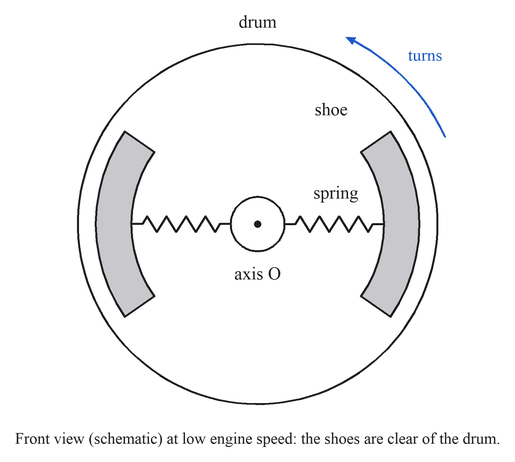
(a) Working in the frame that turns with the plate, name the radial forces on one shoe just before it moves out, and find the engine speed, in revolutions per minute, at which the clutch starts to engage.
(b) Find the force with which each shoe presses on the drum when the engine turns at 6000 revolutions per minute.
(c) Explain how an observer standing on the ground describes the forces on a shoe that is pressing on the drum.
- 181 mark
Question 18
Competency: Analysis & Evaluation
A coin lies on a turntable that turns at a steady rate, and the coin turns with it without slipping. A small camera fixed to the turntable films the coin, so in the camera's frame the coin is at rest.
Assertion (A): To explain why the coin stays at rest in the camera's frame, an outward centrifugal force on the coin must be included along with the forces that the turntable exerts on it.
Reason (R): The friction of the turntable on the coin acts outwards, away from the axis.
- 191 mark
Question 19
Competency: Analysis & Evaluation
Treat the Earth as a uniform sphere turning about its axis. In the Earth's turning frame, the string of a plumb line hanging at rest lines up with the resultant of two forces on the bob: the pull of gravity, towards the Earth's centre, and the centrifugal force, directed away from the Earth's axis. At which places does the string point exactly towards the Earth's centre?
- 204 marks
Question 20
Competency: Application
In a chair-o-plane ride at a fair, each seat hangs from a chain long, fixed to the edge of a top that turns about a vertical axis. The chains are fixed from the axis. When the ride turns steadily, every chain makes an angle of with the vertical, as shown. A rider together with the seat has a mass of . Treat the rider and seat as a particle at the end of the chain, ignore the mass of the chain, and take . (Hypothetical data.)
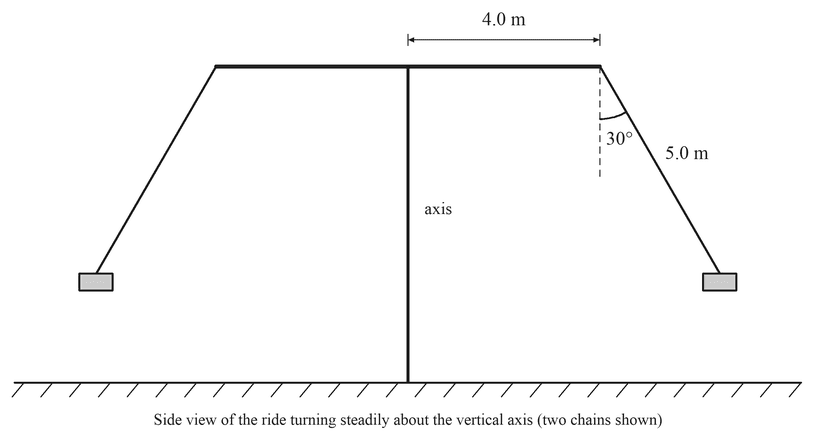
(a) Find the radius of the circle in which the rider moves.
(b) Find the tension in the chain and the angular velocity of the ride, and the time the ride takes for one turn.
(c) An empty seat, of mass , hangs from an identical chain on the same ride. At what angle to the vertical does its chain hang? Explain.
- 211 mark
Question 21
Competency: Analysis & Evaluation
A girl ties a soft ball to a light string and whirls it over her head, so that the ball goes round in a horizontal circle and the string traces out a cone. She tries to whirl it fast enough to make the string lie flat.
Assertion (A): However fast the ball goes round, the string can never be exactly horizontal.
Reason (R): The tension in the string is equal in size to the weight of the ball.
- 221 mark
Question 22
Competency: Application
A small ball bearing slides round the inside of a smooth hemispherical bowl of radius , moving in a horizontal circle above the lowest point of the bowl, as shown. Take . (Hypothetical data.)

What is the angular velocity of the ball bearing?
- 234 marks
Question 23
Competency: Analysis & Evaluation
A ball mill grinds ore with steel balls inside a large drum that turns about a horizontal axis. The inside radius of the drum is , as shown. Treat a ball touching the wall as a particle that moves round with the wall, without slipping, in a vertical circle of radius , until it leaves the wall. Take . (Hypothetical data.)
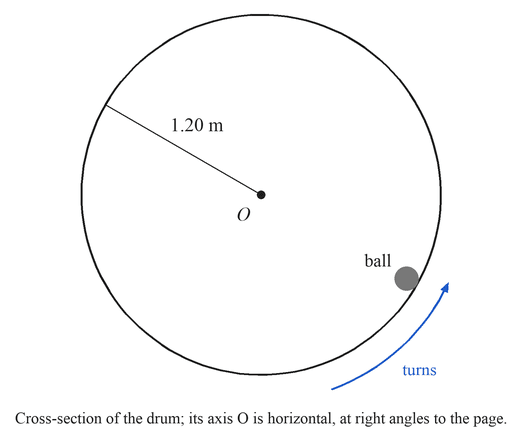
(a) Find the least angular velocity of the drum (the critical speed) at which a ball could stay on the wall all the way round, and give it in revolutions per minute.
(b) The mill runs at 70% of this critical angular velocity. Find the angle from the top of the drum, measured at the axis, at which a ball rising with the wall leaves the wall.
(c) Explain why a mill run faster than its critical speed grinds very little.
- 241 mark
Question 24
Competency: Analysis & Evaluation
On a roller coaster with a vertical loop, some cars carry four riders and some run empty. Treat the top of the loop as part of a vertical circle, and ignore friction and air resistance.
Assertion (A): The least speed at which a car passing the top of the loop still presses on the track is the same for a full car as for an empty one.
Reason (R): At the top of the loop, both the weight of the car and the force needed to keep it moving in its circle are proportional to its mass.
- 251 mark
Question 25
Competency: Analysis & Evaluation
In a toy, a small ball of mass is fixed to one end of a light rigid rod of length . A motor turns the rod about its other end so that the ball moves round a vertical circle at a steady speed , where . At the highest point of the circle, what force does the rod exert on the ball?
- 264 marks
Question 26
A liquid-mirror telescope uses a wide, shallow dish of mercury that turns steadily about a vertical axis through its centre. Once the mercury turns with the dish, its surface takes up a smooth curved shape, lowest at the centre, as shown. Take . (Hypothetical data.)
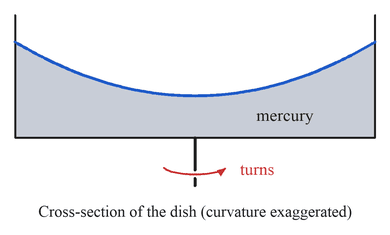
(a) Work in the frame that turns with the dish, in which the mercury is at rest. For a small piece of the surface at distance from the axis, name the two forces per unit mass that act on it, and show that the slope of the surface there is , where is the angular velocity of the dish.
(b) A curve whose slope at distance from the axis is , with constant, is the parabola , with measured up from its lowest point. Write the equation of the mercury surface.
(c) A concave mirror shaped like the parabola brings light arriving parallel to its axis to a focus at height above its lowest point. Find the focal length of the mercury mirror when the dish turns once every .
- 274 marks
Question 27
The bends of an indoor cycle track are banked at to the horizontal. On a bend, a rider moves in a horizontal circle of radius . Take . (Hypothetical data.)

(a) At what speed (the design speed) can a rider go round the bend with no sideways friction at all? Give the answer in .
(b) In a sprint, a rider takes the bend at . In which direction along the slope must the friction on the tyres act, and what is the least coefficient of friction that stops the cycle from sliding?
(c) Explain why a rider who almost stops on the banking will slide down it if the coefficient of friction is .
- 284 marks
Question 28
A ball of mass is tied to a vertical rod by two strings, each long. The upper string is tied to the rod at and the lower string at , below , so that , and form an equilateral triangle when both strings are taut. The rod turns about its own axis, and the ball moves in a horizontal circle with both strings taut, as shown. Take . (Hypothetical data.)
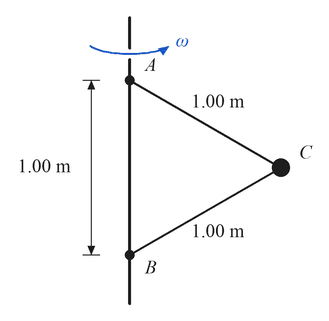
(a) Find the radius of the ball's circle.
(b) Find the tension in each string when the rod turns at .
(c) Find the least angular velocity at which the lower string stays taut.
- 294 marks
Question 29
A small stone of mass is tied to a string long and whirled in a vertical circle. At the lowest point its speed is . Ignore air resistance and take . (Hypothetical data.)
(a) Show that the stone cannot go all the way round the circle with the string taut.
(b) Find the angle, measured at the centre from the lowest point, at which the string goes slack, and the height of the stone above the lowest point there.
(c) Find the speed of the stone at that moment, and describe its motion just afterwards.
- 303 marks
Question 30
A stone tied to the end of the string 100 cm long is whirled in a horizontal circle with a constant speed. If the stone makes 30 revolutions in 15 s. Calculate the magnitude and direction of acceleration of the stone.
- 313 marks
Question 31
A car is moving with a velocity . The car driver sees a truck at rest at a distance . To avoid collision, which is better, to apply brakes or to turn sharply?
- 323 marks
Question 32
You may have seen in a circus a motorcyclist driving in a vertical loop inside a ‘death well’ chamber with holes, so the spectators can watch from outside. Explain clearly why the motorcyclist does not drop down when he is at the uppermost point, with no support from below. What is the minimum speed required to perform a vertical loop if the radius of the chamber is 25 m?
- 333 marks
Question 33
A stone of mass 0.3 kg tied to the end of a string in a horizontal plane is whirled round in a circle of radius 1 m with a speed of 40 rev/min. What is the tension in the string? What is the maximum speed with which the stone can be whirled around if the string can withstand a maximum tension of 200 N?
- 343 marks
Question 34
What is the minimum speed with which a bucket of water can be whirled in a vertical circle of diameter 250 cm so that water does not fall?
- 354 marks
Question 35
A small mass starts from rest and slides down the surface of a frictionless solid sphere of radius . Calculate the angle at which the mass flies off the sphere. If there is friction between the mass and the sphere, does the mass fly off at a greater or lesser angle than the previous one?

- 363 marks
Question 36
A spring of force constant is mounted on a horizontal table and a mass of 3.0 kg is attached to the free end of the spring. The mass is made to rotate with an angular velocity of 10 rad/s. What is the elongation produced in the spring if its unstretched length is 60 cm?
- 373 marks
Question 37
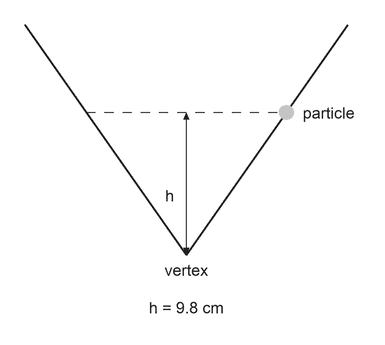
A particle describes a horizontal circle on the smooth surface of an inverted cone. The height of the plane of the circle above the vertex is 9.8 cm. Find the speed of the particle ()
- 383 marks
Question 38
A bridge over a canal is in the form of an arc of a circle of radius 20 m. Calculate the maximum speed at which a motor cycle can pass over the bridge without leaving the ground at the highest point?
- 394 marks
Question 39
In a children's park, using the park ride, the visitors can be made to rotate in a vertical circle. At the top of the circle, a rider has an effective weight of magnitude 1000 N. If his actual weight is 500 N,
(i) what is his effective weight at the bottom of the circle?
(ii) what is the effective weight when the rider is half way to the centre of the circle?
- 403 marks
Question 40
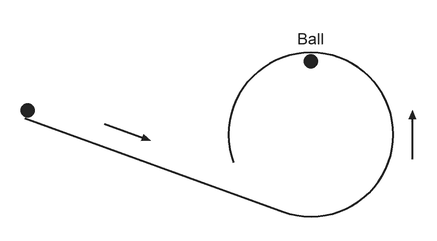
A ball of mass 100 g is made to loop-the-loop in a vertical circle as shown in the given figure. The radius of the circle is 0.5 m.
(i) What is the critical velocity at the highest point of the track?
(ii) If the velocity of the ball at the highest point of the track is twice the critical velocity, what is the force exerted by the ball against track?
- 413 marks
Question 41
A boy of mass sits in a swing supported by two chains, each of length . At the lowest point, the tension in each chain is . What is
(i) the boy's speed at the lowest point and
(ii) the force of the seat on the boy at the lowest point? (Assume that the seat has no mass.)
- 423 marks
Question 42
The kinetic energy of a particle moving along a circle of radius depends on the distance covered as . Calculate the force acting on the particle.
- 433 marks
Question 43
A car is moving in a circular horizontal track of a radius 10 m with a constant speed of 10 m/s. A plumb bob is suspended from the roof of the car by a light rigid rod of length 1.00 m. What is the angle made by the rod with the track?
- 443 marks
Question 44
A train has to negotiate a curve of 40 m radius. What is the super elevation of the outer rail required for a speed of . The distance between the rails is one metre?
- 453 marks
Question 45
Calculate the safe speed with which a train can negotiate a curve of 50 m radius, where the superelevation of the outer rail above the inner rail is 0.6 m. Given that the distance between the rails is 1 m.
- 463 marks
Question 46
A cyclist wants to loop the loop inside a death globe of radius 5 m. Calculate the least velocity the cyclist should have at the lowest point and calculate the height from which he should start.