
A liquid-mirror telescope uses a wide, shallow dish of mercury that turns steadily about a vertical axis through its centre. Once the mercury turns with the dish, its surface takes up a smooth curved shape, lowest at the centre, as shown. Take . (Hypothetical data.)
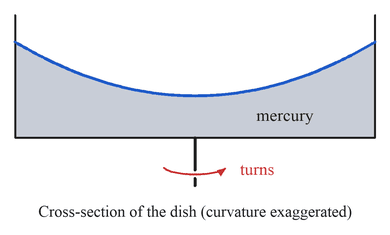
(a) Work in the frame that turns with the dish, in which the mercury is at rest. For a small piece of the surface at distance from the axis, name the two forces per unit mass that act on it, and show that the slope of the surface there is , where is the angular velocity of the dish.
(b) A curve whose slope at distance from the axis is , with constant, is the parabola , with measured up from its lowest point. Write the equation of the mercury surface.
(c) A concave mirror shaped like the parabola brings light arriving parallel to its axis to a focus at height above its lowest point. Find the focal length of the mercury mirror when the dish turns once every .