
Opening your dashboard
Class 11 Physics Chapter 8 Uniform Circular Motion: Practice Questions
115 questions on Chapter 8, each worked through on its own page with the AI tutor. Class 11 Physics, ICSE 2026-27.
115 questions
1–4 marks · Mixed difficulty
- 11 mark
Question 1
A cyclist rides anticlockwise round a circular track of radius . The cyclist starts at A and stops at B after exactly three-quarters of a lap. (Hypothetical data.) The distance covered, the magnitude of the displacement and the angular displacement of the cyclist are, respectively,
- 23 marks
Question 2
A particle moves anticlockwise along a circle of radius centred at the origin . It starts at and stops at , where the coordinates are in metres, as shown in the figure. (Hypothetical data.)
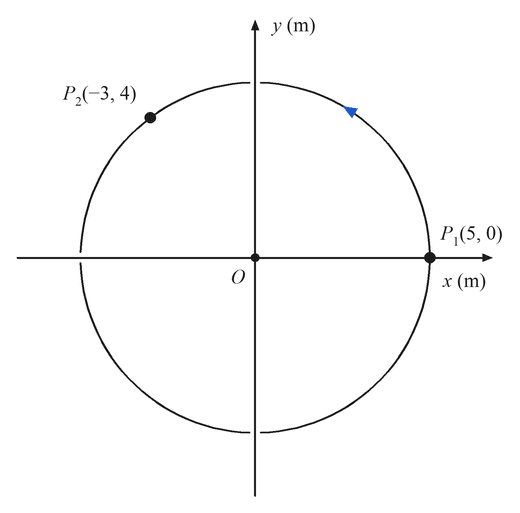
(i) Find its angular displacement in radians and in degrees.
(ii) Find the distance it travels along the circle.
(iii) Through what angle would its radius vector have turned if it had gone clockwise from to instead?
- 31 mark
Question 3
A book lies flat on a table. It is turned through about a vertical axis and then through about a horizontal axis. When the same two turns are made in the opposite order, the book ends up facing a different way. What does this show about large angular displacements?
- 43 marks
Question 4
A particle moves on a circle of radius . (Hypothetical data.) For an angular displacement , compare the distance it travels along the arc with the length of the straight chord joining its start and end points, which is the magnitude of its displacement.
(i) Find and for , and the percentage by which is less than .
(ii) Do the same for .
(iii) What does this show about the displacement for a very small angular displacement?
- 51 mark
Question 5
In a race, runners in lanes 1 and 5 each run one semicircular bend. Take the running line in lane 1 as a semicircle of radius and in lane 5 as a semicircle of radius . (Hypothetical data.) Which statement about the bend is correct?
- 63 marks
Question 6
An astronomer photographs the night sky with a camera fixed on a tripod. Because the Earth spins, the stars appear to turn round the celestial pole, making one full turn in (one sidereal day). The camera lens has a focal length of . During an exposure, the image of a star near the celestial equator moves across the sensor through a distance equal to the focal length multiplied by the angle, in radians, through which the sky turns. (Hypothetical data.) For an exposure of , find
(i) the angle through which the sky turns, in degrees,
(ii) the same angle in radians, and
(iii) the length of the star's trail on the sensor.
- 71 mark
Question 7
A car moves due north along a straight, level road. What is the direction of the angular velocity of its wheels?
- 83 marks
Question 8
A ceiling fan running at 300 revolutions per minute is switched off. Its angular velocity then falls uniformly, and it stops after . (Hypothetical data.) For a uniform change, the angle turned equals the average angular velocity multiplied by the time.
(i) Find the fan's angular velocity just before it is switched off.
(ii) Find its angular acceleration, and state its direction.
(iii) How many revolutions does it make before it stops?
- 91 mark
Question 9
A bicycle wheel on a repair stand is spun up by a motor, kept turning steadily and then braked to rest. Its angular velocity changes with time as shown in the graph. (Hypothetical data.)
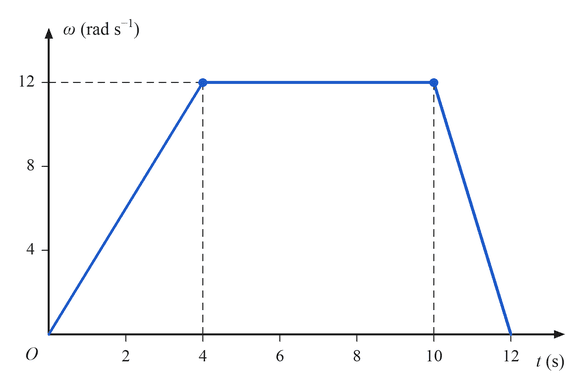
Through what total angle does the wheel turn in these ?
- 103 marks
Question 10
A small disc is started from rest by a motor. A video of a mark on the disc gives the angle through which it has turned at equal intervals of time. (Hypothetical data.)
Time (s) 0 0.5 1.0 1.5 2.0 Angle (rad) 0 0.30 1.20 2.70 4.80 For a uniform angular acceleration, the average angular velocity over an interval equals the angular velocity at the middle of that interval.
(i) Find the average angular velocity in each half-second interval.
(ii) Show that the angular acceleration is uniform, and find its value.
(iii) Find the angular velocity of the disc at .
- 111 mark
Question 11
A potter's wheel spins anticlockwise as seen from above. The potter presses a brake, so the wheel slows down. What is the direction of its angular acceleration?
- 123 marks
Question 12
Two runners, Kavya and Meera, start together from the same line on a circular track and run in the same direction at steady speeds. Kavya completes a lap in and Meera in . (Hypothetical data.)
(i) Find the angular velocity of each runner about the centre of the track.
(ii) After how long does Kavya first catch up with Meera again?
(iii) How many laps has each of them run by then?
- 131 mark
Question 13
A turntable is switched on and speeds up. Two stickers, P and Q, are stuck on it at and from its centre. (Hypothetical data.) While the turntable is speeding up, which statement about the two stickers is correct?
- 144 marks
Question 14
A cyclist turns the pedals at 60 revolutions per minute. The pedals turn a chainring of radius , which drives, through the chain, a rear sprocket of radius fixed to the rear wheel of radius , as shown in the figure. The chain does not slip, and the wheel rolls without slipping, so the bicycle's speed equals the speed of a point on the wheel's rim relative to the axle. (Hypothetical data.)
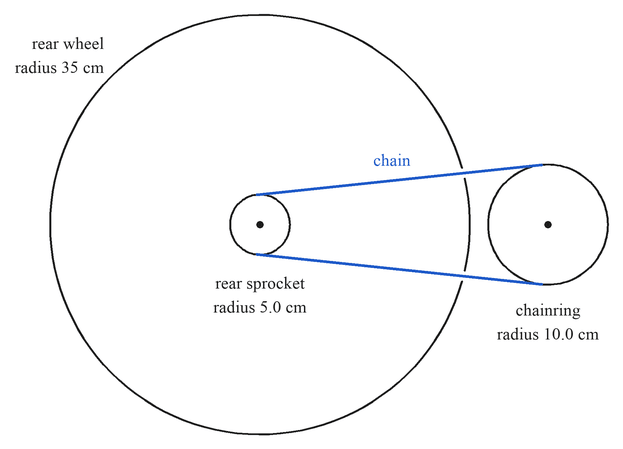
Find
(i) the angular velocity of the chainring,
(ii) the speed of the chain,
(iii) the angular velocity of the rear wheel, and
(iv) the speed of the bicycle in .
- 153 marks
Question 15
A CD player reads a disc at a constant linear speed of under the laser. The recording starts at a radius of near the centre and ends at a radius of near the edge. (Hypothetical data.)
(i) Find the angular velocity of the disc at the start of the recording.
(ii) Find its angular velocity at the end of the recording.
(iii) Express both in revolutions per minute, and say whether the disc speeds up or slows down as the music plays.
- 162 marks
Question 16
A windlass is used to lift a bucket from a well. The rope winds on a drum of radius , and the handle is from the axle, as shown in the figure. The bucket rises at a steady . (Hypothetical data.)

Find (i) the angular velocity of the drum, and (ii) the speed of the hand that turns the handle.
- 173 marks
Question 17
A particle moves anticlockwise round a circle in the -plane, centred at the origin, with angular velocity . At one instant its position vector is . (Hypothetical data.)
(i) Find its velocity at this instant.
(ii) Find its speed, and check that it equals .
(iii) Show that is perpendicular to .
- 181 mark
Question 18
Gear A, which has 20 teeth, turns clockwise at and drives gear B, which has 60 teeth, as shown in the figure. The teeth of the two gears are the same size, so the radius of each gear is proportional to its number of teeth. (Hypothetical data.)
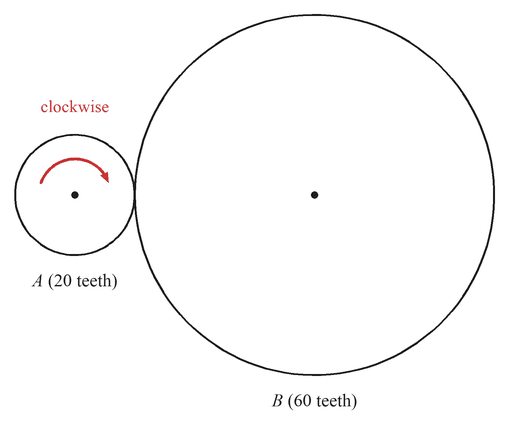
The angular velocity of gear B is
- 193 marks
Question 19
A car's speedometer works out the speed from the angular velocity of the wheels, taking the tyre radius as . The tyres roll without slipping. (Hypothetical data.)
(i) With new tyres of radius , the car travels at . Find the angular velocity of the wheels in and in revolutions per minute.
(ii) The owner later fits smaller tyres, of radius , without resetting the speedometer. When the car really travels at , what speed does the speedometer show?
- 203 marks
Question 20
A laboratory centrifuge must give a blood sample, from the axis of rotation, a centripetal acceleration of 5000 times the acceleration due to gravity. Take . (Hypothetical data.)
(i) Find the angular velocity needed.
(ii) Express it in revolutions per minute.
(iii) Find the speed of the sample, and state the direction of its acceleration.
- 214 marks
Question 21
A toy car moves anticlockwise round a circular track of radius at a constant speed of . It goes from point A to point B, a quarter of a turn. (Hypothetical data.)
(i) Find the time it takes to go from A to B.
(ii) Find the magnitude of its change in velocity from A to B, and hence the magnitude of its average acceleration over this quarter turn.
(iii) Compare this with the centripetal acceleration .
(iv) Find the average acceleration over a turn of only , and say what this shows.
- 223 marks
Question 22
A car starts from rest on a circular test track of radius and speeds up with a constant tangential acceleration of . (Hypothetical data.)
(i) After how long is its centripetal acceleration equal to its tangential acceleration?
(ii) How far along the track has it gone by then, and through what angle has it turned about the centre?
(iii) Find the magnitude of its total acceleration at that instant, and the angle it makes with the direction of motion.
- 231 mark
Question 23
A car is going round a level circular bend, and the driver is braking, so the car is slowing down. Which describes the direction of the car's acceleration?
- 242 marks
Question 24
A wooden horse on a merry-go-round moves at a steady speed of , while the merry-go-round turns with an angular velocity of . (Hypothetical data.)
(i) How far is the horse from the axis of the merry-go-round?
(ii) Find the horse's centripetal acceleration in two ways, using and , and state its direction.
- 251 mark
Question 25
A ball moves round a horizontal circle of radius at a constant speed of . (Hypothetical data.) At every instant, its velocity vector is drawn starting from one fixed point P. The tips of these vectors then move round a circle centred at P. At what rate does the tip move along this circle?
- 261 mark
Question 26
Two small balls and , each of mass , are tied to one light string on a smooth horizontal table. The string runs from a fixed peg to and on to , with . The balls go round with the same angular velocity, keeping the string straight, as shown.
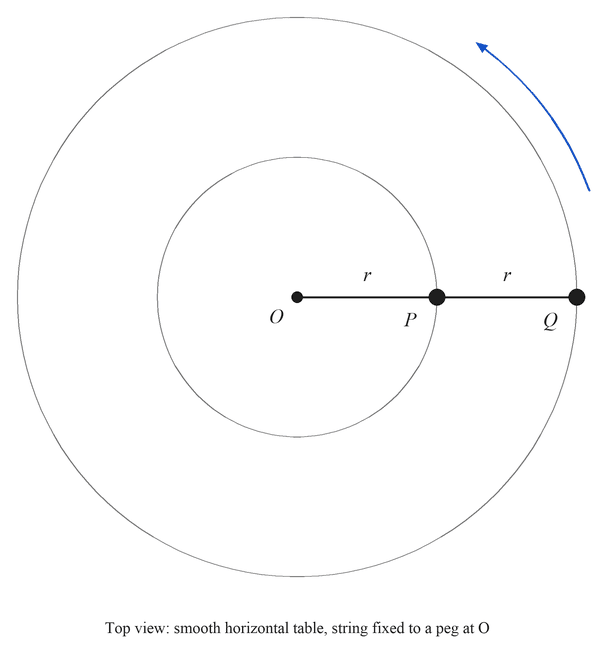
What is the ratio of the tension in the part of the string to the tension in the part ?
- 273 marks
Question 27
In the hammer throw, an athlete whirls a hammer of mass round a circle of radius (measured to the centre of the ball). Just before release, the ball moves at . Treat the path just before release as a horizontal circle, ignore the mass of the wire, and take . (Hypothetical data.)
(a) Find the centripetal force needed on the hammer just before release, and express it as a multiple of the hammer's weight.
(b) Which force supplies this centripetal force? What force does the hammer exert on the athlete, and why does the athlete lean backwards?
(c) If the release speed were 10% lower, by what percentage would the force needed fall?
- 283 marks
Question 28
In a school experiment, a rubber bung is whirled in a horizontal circle on a string that passes through a smooth vertical glass tube held in the hand. The other end of the string carries a hanging mass , which is kept still, so the tension in the string equals . A marker on the string keeps the radius of the circle at . The student times 20 revolutions for three different hanging masses. (Hypothetical data.)

Hanging mass (kg) Time for 20 revolutions (s) Assume that the string from the tube to the bung is horizontal, and take .
(a) Find the period of the motion for each hanging mass.
(b) Show that is nearly the same for all three readings, and explain why theory predicts this.
(c) Find the mass of the bung.
- 291 mark
Question 29
A car goes round a level, unbanked bend at constant speed. Ignore air resistance and rolling resistance. Which set of forces acts on the car, as seen by an observer standing on the road?
- 303 marks
Question 30
The Moon moves round the Earth in a nearly circular orbit of radius , once every days (measured relative to the stars). Its mass is . The radius of the Earth is , and at its surface.
(a) Find the centripetal acceleration of the Moon.
(b) Find the centripetal force on the Moon, and name the force that supplies it.
(c) Show that is about times the Moon's centripetal acceleration and that the Moon is about Earth radii from the Earth's centre. What does this suggest about how the Earth's pull changes with distance?
- 312 marks
Question 31
A car moves along a straight, level road at a steady . A small pebble of mass is stuck in the tread of one tyre, of radius . The tyres roll without slipping, so relative to the axle the pebble goes round a circle of radius at the speed of the car. Take . (Hypothetical data.)
(a) Find the force with which the tread must hold the pebble to keep it moving round with the tyre, and compare it with the pebble's weight. (The weight is small enough to ignore in working out this force.)
(b) Explain why pebbles stuck in the tread are often flung out when the car moves fast.
- 321 mark
Question 32
A person of mass stands on a spring balance at the equator. Treat the Earth as a sphere of radius that turns once in hours. In the frame of the turning Earth, an outward centrifugal force acts on the person, so the balance reads less than . By about how much is the reading smaller than ?
- 333 marks
Question 33
A space station far from any planet is a large ring of radius that turns about its central axis. An astronaut stands on the inside of the outer wall, with feet on the wall and head towards the axis, as shown. Take . (Hypothetical data.)
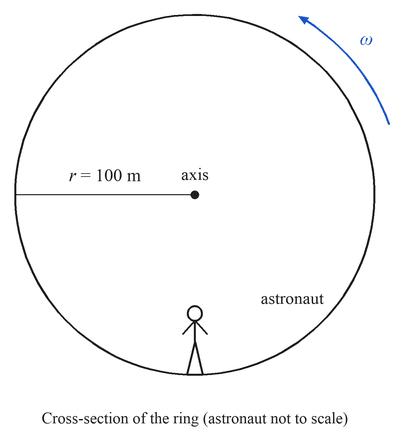
(a) Find the angular velocity, and the number of revolutions per minute, that make the astronaut feel as heavy as on the Earth.
(b) The astronaut is tall. By what percentage is this artificial gravity weaker at the head than at the feet?
(c) Explain the astronaut's feeling of weight (i) as seen from outside the station, in an inertial frame, and (ii) as described in the turning frame of the station.
- 341 mark
Question 34
A child sits in a car with all its windows closed. The child holds the string of a helium-filled balloon, which floats above the child's hand with the string straight. The car goes round a level bend to the left at constant speed. Seen from inside the car, how does the balloon behave?
- 351 mark
Question 35
A stone tied to a string is whirled in a horizontal circle at constant speed. Which statement about the centrifugal force on the stone is correct?
- 363 marks
Question 36
In a simple speed governor, two heavy balls are each fixed to a light arm of length . The arms hang from a hinge at the top of a vertical spindle. When the spindle turns, the balls swing out and move in a horizontal circle, each arm making an angle with the spindle, as shown. Take . (Hypothetical data.)
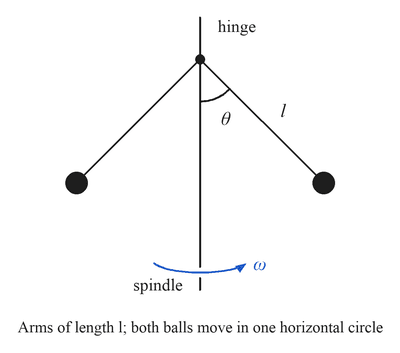
(a) Working in the frame that turns with the spindle, name the forces on one ball and show that , where is the angular velocity of the spindle.
(b) Find when the spindle turns at revolutions per minute.
(c) Show that the arms stay hanging straight down unless is greater than , and find this angular velocity in revolutions per minute.
- 371 mark
Question 37
Two small bobs hang from the same fixed point , one on a string of length and the other on a string of length . Each bob is set moving in a horizontal circle, and both circles lie in the same horizontal plane, below , as shown. (Hypothetical data.)
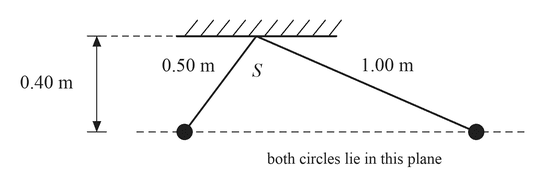
What is the ratio of the period of the bob on the longer string to the period of the bob on the shorter string?
- 383 marks
Question 38
A racing car of mass takes a level, unbanked bend of radius . The coefficient of friction between its tyres and the track is . Take . (Hypothetical data.)
(a) Find the greatest speed at which the car could take the bend if only its weight pressed it on to the track.
(b) At its cornering speed, the car's wings press it down on the track with an extra aerodynamic force (downforce) of . Taking this force as fixed, find the greatest speed now.
(c) Explain why the downforce lets the car corner faster.
- 391 mark
Question 39
A road bend is banked so that cars can take it at with no friction at all. One winter morning the road is covered with smooth ice, so friction is negligible, and a car enters the bend at only . What happens to the car?
- 401 mark
Question 40
On a level, unbanked road, the greatest speed at which a car can take a bend of radius without skidding is . Another level bend has radius , but its surface is wet, so the coefficient of friction there is only half as large. What is the greatest speed at which the car can take the second bend without skidding?
- 413 marks
Question 41
A car goes round a level bend of radius . The coefficient of friction between the tyres and the road is , and the road can supply a friction force of at most in any horizontal direction. Take . (Hypothetical data.)
(a) Find the greatest speed at which the car can take the bend at constant speed.
(b) The driver brakes on the bend, so that the car slows down at . Find the greatest speed at which it can be going round the bend at that moment without skidding.
(c) Use your answers to explain why drivers are told to brake before a bend rather than in it.
- 421 mark
Question 42
A stone tied to a string is whirled in a vertical circle, with no air resistance, and the string stays taut all the way round. By how much is the tension in the string when the stone passes the lowest point greater than the tension when the string is horizontal?
- 431 mark
Question 43
A small ball is fixed to one end of a light rigid rod of length . The rod can turn freely in a vertical plane about a smooth axle through its other end. The ball hangs at rest at the lowest point. To go all the way round the circle, the speed given to the ball at the lowest point must be greater than which of these?
- 443 marks
Question 44
A demolition crane swings a wrecking ball of mass on a steel cable long. The ball is pulled aside until the cable makes with the vertical, and is then released from rest, as shown. Ignore air resistance and the mass of the cable, and take . (Hypothetical data.)
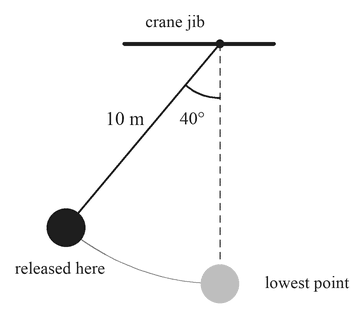
(a) Find the speed of the ball at the lowest point.
(b) Find the tension in the cable at the lowest point.
(c) The cable must never carry more than twice the ball's weight. Find the greatest angle from the vertical at which the ball may be released.
- 452 marks
Question 45
A road runs down into a hollow and up again. Near the lowest point, the road follows an arc of a vertical circle of radius , with the centre of the circle above the road, as shown. A car carrying a passenger of mass passes the lowest point at . Take . (Hypothetical data.)
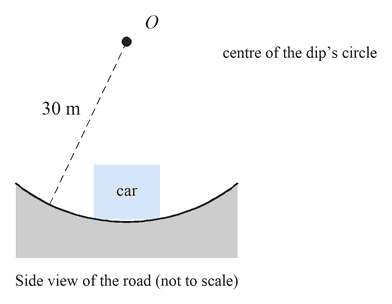
(a) Find the force that the seat exerts on the passenger at the lowest point, and compare it with the passenger's weight.
(b) At what speed would the passenger feel twice as heavy as usual at the lowest point?
- 461 mark
Question 46
A stone on a string is whirled in a vertical circle with the least speed that lets it go all the way round, so that the string is only just taut at the top. Ignore air resistance. What is the magnitude of the stone's acceleration when the string is horizontal?
- 472 marks
Question 47
When a car takes a round curve on a level road at high speed, two of its wheels leave the ground. Which two remain on the ground?
- 482 marks
Question 48
If the acceleration of a particle remains constant in magnitude but not in direction, is its path necessarily a straight line or a circle?
- 492 marks
Question 49
When a car rounds a curve, to which side of the car does a passenger inside it tend to slide?
- 502 marks
Question 50
Why does an aeroplane tilt while making a curved flight?
- 512 marks
Question 51
A stone is tied to the end of a string and is whirled in a horizontal circle with a constant speed. Suppose the string breaks suddenly. What happens to the stone?
- 521 mark
Question 52
During uniform circular motion, name the quantities which remain constant.
- 531 mark
Question 53
Does the kinetic energy of a body moving in a vertical circular path also remain constant?
- 542 marks
Question 54
The speed of a body moving in uniform circular motion is doubled and the radius of the circular path is halved. What happens to the centripetal force?
- 552 marks
Question 55
Give an example of a body moving such that it has tangential and centripetal acceleration.
- 562 marks
Question 56
A heavy mass is attached to a string and is just in equilibrium. When the mass is made to oscillate the string breaks. Why?
- 571 mark
Question 57
For uniform circular motion, does the direction of centripetal force depend on the sense of rotation?
- 583 marks
Question 58
What is the angular velocity of
(a) a second hand and
(b) minute hand of a clock?
- 593 marks
Question 59
What is the angular velocity of a body on the surface of the Earth at the equator? Also find its linear velocity. Given radius of the Earth is 6400 km. Period of rotation of the Earth = 24 hours.
- 603 marks
Question 60
The blades of an aeroplane propeller are 2 m long and rotate at 300 rpm. Calculate
(i) frequency,
(ii) period of rotation,
(iii) angular velocity and
(iv) linear velocity of a point 0.5 m from the top of the blades.
- 613 marks
Question 61
The angular displacement of a body is given by . Find the value of the angular velocity and angular acceleration when s.
- 623 marks
Question 62
A stone is tied at the end of a string 1 m long and whirled round by holding the other end. The stone makes 120 revolutions in 12 seconds. Calculate the angular velocity and linear velocity.
- 633 marks
Question 63
An artificial satellite is orbiting around the Earth with the speed of at a distance of km from the Earth. Calculate its centripetal acceleration.
- 643 marks
Question 64
A body of mass 0.5 kg is whirled with a velocity of using 0.5 m length string which can withstand a tension of 15 N. Neglecting the force of gravity on the body predict whether or not the string will break.
- 653 marks
Question 65
A string 1 m long can just support a weight of 16 kg. A mass of 1 kg is attached to one of its ends. The body is revolved in a horizontal circle about the other fixed end of the string. Find the greatest number of revolutions made by the mass per second. (Take )
- 663 marks
Question 66
A stone tied to the end of a string 80 cm long is whirled in a horizontal circle with a constant speed. If the centripetal acceleration of the stone is , how many revolutions does the stone make in 20 seconds?
- 673 marks
Question 67
A mass is tied to a string 1 m long and rotated in a horizontal circle at the rate of 600 rpm. If the tension in the string is 3943.8 N, calculate the mass.
- 683 marks
Question 68
A sphere of mass 20 g is whirled around in a horizontal circular path on the end of a string, the other end of which is stationary. If the tension in the string is 12.62 N, calculate the length of the string.
- 693 marks
Question 69
An Earth satellite revolves in a circular orbit at a height of 300 km above the Earth's surface with a period of 90 min. What is its speed? Calculate the radial acceleration of the satellite? Radius of the Earth is m.
- 703 marks
Question 70
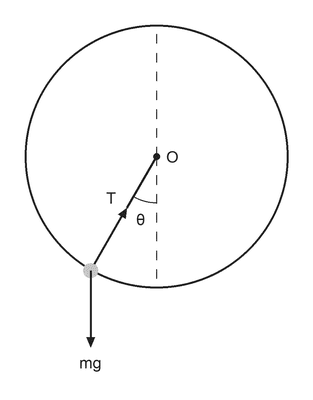
What is the tension in the cord connected to the ball of mass 0.1 kg rotating in a vertical circle of radius 1 m, if the speed of the ball is 0.2 m/s and ?
- 713 marks
Question 71
The speed of the electron in the hydrogen atom is approximately m/s. What is the centripetal force acting on the electron if the radius of the circular orbit is m? Mass of the electron is kg.
- 723 marks
Question 72
What is the centripetal acceleration of a space vehicle moving round the Earth, assuming its orbit to be circular? What is the apparent weight of an astronaut?
- 733 marks
Question 73
Suppose that the rotation of the Earth was increased such that the centripetal acceleration was equal to the gravitational acceleration at the equator.
(i) Find the speed of a person standing at the equator and
(ii) how long would a day be?
- 743 marks
Question 74
If a body moves on the circumference of a circle with a speed equal to that which it would acquire by falling freely through half the radius of the circle, prove that its centripetal acceleration is equal to the acceleration of the free fall.
- 753 marks
Question 75
An electric bulb suspended from the roof of a train by a thread shifts through an angle of 19.8° when the train goes round a curved path 100 m in radius. Find the speed of the train.
- 763 marks
Question 76
A train is moving with a speed of 20 m/s at a place where the radius of curvature of the railway line is 1500 m. Calculate the distance between the rails if the elevation of the outer rail above the inner rail is 0.042 m.
- 773 marks
Question 77
At what angle must a railway track with a bend of 250 m radius be banked for safe running of a train at a speed of .
- 783 marks
Question 78
A cyclist moving at a speed of , describes a circle of radius 10 m. What is the smallest value of the coefficient of friction between the tyres and the ground so that the cyclist may be held in balance?
- 793 marks
Question 79
A cyclist goes around a circular track of circumference 410 m, in 20 s. Find the angle that his cycle makes with the vertical.
- 803 marks
Question 80
A motorcyclist goes round a circular race curve at . To keep his balance, he leans inward 40° from the vertical. What is the radius of the circular path?
- 813 marks
Question 81
What is the maximum speed with which a cyclist can move without skidding, in a circular path of radius 10 m, on a road where the coefficient of friction between the tyre and the road is 0.5?
- 821 mark
Question 82
Two stones of masses and are whirled in horizontal circles, the heavier one in radius and the lighter one in radius . The tangential speed of lighter stone is times that of the value of heavier stone when they experience same centripetal forces. The value of is
- 831 mark
Question 83
A body of mass is moving in a circle of radius with a constant speed . The force on the body is and is directed towards the centre. What is the work done by this force in moving the body over half the circumference of the circle?
- 841 mark
Question 84
A body is tied with a string and is given a circular motion with velocity in radius . The magnitude of the acceleration is
- 851 mark
Question 85
One end of a string of length is connected to a particle of mass and the other to a small peg on a smooth horizontal table. If the particle moves in a circle with speed , the net force on the particle (directed towards the centre) will be ( represents the tension in the string)
- 861 mark
Question 86
If the length of the second's hand in a stop clock is 3 cm, the angular velocity and linear velocity of the tip is
- 871 mark
Question 87
Two particles of equal masses are revolving in circular paths of radii and respectively with the same speed. The ratio of their centripetal forces is
- 881 mark
Question 88
What is the angular velocity of the Earth?
- 891 mark
Question 89
A car runs at a constant speed on a circular track of radius 100 m, taking 62.8 seconds for every circular loop. The average velocity and average speed for each circular loop respectively is
- 901 mark
Question 90
A body of mass moves in a circular path with uniform angular velocity. The motion of the body has constant
- 911 mark
Question 91
The position vector of a particle as a function of time is given by where is in meters, is in seconds and and denote unit vectors along - and -directions, respectively. Which one of the following statements is wrong for the motion of particle?
- 921 mark
Question 92
A body moves in a circle covers equal distance in equal intervals of time. Which of the following remains constant?
- 931 mark
Question 93
A particle moves in a circle of radius 5 cm with constant speed and time period s. The acceleration of the particle is
- 941 mark
Question 94
A particle revolves round a circular path. The acceleration of the particle is
- 951 mark
Question 95
The force required to keep a body in uniform circular motion is
- 961 mark
Question 96
A particle of mass describes uniform circular motion in a horizontal plane. The quantity that is conserved is
- 971 mark
Question 97
A brick of mass , tied to a rope, is being whirled in a vertical circle, with a uniform speed. The tension in the rope is
- 981 mark
Question 98
A motorcycle is going on an over bridge of radius . The driver maintains a constant speed. As the motorcycle is ascending on the over bridge, the normal force on it
- 991 mark
Question 99
Two cars of masses and are moving in circles of radii and respectively. Their speeds are such that they make complete circles in the same time . The ratio of their centripetal acceleration is
- 1001 mark
Question 100
A body of mass 5 kg is moving in a circle of radius 1 m with an angular velocity of 2 radian/s. The centripetal force is
- 1011 mark
Question 101
A car of mass 1000 kg negotiates a banked curve of radius 90 m on a frictionless road. If the banking angle is 45°, the speed of the car is
- 1021 mark
Question 102
For a particle in uniform circular motion, the acceleration at a point on the circle of radius is (Here is measured from the -axis)
- 1031 mark
Question 103
The Earth moves round the Sun in a near circular orbit of radius m. Its centripetal acceleration is
- 1041 mark
Question 104
If a cyclist moving with a speed of 4.9 m/s on a level road can take a sharp circular turn of radius 4 m, then coefficient of friction between the cycle tyres and road is
- 1051 mark
Question 105
A block of mass at the end of a string is whirled round in a vertical circle of radius . The critical speed of the block at the top of its swing below which the string would slacken before the block reaches the top is
- 1061 mark
Question 106
A 1 kg stone at the end of 1 m long string is whirled in a vertical circle at constant speed of 4 m/s. The tension in the string is 6 N, when the stone is at ( m/s²)
- 1071 mark
Question 107
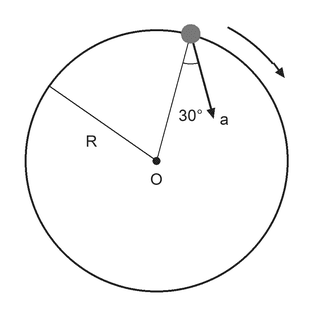
In the given figure, m/s² represents the total acceleration of a particle moving in the clockwise direction in a circle of radius m at a given instant of time. The speed of the particle is
- 1081 mark
Question 108
A body moving along a circular path of radius with velocity , has centripetal acceleration . If its velocity is made equal to , then its centripetal acceleration is
- 1091 mark
Question 109
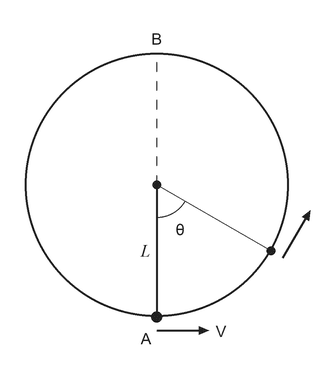
A bob of mass is suspended by a massless string of length . The horizontal velocity at position is just sufficient to make it reach the point . The angle at which the speed of the bob is half of that at , satisfies
- 1101 mark
Question 110
A particle is moving along a circular path with a constant speed of 10 m s⁻¹. What is the magnitude of the change in velocity of the particle, when it moves through an angle of 60° around the centre of the circle?
- 1111 mark
Question 111
Statement I: A cyclist is moving on an unbanked road with a speed of 7 km h⁻¹ and takes a sharp circular turn along a path of radius of 2 m without reducing the speed. The static friction coefficient is 0.2. The cyclist will not slip and pass the curve ( m/s²).
Statement II: If the road is banked at an angle of 45°, cyclist can cross the curve of 2 m radius with the speed of 18.5 km h⁻¹ without slipping.
In the light of the above statements, choose the correct answer from the option given.
- 1121 mark
Question 112
A mass is attached to a thin wire and whirled in a vertical circle. The wire is most likely to break when
- 1131 mark
Question 113
Two particles A and B are moving in uniform circular motion in concentric circles of radius, and with speed, and respectively. The time period of rotation is the same. The ratio of angular speed of A to that of B will be
- 1141 mark
Question 114
A clock has a continuously moving second's hand of 0.1 m length. The average acceleration of the tip of the hand (in units of m s⁻²) is of the order of
- 1151 mark
Question 115
A particle of mass moves in a circular orbit under the central potential field, , where is a positive constant. The correct radius–velocity graph of the particle's motion is