
Opening your dashboard
Class 11 Physics Chapter 20: Kinetic Theory Solutions
58 textbook questions with step-by-step answers, free to read, for ISC 2026-27.
Get talked through Ch 20, not just shown the answer
Reading a finished solution is not the same as being able to do it. The AI tutor takes one question at a time and works it with you, in your own words, until you can.
- Ask it out loud, in your own words
- It gives you the next step, not the answer
- Stuck on part (ii)? Start there
58 questions with solutions
1–5 marks · Mixed difficulty
The first 28 solutions are on this page. This chapter is a long one, so the rest open on their own page to keep this one quick to load.
- 11 mark
Question 1
The r.m.s. speed of oxygen is at a particular temperature. If the temperature is doubled and oxygen molecules dissociate into oxygen atoms, the r.m.s. speed becomes
Solve with AIAnswer
(A)
(B)
- Correct
(C)
(D)
Answer: (C)
Concept: The r.m.s. speed of the molecules of a gas is , where is the absolute temperature and the molar mass. So .
Step 1 — Write the starting speed. For oxygen molecules of molar mass at temperature :
Step 2 — Write what changes. The temperature becomes . Each molecule splits into two O atoms, so the particles now have half the molar mass, .
Step 3 — Find the new speed. We put and into the formula:
- (A) The speed would stay only if were unchanged, but here it becomes four times as large.
- (B) This is the result of doubling the temperature alone; it leaves out the halving of the particle mass when the molecules split into atoms.
- (D) This forgets the square root: becomes 4 times as large, so the speed becomes times as large, not 4 times.
Therefore, the answer is (C): the r.m.s. speed becomes .
- 21 mark
Question 2
The mean free path of molecules of a gas, (radius ) is inversely proportional to
Solve with AIAnswer
(A)
(B)
(C)
- Correct
(D)
Answer: (D)
Concept: The mean free path of gas molecules is , where is the diameter of a molecule and the number of molecules per unit volume. Two molecules collide when their centres come within a distance , so the target area for collisions is .
Step 1 — Write the diameter in terms of the radius. The diameter is twice the radius, , so:
Step 2 — Read off the proportionality. For a given number of molecules per unit volume, everything except is constant, so : molecules twice as large have a mean free path one-quarter as long.
- (A) Doubling makes one-quarter as long, not one-half, so is not inversely proportional to itself.
- (B) A square-root law would make fall far too slowly; the collision target area grows as .
- (C) goes with the volume of a molecule, but collisions depend on its cross-sectional area , not its volume.
Therefore, the answer is (D): the mean free path is inversely proportional to .
- 31 mark
Question 3
At constant volume, temperature is increased. Then
Solve with AIAnswer
(A) Collision on walls will be less
- Correct
(B) Number of collisions per unit time will increase
(C) Collisions will be in straight lines
(D) Collisions will not change
Answer: (B) Number of collisions per unit time will increase
Concept: The r.m.s. speed of gas molecules grows with temperature, . At constant volume the number of molecules per unit volume, and so the mean free path, does not change.
Step 1 — Note what stays the same. The volume is fixed, so the molecules have the same distance to travel across the vessel and the same mean free path between collisions with one another.
Step 2 — Note what changes. Raising the temperature makes the molecules move faster. Covering the same distances in less time, each molecule strikes the walls and other molecules more often.
Step 3 — Draw the conclusion. So the number of collisions per unit time increases (and each impact on a wall is also harder, which is why the pressure rises).
- (A) The molecules move faster in a vessel of the same size, so they reach the walls more often, not less often.
- (C) Between collisions the molecules move in straight lines at every temperature; heating does not change that.
- (D) Both the number of collisions each second and the momentum given to the wall in each collision increase when the gas is heated.
Therefore, the answer is (B): the number of collisions per unit time increases.
- 41 mark
Question 4
Which one of the following is not an assumption of kinetic theory of gases?
Solve with AIAnswer
(A) The volume occupied by the molecules of the gas is negligible
(B) The force of attraction between the molecules is negligible
(C) The collision between the molecules is elastic.
- Correct
(D) All molecules have same speed
Answer: (D) All molecules have same speed
Concept: The kinetic theory assumes that gas molecules are point-like, exert no forces on one another except during collisions, collide elastically, and move at random in all directions with all possible speeds.
Step 1 — Check option (D) against the assumptions. The theory says the molecules move with all possible speeds, spread out as described by Maxwell's distribution. That is exactly why it uses an average such as the r.m.s. speed.
Step 2 — Draw the conclusion. "All molecules have the same speed" contradicts this, so it is not an assumption of the theory.
- (A) This is an assumption: the molecules are treated as points whose own volume is negligible compared with the volume of the gas.
- (B) This is an assumption: apart from collisions, the molecules exert no forces of attraction or repulsion on one another.
- (C) This is an assumption: the collisions are perfectly elastic, so the total kinetic energy of the gas is not lost in them.
Therefore, the answer is (D): "all molecules have the same speed" is not an assumption of the kinetic theory.
- 51 mark
Question 5
The root mean square velocity of the molecules in a sample of helium is 5/7th that of the molecules in a sample of hydrogen. If the temperature of hydrogen sample is , then the temperature of the helium sample is about
Solve with AIAnswer
- Correct
(A)
(B)
(C)
(D)
Answer: (A)
Concept: The r.m.s. speed of the molecules of a gas is , where is the absolute temperature and the molar mass. So .
Step 1 — Write the ratio of the speeds. For helium () and hydrogen ():
Step 2 — Square and put in the data. The ratio is and :
Step 3 — Convert to the Celsius scale. We subtract 273:
This is far closer to than to any other option, so the helium is at about .
- (B) At the kinetic theory gives zero r.m.s. speed, but the helium molecules move at of the speed of the hydrogen molecules.
- (C) At (546 K) helium would have exactly the same r.m.s. speed as hydrogen at 273 K, because ; the speed ratio would be 1, not .
- (D) At (373 K) the speed ratio would be , larger than .
Note: The exact value is about 279 K (6 °C); the option "about 0 °C" is the nearest.
Therefore, the answer is (A): the helium sample is at about (more precisely 278.6 K).
- 61 mark
Question 6
Let and be the two gases and given: ; where is the temperature and is molecular mass. If and are the r.m.s. speed, then the ratio will be equal to
Solve with AIAnswer
- Correct
(A) 2
(B) 4
(C) 1
(D) 0.5
Answer: (A) 2
Concept: The r.m.s. speed of the molecules of a gas is , where is the absolute temperature and the molar mass. So .
Step 1 — Write the ratio of the r.m.s. speeds. The factor is the same for both gases and cancels:
Step 2 — Put in the given condition. The given relation says is 4 times :
- (B) This forgets the square root: the ratio of is 4, but the speeds go as the square root of it.
- (C) The speeds would be equal only if were the same for both gases.
- (D) This is , the ratio taken the other way up.
Therefore, the answer is (A): .
- 71 mark
Question 7
The r.m.s. speed of gas molecules is given by
Solve with AIAnswer
(A)
- Correct
(B)
(C)
(D)
Answer: (B)
Concept: Combining the kinetic-theory pressure with the gas equation for one mole gives the r.m.s. speed in terms of the absolute temperature and the molar mass .
Step 1 — Write the formula and take the factor 3 out of the root. The r.m.s. speed is:
Splitting the square root gives:
Step 2 — Put in the value of . Since :
- (A) The factor 2.5 matches none of the standard speeds: for the r.m.s. speed, for the mean speed and for the most probable speed.
- (C) Here both the factor and the fraction are wrong; has the unit s m, not that of a speed.
- (D) The factor is right, but the fraction is upside down, so this has the unit s m and would make heavier molecules faster.
Therefore, the answer is (B): .
- 81 mark
Question 8
Speed of sound in a gas is and r.m.s. velocity of the gas molecules is . The ratio of to is
Solve with AIAnswer
(A)
(B)
(C)
- Correct
(D)
Answer: (D)
Concept: The speed of sound in a gas is (Laplace), and the kinetic theory gives the r.m.s. speed of its molecules as , where is the pressure, the density and .
Step 1 — Divide the two speeds. The factor is common and cancels:
Step 2 — Check with air. For air , so ; at sound travels at about while the molecules have an r.m.s. speed of about , and .
- (A) is : the ratio is upside down and the square root is missing.
- (B) is ; the square root has been left out.
- (C) is , the ratio taken the other way up; it is greater than 1, but sound is slower than the molecules.
Therefore, the answer is (D): .
- 91 mark
Question 9
According to the kinetic theory of gases, at absolute zero,
Solve with AIAnswer
(A) Water freezes
(B) Liquid helium freezes
- Correct
(C) Molecular motion stops
(D) Liquid hydrogen freezes
Answer: (C) Molecular motion stops
Concept: The kinetic theory links temperature to the mean kinetic energy of the molecules: .
Step 1 — Put into the relation. At absolute zero the right-hand side is zero:
Step 2 — Interpret the result. Since is not zero, , so by this theory the molecules have no motion at all at absolute zero.
- (A) Water freezes at 273 K (), far above absolute zero.
- (B) Liquid helium does not freeze even close to absolute zero unless it is squeezed to a pressure of about 25 atmospheres.
- (D) Liquid hydrogen freezes at about 14 K, well above absolute zero.
Note: This is the prediction of the classical kinetic theory. Quantum physics shows that particles keep a small "zero-point" motion even at absolute zero, so today we say that molecular motion is the least possible there.
Therefore, the answer is (C): according to the kinetic theory, molecular motion stops at absolute zero.
- 101 mark
Question 10
The temperature of an ideal gas is reduced from to . The r.m.s. velocity of the molecules becomes
Solve with AIAnswer
(A) Double the initial value
- Correct
(B) Half of the initial value
(C) Four times the initial value
(D) Ten times the initial value
Answer: (B) Half of the initial value
Concept: For a given gas , so , where is the absolute (kelvin) temperature.
Step 1 — Convert the temperatures to kelvin. We add 273 to each:
Step 2 — Find the ratio of the speeds. The speeds are in the ratio of the square roots of the temperatures:
- (A) The gas is cooled, so its molecules slow down; doubling the speed would need the temperature to be raised four times.
- (C) Four is the ratio of the kelvin temperatures, but the speed changes as the square root of the temperature, and here it falls.
- (D) A tenfold speed would need the temperature to rise a hundredfold; here the gas is cooled.
Therefore, the answer is (B): the r.m.s. velocity becomes half of its initial value.
- 111 mark
Question 11
The molecules of a given mass of a gas have r.m.s. velocity of at and pressure. When the temperature and pressure of the gas are respectively, and , the r.m.s. velocity of its molecules in is
Solve with AIAnswer
(A)
- Correct
(B)
(C)
(D)
Answer: (B)
Concept: The r.m.s. speed of the molecules of a gas is , where is the absolute temperature and the molar mass. So . It depends on the temperature only, not on the pressure.
Step 1 — Convert the temperatures to kelvin. We add 273 to each:
Step 2 — Find the new speed. The change of pressure does not matter, so only the temperature ratio enters:
This is about .
- (A) is less than , yet the gas has been heated, so its molecules must move faster.
- (C) is far less than , but heating makes the molecules faster. The fall in pressure cannot slow them, because at a given temperature the r.m.s. speed does not depend on the pressure, so this value has no basis in the data.
- (D) is also less than the starting speed, which cannot happen when the temperature rises.
Therefore, the answer is (B): the r.m.s. velocity becomes , about .
- 121 mark
Question 12
If the ratio of vapour density for hydrogen and oxygen is , then under constant pressure, the ratio of their rms velocities will be
Solve with AIAnswer
- Correct
(A)
(B)
(C)
(D)
Answer: (A)
Concept: The kinetic theory gives , so . At the same pressure, . The vapour densities of two gases are in the same ratio as their densities measured under the same conditions.
Step 1 — Write the ratio of the speeds. At the same pressure the factor cancels:
Step 2 — Put in the density ratio. Since , the inverse ratio is 16:
- (B) is the ratio of oxygen's speed to hydrogen's; the lighter hydrogen molecules are the faster ones.
- (C) is just the ratio of the densities; the speeds go as the inverse square root of the densities.
- (D) inverts the density ratio correctly but leaves out the square root.
Therefore, the answer is (A): the r.m.s. velocities of hydrogen and oxygen are in the ratio 4 : 1.
- 131 mark
Question 13
The mass of He atom is 4 times that of hydrogen atom, then mean velocity of He is
Solve with AIAnswer
(A) 2 times of H-mean value
- Correct
(B) 1/2 times of H-mean value
(C) 4 times of H-mean value
(D) Same as H-mean value
Answer: (B) 1/2 times of H-mean value
Concept: At a given temperature the mean speed of gas particles is , so , where is the mass of one particle.
Step 1 — State the assumption. We compare the two gases at the same temperature, as the question intends.
Step 2 — Find the ratio of the mean speeds. We put into the ratio:
- (A) This turns the ratio upside down: the heavier helium atoms move more slowly, not faster.
- (C) This both inverts the ratio and leaves out the square root of the mass ratio.
- (D) At the same temperature the mean kinetic energies are equal, not the speeds; equal energies with a 4 times larger mass need a smaller speed.
Therefore, the answer is (B): the mean velocity of helium is half that of hydrogen.
- 141 mark
Question 14
According to the kinetic theory of gases, the r.m.s. velocity of gas molecules is directly proportional to
Solve with AIAnswer
(A)
- Correct
(B)
(C)
(D)
Answer: (B)
Concept: The r.m.s. speed of the molecules of a gas is , where is the absolute temperature and the molar mass. So .
Step 1 — Look at what changes for a given gas. For a given gas and are fixed, so the only variable under the root is :
Step 2 — Read off the proportionality. So : raising the absolute temperature four times doubles the r.m.s. velocity.
- (A) It is the mean kinetic energy of the molecules, , that is proportional to ; the speed goes as its square root.
- (C) If were proportional to , the mean kinetic energy would grow as , but the kinetic theory gives it as , which is proportional to .
- (D) This would make the molecules slow down when the gas is heated, which is the wrong way round.
Therefore, the answer is (B): the r.m.s. velocity is directly proportional to .
- 151 mark
Question 15
Root mean square velocity of a particle is at pressure . If pressure is increased two times, then the r.m.s. velocity becomes
Solve with AIAnswer
(A)
(B)
(C)
- Correct
(D)
Answer: (D)
Concept: The r.m.s. velocity of gas molecules, , depends only on the temperature and the molar mass, not on the pressure.
Step 1 — State the assumption. We take the pressure to be doubled at constant temperature (for example by halving the volume slowly).
Step 2 — Check with . At constant temperature, doubling the pressure halves the volume (Boyle's law), so the density doubles too. The ratio stays the same, and so does .
Step 3 — Draw the conclusion. The molecules strike the walls more often because they are crowded closer together, not because they move faster, so the r.m.s. velocity stays .
- (A) Doubling the r.m.s. velocity would need the absolute temperature to become four times as large.
- (B) Tripling it would need the absolute temperature to become nine times as large.
- (C) Halving it would need the absolute temperature to fall to a quarter, but here it is kept the same.
Note: If the pressure were doubled instead by heating the gas in a closed vessel, the temperature would double and the speed would become , which is not offered.
Therefore, the answer is (D): at constant temperature the r.m.s. velocity stays .
- 161 mark
Question 16
If the degree of freedom of a gas are , then the ratio of two specific heats is given by
Solve with AIAnswer
- Correct
(A)
(B)
(C)
(D)
Answer: (A)
Concept: By the law of equipartition, each degree of freedom of a molecule has mean energy , so one mole of a gas with degrees of freedom has internal energy .
Step 1 — Find . The molar heat capacity at constant volume is the rise in per kelvin:
Step 2 — Find . We use , which holds for an ideal gas:
Step 3 — Divide them. The ratio is:
- (B) This is less than 1, but is always greater than , because at constant pressure part of the heat is used to do work.
- (C) This gives for a monatomic gas (), but the correct value is .
- (D) This is also less than 1, which is impossible for .
Therefore, the answer is (A): .
- 171 mark
Question 17
On colliding in a closed container, the gas molecules
Solve with AIAnswer
- Correct
(A) Transfer momentum to the walls
(B) Momentum becomes zero
(C) Move in opposite directions
(D) Perform Brownian motion
Answer: (A) Transfer momentum to the walls
Concept: When a molecule strikes a wall elastically, the component of its velocity perpendicular to the wall is reversed, from to , while the components along the wall are unchanged.
Step 1 — Find the change of momentum of the molecule. Its momentum perpendicular to the wall changes by:
Step 2 — Apply Newton's third law. The wall gives the molecule this momentum, so the molecule gives the wall an equal and opposite momentum, . The momentum transferred per second by all the molecules is the force on the wall, which is the origin of the gas pressure.
- (B) In an elastic collision the molecule rebounds with the same speed; its momentum is reversed in direction, not reduced to zero.
- (C) Only the velocity component perpendicular to the wall is reversed; the component along the wall is unchanged, so the molecule moves back exactly the way it came only in a head-on collision.
- (D) Brownian motion is the irregular movement of small particles suspended in a fluid, caused by the impacts of the fluid's molecules; it is not something the gas molecules do when they hit the walls.
Therefore, the answer is (A): on colliding with the walls, the molecules transfer momentum to them.
- 181 mark
Question 18
The kinetic energy per g mol for a diatomic gas at room temperature is
Solve with AIAnswer
(A)
- Correct
(B)
(C)
(D)
Answer: (B)
Concept: By the law of equipartition, each degree of freedom has mean energy per molecule, that is, per mole. At room temperature a diatomic molecule has 5 degrees of freedom: 3 of translation and 2 of rotation (it does not vibrate appreciably).
Step 1 — Count the degrees of freedom. We add the translational and rotational degrees of freedom of a diatomic molecule:
Step 2 — Multiply by the energy per degree of freedom. For one mole:
- (A) belongs to 6 degrees of freedom, as for a non-linear polyatomic molecule such as .
- (C) is the translational kinetic energy only; it is correct for that part, but a diatomic molecule also has rotational kinetic energy per mole, so (B) gives the total.
- (D) is the energy for just one degree of freedom per mole.
Therefore, the answer is (B): the kinetic energy per mole of a diatomic gas at room temperature is .
- 191 mark
Question 19
What is the physical significance of the universal gas constant ?
Solve with AIWritten solution
Solution:
Concept: For moles of an ideal gas, . When a gas expands at constant pressure, the work it does is .
Step 1 — Heat one mole at constant pressure. For one mole heated through at constant pressure, the gas equation gives:
Step 2 — Take a rise of 1 K. Putting shows that , the work done by the gas, equals .
Step 3 — State its value. It is the same for every ideal gas: .
Therefore, is the work done by one mole of an ideal gas when its temperature is raised by 1 K at constant pressure, about for every gas.
- 201 mark
Question 20
When an automobile moves for a long time, the air pressure in the tyres increases slightly. Why?
Solve with AIWritten solution
Solution:
Concept: At constant volume the pressure of a gas is proportional to its absolute temperature (pressure law). By the kinetic theory, hotter molecules move faster and strike the walls more often and harder.
Step 1 — Find the source of heat. As the tyre rolls, it is squeezed and released over and over, and it rubs against the road. This work is turned into heat, so the tyre and the air inside it warm up.
Step 2 — Apply the pressure law. The tyre's volume hardly changes, so the pressure of the air inside rises in proportion to its absolute temperature. For example, warming from to raises the absolute pressure in the ratio , about 6%.
Therefore, the tyre pressure rises because the air inside is heated by the repeated flexing of the tyre and friction with the road, and at nearly constant volume .
- 211 mark
Question 21
“We do not take into account the changes in gravitational potential energy of the molecules also in the kinetic theory of gases”. Why?
Solve with AIWritten solution
Solution:
Concept: The kinetic theory deals with the kinetic energy of the molecules, whose mean value is , about at 300 K.
Step 1 — Estimate the change in potential energy. A nitrogen molecule (mass ) rising by 1 m across a vessel gains:
Step 2 — Compare it with the kinetic energy. This is only about one ten-thousandth of the mean kinetic energy, so it hardly affects the motion of the molecules.
Therefore, the changes in gravitational potential energy are neglected because they are negligibly small compared with the kinetic energy of the molecules.
- 221 mark
Question 22
What is the mean translational kinetic energy of a perfect gas molecule at temperature ?
Solve with AIWritten solution
Solution:
Concept: The kinetic theory gives for one mole; comparing with and dividing by Avogadro's number gives the energy of one molecule.
Step 1 — Write the result. The mean translational kinetic energy of one molecule is:
Here is Boltzmann's constant and the absolute temperature.
Therefore, the mean translational kinetic energy of a perfect gas molecule is .
- 231 mark
Question 23
What is the equation of state for of ?
Solve with AIWritten solution
Solution:
Concept: For moles of an ideal gas, , where .
Step 1 — Find the number of moles. The molar mass of oxygen is and :
Step 2 — Write the equation of state. We put this number of moles into the ideal gas equation :
Here , with in pascals, in cubic metres and in kelvin.
Note: The book's printed answer, , is the equation for of oxygen (half a mole), not .
Therefore, the equation of state for of oxygen is .
- 241 mark
Question 24
What is the volume of a gas at absolute zero of temperature?
Solve with AIWritten solution
Solution:
Concept: By Charles's law, at constant pressure the volume of a gas is proportional to its absolute temperature, .
Step 1 — Put . Charles's law gives the volume as a constant times , so the volume becomes zero at absolute zero, .
Note: This holds only for an ideal gas. Every real gas turns into a liquid long before absolute zero is reached (helium last, at about 4.2 K), and every real gas except helium also freezes at ordinary pressure; liquid helium freezes only when squeezed to about 25 atmospheres.
Therefore, the volume of an ideal gas at absolute zero would be zero.
- 251 mark
Question 25
Will the mean kinetic energy per molecule of a mixture of two different gases in equilibrium be equal?
Solve with AIWritten solution
Solution:
Concept: The mean translational kinetic energy of a gas molecule is ; it depends only on the temperature, not on the kind of gas.
Step 1 — Use the equilibrium. In equilibrium both gases in the mixture are at the same temperature , so the molecules of each gas have the same mean translational kinetic energy, , although the lighter molecules move faster.
Note: If one gas is diatomic, its molecules also have rotational kinetic energy, so the equality is for the translational kinetic energy.
Therefore, yes: the mean (translational) kinetic energy per molecule is the same, , for both gases.
- 261 mark
Question 26
What are the conditions under which the real gases obey the ideal gas equation?
Solve with AIWritten solution
Solution:
Concept: The ideal gas equation assumes that the molecules have negligible volume and no forces between them.
Step 1 — Find when these assumptions hold. At low pressure the molecules are far apart, so their own volume is small compared with the volume of the gas. At high temperature they move so fast that the weak attractions between them hardly matter.
Therefore, real gases obey the ideal gas equation at low pressure and high temperature.
- 271 mark
Question 27
The velocity of air molecules is about . But still the smell of a scent spreads very slowly. Why?
Solve with AIWritten solution
Solution:
Concept: A gas molecule travels only a very short distance, the mean free path (of the order of in air at room conditions), before it collides with another molecule and changes direction.
Step 1 — Count the collisions. An air molecule moving at about covers one free path of about between collisions. Calling the number of collisions per second , we get:
A scent molecule is heavier than an air molecule, so at room temperature it moves somewhat more slowly (typically to ), but it too collides billions of times every second.
Step 2 — Find the result. After each collision it moves off in a random direction, so it follows a zigzag path and its net progress in any one direction is very slow, although its speed is high.
Step 3 — Allow for air currents. By this random zigzag motion alone, the scent would take days to spread a few metres through perfectly still air. In a real room the smell reaches us much sooner because draughts and convection currents carry the scent molecules along, but it still takes seconds to minutes, not the tiny fraction of a second that a speed of suggests.
Therefore, the smell spreads slowly because the scent molecules collide with air molecules billions of times a second and wander along random zigzag paths.
- 281 mark
Question 28
“If a container with porous wall filled with a mixture of two gases is placed in an evacuated space, the lighter of the two gases will escape sooner.” Why?
Solve with AIWritten solution
Solution:
Concept: At a given temperature, , so .
Step 1 — Compare the speeds. Both gases in the mixture are at the same temperature, so the lighter gas, with the smaller molar mass, has the faster molecules.
Step 2 — Apply it to the pores. Faster molecules reach the pores more often and pass through them sooner, so the lighter gas diffuses out faster (Graham's law).
Therefore, the lighter gas escapes sooner because its molecules move faster, .
- 291 mark
Question 29
Does a single particle of a gas have temperature?
- 302 marks
Question 30
What is kinetic theory of matter? Why is it called so?
- 312 marks
Question 31
Why do real gases deviate from Boyle's law?
- 322 marks
Question 32
What is meant by a perfect gas?
- 332 marks
Question 33
State Boyle's law in terms of pressure and density of a gas.
- 342 marks
Question 34
While stating Boyle's law why should we use the phrase “at constant temperature”?
- 352 marks
Question 35
Draw a graph to show the deviation of real gas from Boyle's law.
- 362 marks
Question 36
Write down the relation connecting the pressure and temperature of a gas if volume is kept constant.
- 372 marks
Question 37
is called the universal gas constant, why? Give its value in S.I.
- 382 marks
Question 38
What is the difference between and ?
- 392 marks
Question 39
State the postulates of kinetic theory of gases.
- 402 marks
Question 40
Who is known as the father of kinetic theory?
- 412 marks
Question 41
Define average speed and r.m.s. speed of a gas molecule.
- 422 marks
Question 42
Define free path and mean free path.
- 432 marks
Question 43
Explain the kinetic interpretation of temperature.
- 442 marks
Question 44
Derive an expression for the mean K.E. of a gas molecule.
- 452 marks
Question 45
State the law of equipartition of energy.
- 462 marks
Question 46
What is the value of for (i) monatomic gas, (ii) diatomic gas and (iii) triatomic gas?
- 472 marks
Question 47
Write down the expression for mean free path.
- 482 marks
Question 48
Define degrees of freedom. Write down the expression for the degrees of freedom of (i) monatomic gas, (ii) diatomic gas and (iii) polyatomic gas.
- 492 marks
Question 49
What is the relation connecting the degrees of freedom of a gas and its specific heat capacity?
- 503 marks
Question 50
State (i) Boyle's law and (ii) Charle's law. Derive the equation of state of a perfect gas.
- 513 marks
Question 51
State the postulates of kinetic theory of gases. Define r.m.s. velocity and mean speed of a molecule. Write down the relation connecting the r.m.s. velocity and temperature of a gas.
- 523 marks
Question 52
Define degrees of freedom and hence calculate the specific heat capacities for all types of gases.
- 533 marks
Question 53
Explain (i) the concept of the law of equipartition of energy, (ii) the concept of mean free path and (iii) Avogadro's number.
- 545 marks
Question 54
On the basis of the kinetic theory, explain why the pressure of a gas at constant volume increases with rise in temperature.
- 555 marks
Question 55
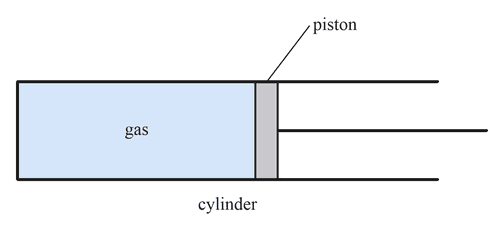
A cylinder fitted with a piston is filled with a gas at a given temperature and pressure. Explain on the basis of the kinetic theory, the increase in pressure of the gas as its temperature is increased.
- 565 marks
Question 56
According to the kinetic theory of gases, the pressure of a gas is expressed as , where is the density of the gas and is the mean square speed of gas molecules. Using this relation, show that the mean kinetic energy of a gas molecule is directly proportional to its absolute temperature.
- 575 marks
Question 57
Using the kinetic theory, derive an expression for the pressure exerted by an ideal gas, stating clearly the assumption which you make.
- 585 marks
Question 58
(a) Explain (i) Boyle's law and (ii) Charles's law.
(b) Explain how gases deviate from the ideal gas law.
(c) Derive the perfect gas equation.
What Class 11 Physics Ch 20 covers
The sections of the chapter, in the order the book takes them. Every question above comes from one of these.
- 01Kinetic Theory of Matter
- 02Assumptions of the Kinetic Theory of Gases
- 03Pressure Exerted by a Gas
- 04Kinetic Interpretation of Temperature
- 05Gas Laws from Kinetic Theory
- 06RMS Speed and Maxwell's Speed Distribution
More ways to study this chapter
The same chapter asked three other ways. Practise it, revise it, and see what the board has set on Ch 20 before.
Class 11 Physics Ch 20 questions students ask
How many questions are there in Class 11 Physics Ch 20?
58 questions. Every one is solved step by step on this page.
Are these Class 11 Physics solutions free?
Yes. Every question and its full working is free to read, with no account needed.
Can I download the Class 11 Physics Ch 20 solutions as a PDF?
There is no PDF to download. Every solution is on this page instead, which means it is searchable, always the current syllabus, and readable on a phone. Use your browser's print option if you want it on paper.