
Question 545 marksMedium
On the basis of the kinetic theory, explain why the pressure of a gas at constant volume increases with rise in temperature.
Confirming your payment
Sign up now and get 250 free tokens.
Kinetic Theory · Question 54 of 58
On the basis of the kinetic theory, explain why the pressure of a gas at constant volume increases with rise in temperature.
Solution:
Concept: By the kinetic theory, the pressure of a gas is the force per unit area exerted on the walls by the impacts of its molecules: , where is the number of molecules, the mass of each, the volume and the mean square speed. Temperature is a measure of the mean kinetic energy: .
Step 1 — Look at one molecule striking a wall. A molecule moving towards face A with velocity component rebounds elastically with , as in the figure. In each impact it gives the wall a momentum .
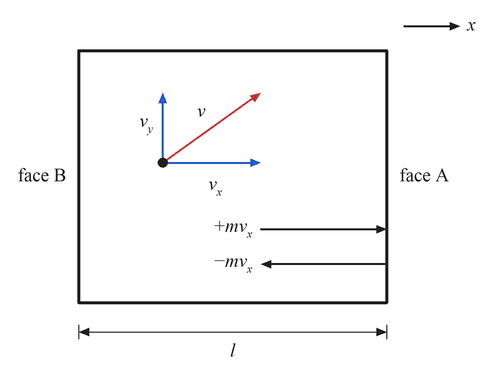
Step 2 — Count the impacts. Between two impacts on face A the molecule travels to the opposite face and back, a distance , so it strikes face A times per second. The force it exerts on the wall is therefore:
Adding the forces of all the molecules and dividing by the area gives .
Step 3 — Keep the volume constant. At constant volume, , and do not change, so:
Step 4 — Bring in the temperature. From :
Putting this into the pressure:
So at constant volume , which is the pressure law.
Step 5 — Explain it in words. When the gas is heated, its molecules move faster. Each molecule then (a) strikes the wall harder, giving it more momentum per impact, since grows with speed, and (b) strikes it more often, since also grows with speed. Both effects grow in proportion to the speed, so together the force grows as the square of the speed, that is, in proportion to the absolute temperature. For example, heating a gas from 300 K to 600 K in a closed vessel makes the r.m.s. speed times as large and doubles the pressure.
Therefore, at constant volume the pressure rises with temperature because the faster molecules strike the walls both harder and more often; since , the pressure is proportional to the absolute temperature, .