
Question 555 marksMedium
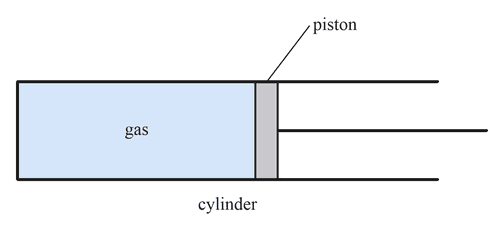
A cylinder fitted with a piston is filled with a gas at a given temperature and pressure. Explain on the basis of the kinetic theory, the increase in pressure of the gas as its temperature is increased.
Confirming your payment
Sign up now and get 250 free tokens.
Kinetic Theory · Question 55 of 58
A cylinder fitted with a piston is filled with a gas at a given temperature and pressure. Explain on the basis of the kinetic theory, the increase in pressure of the gas as its temperature is increased.
Solution:
Concept: The pressure of a gas on the piston is the force per unit area produced by the impacts of its molecules. By the kinetic theory , and the mean kinetic energy of a molecule is .
Step 1 — State the assumption. For the pressure to increase, the piston must be held in place, so the volume of the gas stays constant while it is heated. (If the piston were free, the gas would push it out and expand until its pressure again balanced the pressure outside.)
Step 2 — Find the force on the piston from one molecule. Let the gas column have length and the piston area , so . A molecule with velocity component towards the piston rebounds with , giving the piston momentum in each impact. It returns to the piston after travelling , so it strikes the piston times per second, and its average force on the piston is:
Step 3 — Add the forces of all the molecules. The motion is random, so on average . For molecules:
Dividing by the area :
Step 4 — Bring in the temperature. From , we have , so:
With the piston fixed, and are constant, so .
Step 5 — Explain the increase in words. Heating raises the mean kinetic energy of the molecules, so they move faster. Each molecule now strikes the piston harder (more momentum per impact) and more often (it crosses the column in less time). Both effects increase the force on the piston, and the pressure rises in proportion to the absolute temperature.
Therefore, when the gas in the cylinder is heated with the piston held fixed, its molecules move faster and strike the piston harder and more often, so the pressure rises in proportion to the absolute temperature ().