
Question 533 marksMedium
Explain (i) the concept of the law of equipartition of energy, (ii) the concept of mean free path and (iii) Avogadro's number.
Confirming your payment
Sign up now and get 250 free tokens.
Kinetic Theory · Question 53 of 58
Explain (i) the concept of the law of equipartition of energy, (ii) the concept of mean free path and (iii) Avogadro's number.
Solution:
Concept: These three ideas link the motion of single molecules to the measurable properties of a gas.
Step 1 — Part (i): explain the law of equipartition of energy. A molecule can store energy in several independent ways, its degrees of freedom (motion along , , ; rotation about different axes). The law states that for a system in thermal equilibrium at absolute temperature , the energy is shared equally among all the degrees of freedom, each having an average energy of per molecule. For example, a monatomic molecule, with 3 degrees of freedom, has mean energy .
Step 2 — Part (ii): explain the mean free path. A gas molecule moves in a straight line until it collides with another molecule, then changes direction, so its path is a zigzag. Each straight piece between two successive collisions is a free path, and the average length of these pieces is the mean free path .
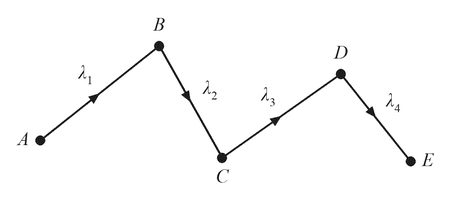
For molecules of diameter , with molecules per unit volume:
So the mean free path is long in a rare gas (small ) and short for large molecules. In air at room conditions it is about , of the order of .
Step 3 — Part (iii): explain Avogadro's number. Avogadro's number is the number of particles (molecules or atoms) in one mole of a substance:
Since 2019 this value is fixed exactly, and it defines the mole; 12 g of carbon-12 contains, very nearly, this number of atoms. If is the molar mass and the mass of one molecule, ; it also links the two gas constants, . By Avogadro's law, equal volumes of all gases at the same temperature and pressure contain equal numbers of molecules. So one mole of any gas (treated as ideal), which contains molecules, occupies about 22.4 litres at N.T.P. ( and ), or about 22.7 litres at and .
Therefore, (i) equipartition gives each degree of freedom an average energy of per molecule, (ii) the mean free path is the average distance between successive collisions, , and (iii) Avogadro's number, about , is the number of particles in one mole.