
Opening your dashboard
Class 11 Physics Chapter 20 Kinetic Theory: Competency-Based Questions (CBQ)
40 questions on Chapter 20, each worked through on its own page with the AI tutor. Class 11 Physics, ICSE 2026-27.
40 questions
1–5 marks · Mixed difficulty
- 13 marks
Question 1
Competency: Application
Rohan leaves a glass bottle half full of water on a laboratory bench at with its cap screwed on tightly. Over several days its water level does not fall at all, while the water in an identical open bottle beside it slowly dries up. The space above the water in the closed bottle holds air and water vapour. Once the level has stopped changing, the pressure of the water vapour in this space is . Take , , the density of water as and its molar mass as . (Hypothetical data.)
(a) Molecules keep leaving the surface of the water in the closed bottle. Use the kinetic theory of matter to explain why its level nevertheless stays the same.
(b) Treating the vapour as an ideal gas, find the number of water molecules in each cubic metre of the vapour. How many times more molecules are there in a cubic metre of liquid water?
(c) The closed bottle is moved to a shelf at , where the pressure of the vapour settles at . By what factor does the number of vapour molecules per cubic metre increase? Explain why this factor is much larger than the ratio of the absolute temperatures.
- 21 mark
Question 2
Competency: Analysis & Evaluation
A family keeps naphthalene balls in a wardrobe to protect woollen clothes. The wardrobe stays at about .
Assertion (A): The naphthalene balls slowly become smaller and finally disappear, although naphthalene melts only at about .
Reason (R): In a solid at a given temperature every molecule has the same kinetic energy, so the surface molecules leave the solid one after another at a steady, slow rate.
- 31 mark
Question 3
Competency: Analysis & Evaluation
A student tries to use to work out the pressure produced by the motion of the molecules in a glass of water.
Assertion (A): The kinetic theory of gases, in the form used to derive , cannot be applied to water in its liquid state.
Reason (R): In a liquid the molecules are packed close together and attract one another strongly, so the assumptions that the molecules are of negligible size and exert no forces on one another except during collisions do not hold.
- 41 mark
Question 4
Competency: Application
A tiny cavity inside a porous material is roughly a cube of side . It is filled with air at and . (Hypothetical data.) Take . One assumption of the kinetic theory is that a gas contains a very large number of molecules. On average, how many air molecules does the cavity hold, and can the kinetic-theory treatment of this air be trusted?
- 53 marks
Question 5
Competency: Application
A small satellite orbits at a height of about , moving at through the very thin upper atmosphere. There the gas is mainly oxygen atoms (mass , where ), and its density is about . The front face of the satellite has an area of and faces the direction of motion. The atoms' own random speeds, about , may be ignored. Assume that every atom striking the front face is brought to rest relative to the satellite. (Hypothetical data.)
(a) Find the momentum given to the satellite by one oxygen atom that strikes the front face.
(b) Find the mass of gas that the front face sweeps up each second, and the number of atoms that strike it each second.
(c) Hence find the drag force on the satellite and the pressure on its front face. How would the force change if every atom bounced straight back from the face with its speed unchanged?
- 61 mark
Question 6
Competency: Analysis & Evaluation
In deriving , the gas is placed in a cube of side . A student asks whether the shape of the container matters. The student puts the same number of molecules of the same gas, at the same temperature, into a rectangular box of the same volume, , but with length along , height and depth , as shown. Face A is an end face (perpendicular to ) and face B is the largest side face. The pressure of the gas in the cube is .
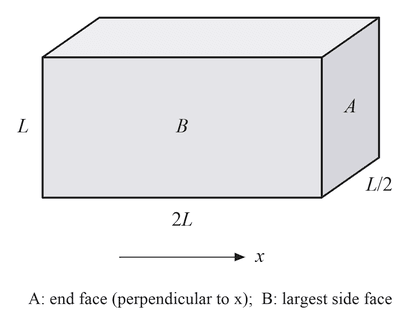
Which statement about the pressures on faces A and B of the box is correct?
- 73 marks
Question 7
Competency: Application
In a physics laboratory, a small cloud of rubidium-87 atoms (mass , where ) is held in a vacuum chamber and cooled with laser beams to a temperature of . The atoms hardly ever collide and behave as an ideal gas. Take . (Hypothetical data.)
(a) Find the mean translational kinetic energy of an atom in the cloud. How many times smaller is it than at room temperature, ?
(b) Find the r.m.s. speed of the atoms, and compare it with a slow walking speed of about .
(c) The laser beams are switched off and the cloud spreads out freely. About how far does an atom moving at the r.m.s. speed travel in ? Explain how photographing the size of the cloud at a known time lets the scientists find its temperature.
- 81 mark
Question 8
Competency: Analysis & Evaluation
A gas in a cylinder fitted with a piston is compressed very slowly. The metal walls of the cylinder stand in a large water bath, so the gas stays at the temperature of the bath throughout.
Assertion (A): During the compression, the mean translational kinetic energy of the gas molecules does not change.
Reason (R): As the gas is compressed, more molecules strike each unit area of the walls every second.
- 93 marks
Question 9
Competency: Application
A weather balloon is filled with of helium on the ground, where the pressure is and the temperature is . Its thin rubber envelope stretches easily, so the helium inside is always at very nearly the same pressure and temperature as the air outside. At a height of the air is at and . Assume that no helium escapes. Take . (Hypothetical data.)
(a) Use to find the number of helium atoms in the balloon.
(b) Find the volume of the balloon at .
(c) Using the kinetic theory, explain why the balloon grows as it rises, even though the helium inside it cools.
- 101 mark
Question 10
Competency: Analysis & Evaluation
A gas syringe with a light, frictionless plunger holds air at . The outside air keeps the pressure on the plunger constant, and the syringe is slowly warmed to . In the kinetic theory, the number of molecules striking unit area of a wall each second is proportional to , where is the number of molecules per unit volume and is their average speed. How does the number of molecules striking each square centimetre of the plunger per second change?
- 111 mark
Question 11
Competency: Analysis & Evaluation
A data book states that dry air near sea level is made up of about 78 % nitrogen molecules and 21 % oxygen molecules, by number.
Assertion (A): In dry air near sea level, the oxygen molecules provide about 21 % of the total pressure of the air.
Reason (R): An oxygen molecule is heavier than a nitrogen molecule, so, on average, each impact of an oxygen molecule on a wall gives the wall more momentum.
- 123 marks
Question 12
Competency: Application
In a research laboratory, potassium atoms (molar mass ) stream out of a small hole in an oven at into a vacuum and pass through a speed selector, as shown. The selector is two discs, apart, fixed on one axle that turns at revolutions per minute. Each disc has a narrow slit, and the slit in the second disc lies behind the slit in the first disc in the sense of rotation. Only atoms that pass through the first slit and reach the second disc just as its slit comes round get through to the detector. Take . For a gas of molar mass at absolute temperature , the r.m.s. speed is and the most probable speed is . (Hypothetical data.)
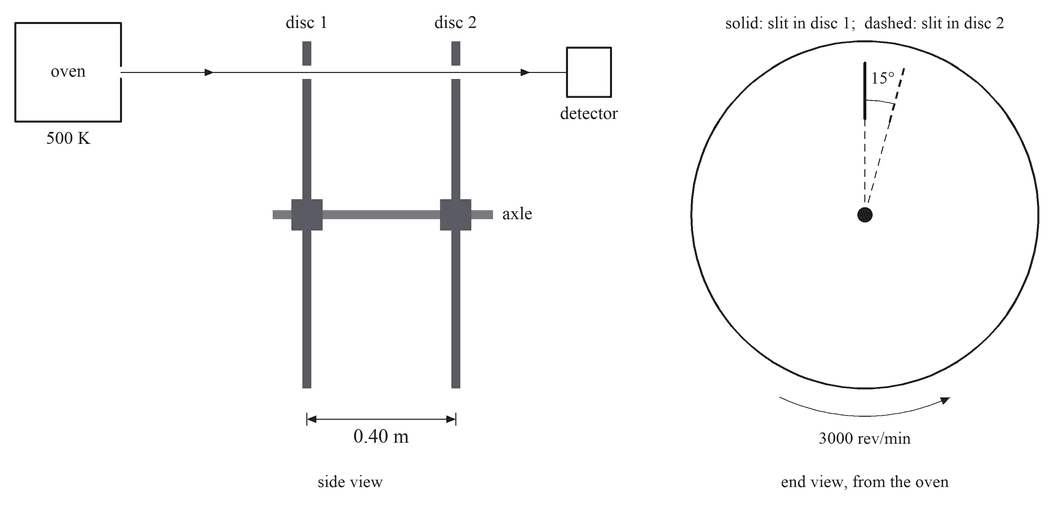
(a) Find the speed of the atoms that reach the detector.
(b) Find the r.m.s. speed and the most probable speed of potassium atoms in the oven. Which of these is closer to the speed found in (a)?
(c) At what rate, in revolutions per minute, should the axle turn so that the atoms reaching the detector move at the r.m.s. speed of the atoms in the oven?
- 131 mark
Question 13
Competency: Application
On a winter morning in Delhi the air temperature is , and on a summer afternoon it is . (Hypothetical data.) Compared with the winter morning, the r.m.s. speed of the nitrogen molecules in the air on the summer afternoon is higher by about
- 141 mark
Question 14
Competency: Analysis & Evaluation
A student studies Maxwell's distribution of molecular speeds for nitrogen at about , where the most probable speed is about .
Assertion (A): More nitrogen molecules have speeds between and than between and .
Reason (R): For small speeds, the number of molecules per unit range of speed grows in proportion to , so it is very small close to .
- 154 marks
Question 15
Competency: Analysis & Evaluation
A thermally insulated rigid container is divided into two parts by a partition. One part holds of helium at , and the other holds of nitrogen at . The partition is removed and the gases mix, with no heat entering or leaving and no work done. Treat helium as monatomic, with 3 degrees of freedom, and nitrogen as a rigid diatomic gas, with 5 degrees of freedom. Take and . (Hypothetical data.)
(a) Using the law of equipartition of energy, find the internal energy of each gas before mixing.
(b) Find the temperature of the mixture.
(c) After mixing, compare (i) the mean translational kinetic energy of a helium atom with that of a nitrogen molecule, and (ii) their mean total kinetic energies.
- 161 mark
Question 16
Competency: Analysis & Evaluation
Oxygen in a sealed rigid container is heated from to . Treat each oxygen molecule as a rigid dumb-bell, which can move in three directions and rotate about two axes.
Assertion (A): When the absolute temperature is doubled, the mean rotational kinetic energy of the molecules doubles, but their mean translational kinetic energy stays the same.
Reason (R): By the law of equipartition of energy, every degree of freedom of a molecule, whether translational or rotational, has the same mean energy, .
- 174 marks
Question 17
Competency: Analysis & Evaluation
In winter, a room measuring is warmed by an electric heater from to . The air in the room is at a pressure of . Treat it as an ideal gas of rigid diatomic molecules, with molar heat capacity at constant volume , and take . Ignore the heat taken up by the walls and furniture. (Hypothetical data.)
(a) If the room were perfectly sealed, how many moles of air would it hold, and how much heat would the air need?
(b) By what percentage would the pressure in the sealed room rise?
(c) In fact some air leaks out through gaps round the door and windows, so the pressure stays at . Using and , show that the internal energy of the air inside the room is the same at as it was at . Where does the heater's energy go?
- 181 mark
Question 18
Competency: Analysis & Evaluation
The graph shows, in simplified form, how the molar heat capacity at constant volume, , of hydrogen gas changes with absolute temperature , plotted on a scale on which each marked step is ten times the one before. is given in units of .
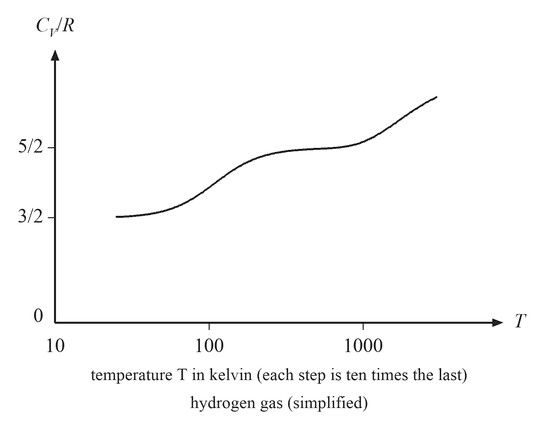
Between about and , stays close to . By the law of equipartition of energy, each degree of freedom that takes part adds to . In this range of temperature, the energy given to the gas is shared among
- 191 mark
Question 19
Competency: Analysis & Evaluation
A sealed steel cylinder of fixed volume holds of argon, a monatomic gas. The argon is warmed from to . Take the molar gas constant as .
Assertion (A): The argon absorbs about of heat.
Reason (R): At constant volume, part of the heat supplied to a gas is used by the gas to do work on its surroundings.
- 204 marks
Question 20
Competency: Analysis & Evaluation
In 1865 Josef Loschmidt combined the mean free path of gas molecules with the density of the liquid to make one of the first estimates of the size of molecules. Follow a simple version of his method for argon, using these rounded data. At and normal atmospheric pressure, argon gas has density , and the mean free path of its atoms, found from experiments on the flow of the gas, is . Liquid argon has density . Assume that in the liquid the atoms, each of diameter , are packed so closely that each one takes up a cube of side . The molar mass of argon is . Use , where is the number of atoms per unit volume of the gas.
(a) Explain why , where is the number of atoms per unit volume of the liquid. Hence show that .
(b) Find .
(c) Use and the density of liquid argon to estimate Avogadro's number, and compare your estimate with the accepted value, .
- 213 marks
Question 21
Competency: Application
A well-known estimate asks whether the air you breathe in now contains any of the molecules from one particular breath breathed out long ago, for example by a great-grandparent. Take one breath to be of air at and . The whole atmosphere has a mass of about , and the average molar mass of air is . Take and . Assume that, over the years, the molecules of that old breath have spread evenly through the whole atmosphere.
(a) Find the number of molecules in one breath.
(b) Find the number of molecules in the whole atmosphere.
(c) On average, how many molecules from that old breath are in each breath you take now?
- 221 mark
Question 22
Competency: Application
Filament lamps are not left empty: the glass bulb is usually filled with an inert gas such as argon, at a pressure a little below atmospheric pressure when the lamp is cold. Tungsten atoms slowly evaporate from the white-hot filament, which thins the filament and blackens the inside of the glass. The main reason for the gas filling is that
- 233 marks
Question 23
Competency: Analysis & Evaluation
A carbon dioxide fire extinguisher at contains liquid carbon dioxide under pressure, but a cylinder of nitrogen at contains only gas, however high its pressure. For a gas obeying the van der Waals equation, for one mole, the critical temperature, above which the gas cannot be liquefied by pressure alone, is . For carbon dioxide and ; for nitrogen and . Take .
(a) Find the critical temperature of each gas, in kelvin and in degrees Celsius.
(b) Use your answers to explain the difference between the extinguisher and the nitrogen cylinder. What must be done to turn nitrogen into a liquid?
(c) What property of the molecules does the constant measure? Explain why a gas with a larger tends to have a higher critical temperature.
- 241 mark
Question 24
Competency: Application
In the van der Waals equation, the constant is about four times the actual volume of the molecules in one mole. For molecules of diameter , this means . For nitrogen, . Taking , the diameter of a nitrogen molecule estimated in this way is about
- 251 mark
Question 25
Competency: Analysis & Evaluation
A thermally insulated rigid vessel is divided into two halves by a thin partition. One half holds carbon dioxide gas and the other is evacuated. The partition is broken, and the gas rushes into the empty half.
Assertion (A): The temperature of the carbon dioxide falls slightly.
Reason (R): As the molecules spread apart, they do work against their mutual attraction, so their average kinetic energy decreases.
- 263 marks
Question 26
The length of a faulty barometer is 90 cm and there is a little air above the mercury. When the atmospheric pressure is 76 cm of Hg, it reads 74.8 cm. What will be the true atmospheric pressure if the reading on the barometer is 74.3 cm?
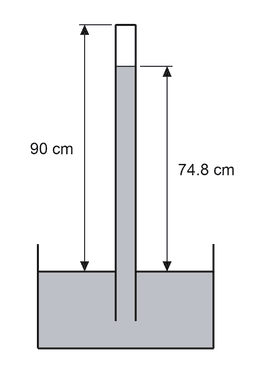
- 273 marks
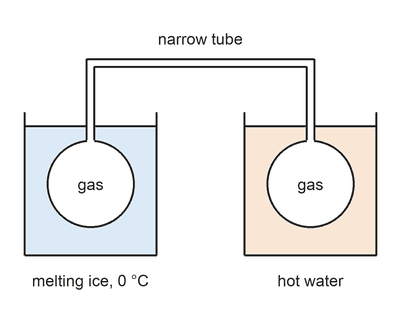
Question 27
Two glass bulbs of same volume containing a gas at NTP are connected by a very narrow tube. The pressure is 88.46 cm of mercury when one bulb is kept in ice and the other in hot water. Calculate the temperature of the hot water.
- 283 marks
Question 28
1.5 mole of at 77°C and at a pressure of 5 atmosphere is mixed with 0.5 mole of helium at 27°C and at a pressure of 2 atmosphere. The volume of the mixture is equal to the sum of their initial volumes. What is the pressure of the mixture if the temperature of the mixture is 69°C?
- 293 marks
Question 29
Calculate the frequency of revolution of a hydrogen molecule at 27°C about its own axis, assuming it to be diatomic, with distance between the atoms as 1.5 Å. Mass of each atom is kg. .
- 303 marks
Question 30
Two perfect gases (1) and (2) are at temperatures and . If the number of molecules of the two gases are and and the masses of the molecules and , find the resulting temperature when the two gases are mixed. Assume that there is no loss of energy on mixing the two gases.
- 313 marks
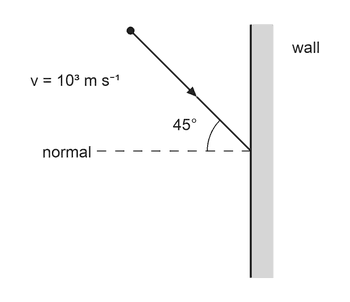
Question 31
If hydrogen molecules per second strike 2 cm² of wall at an angle of 45° with the normal when moving with a speed of m/s, what pressure do they exert on the wall? Given the mass of molecule is g.
- 321 mark
Question 32
Competency: Analysis
In older uranium-enrichment plants, uranium was turned into the gas uranium hexafluoride, , and pumped through thousands of porous barriers with very fine holes. Molecules pass through such holes at a rate proportional to their average speed, so the lighter molecules (molar mass ) get through slightly faster than (). In an ideal stage, the ratio of the number of atoms to the number of atoms in the gas that gets through is multiplied by the ratio of the average speeds of the two kinds of molecule at the same temperature. Natural uranium has of atoms, and reactor fuel needs . About how many ideal stages are needed, one after another?
- 331 mark
Question 33
Competency: Application & Analysis
On its low setting, a hair dryer draws in room air at and blows it out at . The air passes through it at atmospheric pressure, at a rate of each second. (Hypothetical data.) Treat air as an ideal gas of rigid diatomic molecules, with 5 degrees of freedom, and take . Ignoring heat lost to the surroundings and the energy used by the fan, the power that the heating element must supply is about
- 341 mark
Question 34
Competency: Analysis & Evaluation
At a height of about , the very thin gas of the upper atmosphere is at a temperature of about , but it holds only about particles in each cubic metre, compared with about in air at sea level. (Hypothetical data.) An astronaut on a spacewalk holds a thermometer in the shade of the space station.
Assertion (A): The thermometer reads a temperature far below .
Reason (R): The mean translational kinetic energy of a gas particle is proportional to the absolute temperature, so a particle there has about times the mean translational kinetic energy of an air molecule at .
- 351 mark
Question 35
Competency: Analysis & Evaluation
A computer program follows every molecule of a gas in a closed box, and the molecules move in random directions. At one instant the program changes the speed of every molecule to the same value, equal to the r.m.s. speed of the molecules just before the change. The direction in which each molecule moves is not changed.
Assertion (A): Just after the change, the gas exerts the same pressure on the walls as it did just before.
Reason (R): For a gas whose molecules move in random directions, , so the pressure depends on the molecular speeds only through the mean of their squares.
- 362 marks
Question 36
Competency: Application
A trekker flies from Chennai, where the air is at and , to Leh in Ladakh, where on a March morning the air is at and . (Hypothetical data.) At both places of the molecules in dry air are oxygen molecules. Take and treat air as an ideal gas.
(a) Using , find the number of oxygen molecules in each cubic metre of air at Chennai and at Leh.
(b) At rest in Chennai, the trekker takes breaths a minute. Assuming each breath draws in the same volume of outside air, about how many breaths a minute are needed at Leh to take in the same number of oxygen molecules each minute?
- 372 marks
Question 37
Competency: Analysis
A cloud of hydrogen gas in space between the stars holds about one hydrogen atom in each cubic centimetre, at a temperature of about . Take the effective diameter of a hydrogen atom for collisions as , and the mean free path as , where is the number of atoms per unit volume. (Hypothetical data.)
(a) Find the mean free path of an atom in the cloud, and compare it with the distance from the Earth to the Sun, .
(b) A large body of gas behaves as a gas with a single temperature only if each atom collides many times while crossing it, so that energy is shared among the atoms. The cloud is about across. About how many collisions does an atom make in crossing it? Does the cloud behave as a gas in this sense?
- 383 marks
Question 38
Competency: Evaluation
Early one morning, at , a car tyre is filled with air to a gauge pressure of . A tyre gauge reads the pressure above atmospheric pressure, which is . After a long drive on a hot afternoon the air in the tyre is at . Treat the volume of the tyre as constant and the air as an ideal gas. (Hypothetical data.) A tyre shop advertises: "Fill your tyres with pure nitrogen. Its pressure rises much less than that of air when the tyre heats up."
(a) Find the gauge pressure of the air-filled tyre at .
(b) Use the kinetic interpretation of temperature to evaluate the shop's claim. What would the gauge pressure of the tyre at be if it had been filled with pure nitrogen to the same gauge pressure at ?
(c) A student works out the hot pressure as . Find the value this gives, and explain the two mistakes the student has made.
- 393 marks
Question 39
Competency: Creativity
A cold-storage company wants a simple thermometer for its freezer rooms, which work between and . It has a rigid metal bulb of volume , a long thin tube, a pressure sensor that shows pressure in kPa, a bucket of melting ice, and cylinders of helium and of carbon dioxide. The thermometer is to work on the pressure law.
(a) Describe how you would build and calibrate the thermometer. State which gas you would choose and why, using the assumptions of the kinetic theory of gases, and say how you would keep the volume of the gas constant.
(b) The bulb is sealed with the chosen gas when it is in melting ice, and the sensor then reads . Find the reading when the bulb is at .
(c) Write the rule that the display should use to change a pressure reading (in kPa) into a temperature in degrees Celsius, and use it to find the temperature when the sensor reads . Take as .
- 405 marks
Question 40
Competency: Application & Analysis
In 1931 the German physicist Eugen Kappler hung a tiny mirror from a very fine fibre inside a closed chamber of gas. Gas molecules strike the mirror at random, so it never stays still: it keeps twisting through tiny random angles about its rest position. A beam of light reflected from the mirror onto a distant scale shows this jitter. The mirror is in thermal equilibrium with the gas, so by the law of equipartition of energy the mean value of its twisting energy, , is , where is the torsion constant of the fibre. Kappler used this to measure Avogadro's number.
A student repeats the idea with a fibre of torsion constant and measures the mean square angle at four temperatures. (Hypothetical data.)
Temperature (K) 250 300 350 400 () 1.73 2.07 2.42 2.76 Take .
(a) Show that the law of equipartition predicts , and check whether the data agree with this prediction.
(b) Use all four readings to find Boltzmann's constant , and hence Avogadro's number.
(c) At , the light beam falls on a scale from the mirror. When the mirror turns through an angle , the reflected beam turns through . Find the r.m.s. jitter of the light spot on the scale. The student then pumps out most of the gas, keeping the chamber at , expecting the jitter to become much smaller because fewer molecules strike the mirror. Evaluate this expectation.