
Competency: Application
In a research laboratory, potassium atoms (molar mass ) stream out of a small hole in an oven at into a vacuum and pass through a speed selector, as shown. The selector is two discs, apart, fixed on one axle that turns at revolutions per minute. Each disc has a narrow slit, and the slit in the second disc lies behind the slit in the first disc in the sense of rotation. Only atoms that pass through the first slit and reach the second disc just as its slit comes round get through to the detector. Take . For a gas of molar mass at absolute temperature , the r.m.s. speed is and the most probable speed is . (Hypothetical data.)
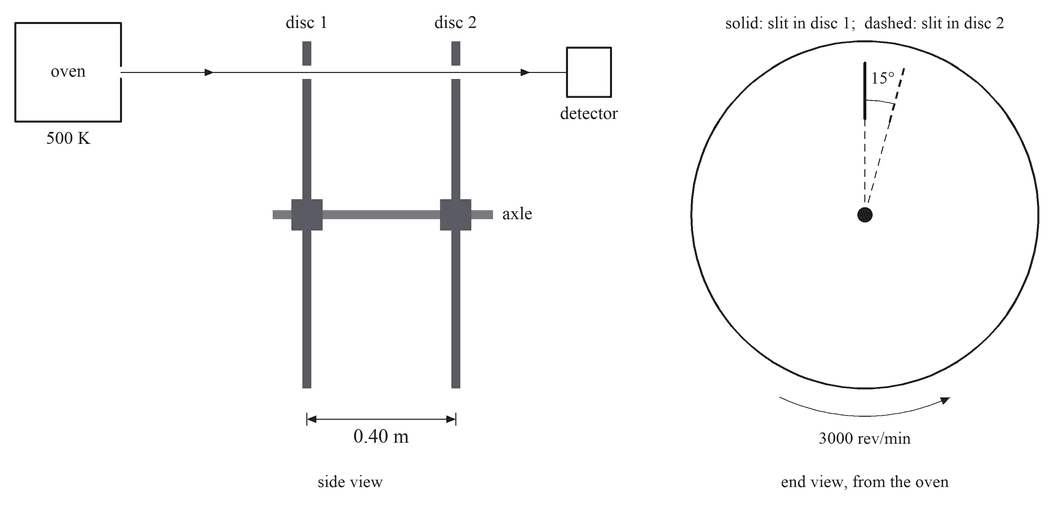
(a) Find the speed of the atoms that reach the detector.
(b) Find the r.m.s. speed and the most probable speed of potassium atoms in the oven. Which of these is closer to the speed found in (a)?
(c) At what rate, in revolutions per minute, should the axle turn so that the atoms reaching the detector move at the r.m.s. speed of the atoms in the oven?