
Question 585 marksMedium
(a) Explain (i) Boyle's law and (ii) Charles's law.
(b) Explain how gases deviate from the ideal gas law.
(c) Derive the perfect gas equation.
Confirming your payment
Sign up now and get 250 free tokens.
Kinetic Theory · Question 58 of 58
(a) Explain (i) Boyle's law and (ii) Charles's law.
(b) Explain how gases deviate from the ideal gas law.
(c) Derive the perfect gas equation.
Solution:
Concept: By the kinetic theory, for a gas of mass , and the mean square speed is proportional to the absolute temperature . The gas laws follow from these two facts for an ideal gas.
Step 1 — Part (a)(i): explain Boyle's law. Boyle's law states that at constant temperature the volume of a given mass of gas is inversely proportional to its pressure, . By the kinetic theory, at constant temperature is constant, so is constant. In words: if the volume is halved, the molecules, still moving at the same speeds, are twice as crowded and strike each unit area of the wall twice as often, so the pressure doubles.
Step 2 — Part (a)(ii): explain Charles's law. Charles's law states that at constant pressure the volume of a given mass of gas is directly proportional to its absolute temperature, . By the kinetic theory, ; at constant pressure , and , so . In words: heated molecules strike harder and more often, so to keep the pressure unchanged the gas must expand.
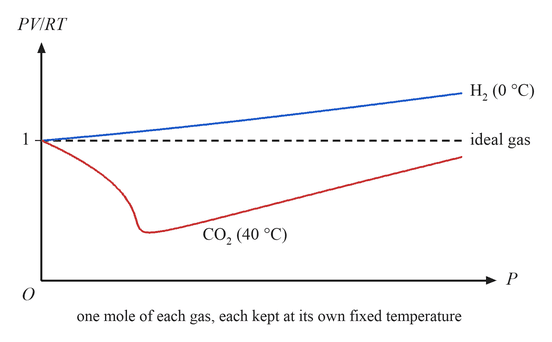
Step 3 — Part (b): explain the deviations. Real gases obey closely only at low pressure and high temperature. At high pressure and low temperature they deviate for two reasons. First, the molecules have a definite size, so the space free for their motion is less than , which makes larger than the ideal value. Second, the molecules attract one another, so a molecule about to hit the wall is pulled back and strikes it less hard, which makes smaller than the ideal value. The graph shows for one mole against (drawn from the van der Waals equation, which allows for both effects): it is 1 for an ideal gas, rises steadily for hydrogen, and for carbon dioxide first falls and then rises.
Step 4 — Part (c): start the derivation. We now combine Boyle's and Charles's laws.
Step 5 — Choose a two-step change. Let a given mass of gas go from state A to state C in two steps: first from A to B at constant temperature , until its pressure is and its volume ; then from B to C at constant pressure , until its temperature is .

Step 6 — Apply Boyle's law from A to B. The temperature stays , so is constant:
Step 7 — Apply Charles's law from B to C. The pressure stays , so is constant:
Step 8 — Equate the two expressions for . Both give the same volume , so:
Since A and C are any two states, is the same in every state of the given mass of gas.
Step 9 — Write the equation of state. For one mole of gas this constant is the universal gas constant :
For moles the volume is times as large at the same and , so:
Therefore, (a) Boyle's law ( constant at constant ) and Charles's law ( at constant ) follow from with ; (b) real gases deviate at high pressure and low temperature because their molecules have size and attract one another; (c) the perfect gas equation is .