
Question 575 marksMedium
Using the kinetic theory, derive an expression for the pressure exerted by an ideal gas, stating clearly the assumption which you make.
Confirming your payment
Sign up now and get 250 free tokens.
Kinetic Theory · Question 57 of 58
Using the kinetic theory, derive an expression for the pressure exerted by an ideal gas, stating clearly the assumption which you make.
Solution:
Concept: The pressure of a gas is the force per unit area on the walls of its vessel. By Newton's second law, the force is the rate at which momentum is given to the walls by the molecules striking them.
Step 1 — State the assumptions. We assume that:
Step 2 — Set up the vessel. Let the gas be in a cube of side , volume . Consider one molecule with velocity , whose components along the three edges are , and , so that . The figure shows the molecule and face A, perpendicular to the -axis.
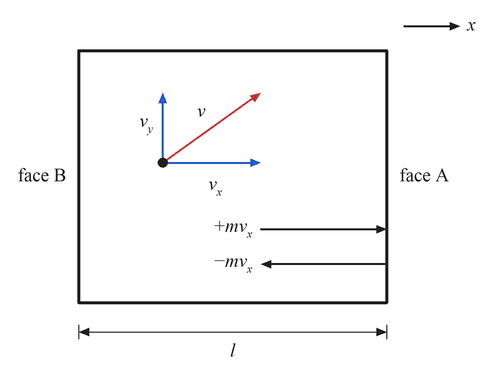
Step 3 — Find the momentum change in one impact. The molecule strikes face A with -momentum and, the collision being elastic, rebounds with ; the other components are unchanged. The change in its momentum is:
By Newton's third law, the wall receives a momentum .
Step 4 — Count the impacts per second. After striking face A, the molecule travels to face B and back, a distance , before it strikes A again. The time between impacts is , so the number of impacts per second is .
Step 5 — Find the force on face A due to one molecule. The force equals the momentum given per second:
Step 6 — Add up all the molecules. If are the -components of the velocities of the molecules, the total force on face A is:
The area of face A is , so the pressure on it is:
Step 7 — Use the randomness of the motion. Since the molecules move at random, no direction is preferred, so the sums of , and over all molecules are equal. Each is therefore one-third of the sum of :
Here is the mean square speed of the molecules.
Step 8 — Write the pressure. We substitute this sum and :
The total mass of the gas is , so its density is , and:
The same pressure acts on every face, as Pascal's law requires.
Therefore, the pressure exerted by an ideal gas is , or , where is its density and the mean square speed of its molecules.