
Opening your dashboard
Class 11 Physics Chapter 20 Kinetic Theory: Practice Questions
127 questions on Chapter 20, each worked through on its own page with the AI tutor. Class 11 Physics, ICSE 2026-27.
127 questions
1–3 marks · Mixed difficulty
- 11 mark
Question 1
A drop of diluted milk is viewed under a microscope at a magnification of about 400. The tiny fat droplets in it are seen jiggling about all the time in random directions. A student suggests that the jiggling is caused by slow currents in the water. Which further observation shows that the student is wrong and supports the kinetic theory of matter?
- 23 marks
Question 2
At and normal atmospheric pressure (), of liquid water occupies about , while of steam occupies about .
(a) By what factor is the average distance between neighbouring molecules larger in the steam than in the liquid water?
(b) About of heat is needed to turn this of water at into steam at . Using the kinetic theory of matter, explain where this energy goes, given that the temperature does not change. Find the part of it that is used in pushing back the atmosphere.
- 31 mark
Question 3
According to the kinetic theory of matter, which statement about the molecules of a substance in its three states is correct?
- 42 marks
Question 4
A little water left in a saucer in a room at dries up in a few hours, although water boils only at . A wet cloth wrapped round a bottle of water keeps the bottle cool.
(a) Use the kinetic theory of matter to explain why water evaporates at a temperature well below its boiling point.
(b) Explain why evaporation cools the water that is left behind.
- 51 mark
Question 5
A tiny fog droplet is a sphere of water in diameter. Take the density of water as , its molar mass as and . The number of water molecules in the droplet is about
- 61 mark
Question 6
One assumption of the kinetic theory of gases is that the molecules exert no forces on one another, or on the walls, except during collisions. Neglecting the weight of the molecules, which result follows directly from this assumption?
- 71 mark
Question 7
The molecules of a gas in a container at rest move at random, with no preferred direction. For nitrogen at about , the mean square speed of the molecules is about . Taking the -axis along one edge of the container, the mean value of the velocity component and the mean value of are, respectively,
- 83 marks
Question 8
The figure shows a laboratory model of a gas. Steel balls rest on a plate at the bottom of a vertical glass tube. A vibrator drives the plate rapidly up and down, so that the balls fly about at random inside the tube, and a light disc placed on top is kept floating on the bouncing balls.
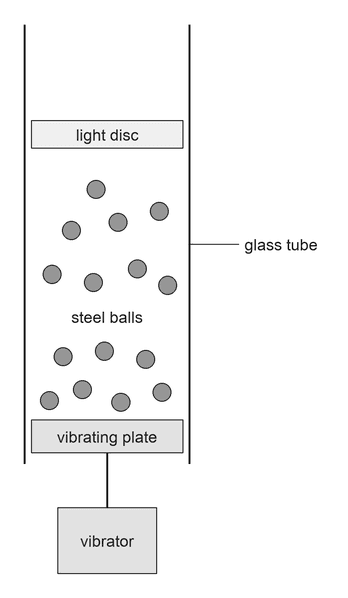
(a) Which property of a gas does the support of the disc by the balls model? Explain how.
(b) When the vibrator is made to vibrate more vigorously, the disc rises and floats at a higher level. What does the more vigorous vibration represent, and which gas law does this illustrate?
(c) When the vibrator is switched off, the balls soon come to rest on the plate. Which assumption of the kinetic theory of gases do the steel balls fail to obey? Why does a real gas sealed in an insulated container not "run down" in this way?
- 92 marks
Question 9
One assumption of the kinetic theory of gases is that the time a collision takes is negligible compared with the time between collisions. In nitrogen at and normal atmospheric pressure, the average speed of a molecule is about , the average distance a molecule travels between collisions (its mean free path) is about , and the diameter of a molecule is about .
(a) Find the average time between collisions of a molecule.
(b) Treat a collision as lasting about the time a molecule takes to travel a distance equal to its own diameter. Estimate this time, and use your answers to test the assumption.
- 103 marks
Question 10
A diving cylinder holds air at and a pressure of (about 200 atmospheres). Treat the air as an ideal gas whose molecules, like those of nitrogen, have a diameter of about , and take .
(a) Find the average volume available to each molecule in the cylinder, and hence the average distance between neighbouring molecules.
(b) Compare this distance with the diameter of a molecule, and say whether the kinetic-theory assumption that the molecules are of negligible size is reasonable in the cylinder.
(c) Estimate the pressure, at the same temperature, at which the average distance between neighbouring molecules would be three molecular diameters.
- 113 marks
Question 11
(Hypothetical data.) A single nitrogen molecule (mass , where ) moves inside a cubical box of side . Its velocity component perpendicular to the face A of the box is , as shown in the figure. Assume that it collides elastically with the walls and with nothing else.

(a) Find the change in the molecule's momentum in one collision with face A.
(b) How many times per second does the molecule strike face A?
(c) Find the average force that the molecule exerts on face A.
- 121 mark
Question 12
A classroom measures , and the air in it is at a pressure of . (Hypothetical data.) Using , the total translational kinetic energy of all the air molecules in the room is about
- 133 marks
Question 13
At a height of about , the air has a pressure of about and contains about molecules per cubic metre. At sea level, where the pressure is and the temperature about , there are about molecules per cubic metre. Take .
(a) Use the kinetic-theory result , where is the number of molecules per unit volume and the mean translational kinetic energy of a molecule, to find at a height of .
(b) Hence find the temperature of the air at that height.
(c) The pressure at is about three million times smaller than at sea level. Use your results to explain which factor is mainly responsible for this.
- 141 mark
Question 14
An ideal gas in a rigid container exerts a pressure . Half of its molecules are let out while the temperature is kept the same. The gas left in the container is then heated until the r.m.s. speed of its molecules is twice its original value. The final pressure is
- 152 marks
Question 15
In deriving for a gas in a cubical box, a molecule is followed as it crosses from one face to the opposite face and back, as if it never met another molecule on the way. In a real gas, each molecule collides with other molecules millions of times in crossing the box. Explain why ignoring these collisions does not change the result for the pressure.
- 162 marks
Question 16
Take and .
(a) At what temperature is the mean translational kinetic energy of the molecules of an ideal gas equal to ?
(b) Find this mean energy, in electronvolts, for the molecules of the air in your lungs, at a body temperature of .
- 173 marks
Question 17
Two equal samples of the same ideal gas, containing the same number of molecules, are kept in the two halves of an insulated box. The halves are separated by a thin, fixed metal wall, as shown. The gas on the left is at and the gas on the right at . (Hypothetical data.)
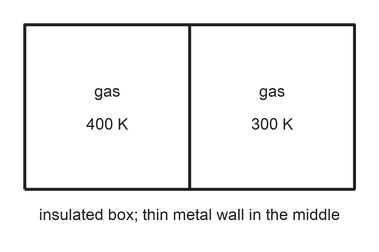
(a) Using the kinetic interpretation of temperature, describe how energy passes from the gas on the left to the gas on the right through collisions with the wall.
(b) When does the flow of energy stop?
(c) Neglecting the energy taken up by the wall, find the final temperature of the two samples.
- 181 mark
Question 18
For an ideal gas, the mean translational kinetic energy of a molecule is plotted against the temperature measured in degrees Celsius. The plot obtained is
- 192 marks
Question 19
Since 2019 the SI has fixed the Boltzmann constant at exactly and the Avogadro constant at exactly .
(a) Use these values to find the universal gas constant to four significant figures.
(b) Find the mean translational kinetic energy of a molecule of an ideal gas at , the triple point of water.
- 201 mark
Question 20
An ideal gas is sealed in a rigid steel vessel at . On heating, its pressure rises from to . (Hypothetical data.) The mean translational kinetic energy of its molecules is multiplied by
- 213 marks
Question 21
Two identical balloons each hold of gas at and . One is filled with helium (molar mass ) and the other with sulphur hexafluoride, (molar mass ). (Hypothetical data.)
(a) Starting from , and the fact that the molecules of different gases at the same temperature have the same mean translational kinetic energy, show that the two balloons contain the same number of molecules.
(b) Find this number. Take .
(c) Find the ratio of the mass of gas in the balloon to the mass of gas in the helium balloon.
- 221 mark
Question 22
In a laboratory test, an unknown gas diffuses through a porous plug at times the rate at which oxygen (molar mass ) diffuses through it, under the same conditions of temperature and pressure. (Hypothetical data.) By Graham's law, the molar mass of the unknown gas is about
- 233 marks
Question 23
A vessel of volume contains a mixture of two ideal gases that do not react with each other: molecules of mass and molecules of mass , all at the same temperature .
(a) Using the kinetic-theory expression for each gas, show that the total pressure of the mixture is the sum of the pressures that each gas would exert if it alone filled the vessel (Dalton's law of partial pressures). State the assumption of the kinetic theory that makes this possible.
(b) In dry air at sea level, about of the molecules are oxygen molecules. Find the partial pressure of oxygen when the total pressure is .
- 243 marks
Question 24
The air inside a hot-air balloon is heated to about , while the air outside is at . The envelope is open at the bottom, so the pressure inside is practically the same as outside. The density of the outside air is . (Hypothetical data.) Treat air as an ideal gas.
(a) Using and the kinetic interpretation of temperature, show that at constant pressure the density of a gas is inversely proportional to its absolute temperature.
(b) Find the density of the hot air inside the balloon.
(c) Find the mass that each cubic metre of hot air can lift (the difference between the weights of a cubic metre of outside air and of inside air, expressed as a mass).
- 253 marks
Question 25
The figure shows graphs of pressure against for the same sample of an ideal gas at two different temperatures, and . The sample contains of gas. (Hypothetical data.) Take .
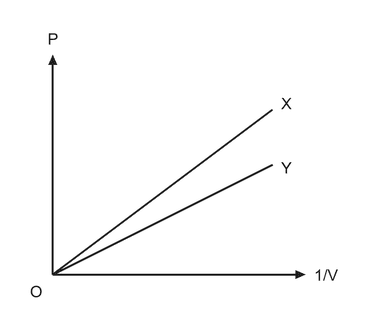
(a) Use the kinetic theory to explain why each graph is a straight line through the origin.
(b) Which line, X or Y, belongs to ? Give a reason.
(c) Find the slope of each line, with its unit.
- 261 mark
Question 26
In a computer simulation of argon gas (molar mass ) in a closed box, the speed distribution of the atoms has its peak at . (Hypothetical data.) Taking , the temperature of the gas is about
- 273 marks
Question 27
Nitrogen molecules (, molar mass ) are in air at . Take .
(a) Find the r.m.s. speed of the molecules.
(b) Find their average (mean) speed and most probable speed.
(c) A passenger jet cruises at about . How many times faster than the jet does a nitrogen molecule move at the r.m.s. speed?
- 281 mark
Question 28
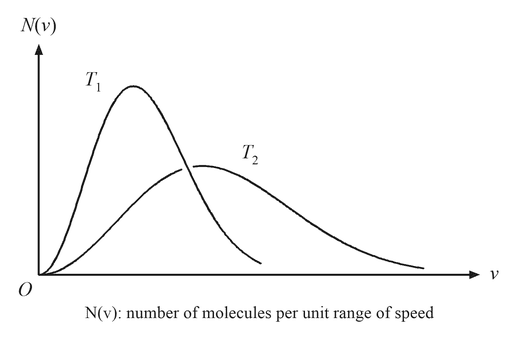
The figure shows Maxwell's speed distribution for the same sample of oxygen at two temperatures, and . Which statement is correct?
- 293 marks
Question 29
Equal numbers of hydrogen molecules (, molar mass ) and nitrogen molecules (, molar mass ) are at the same temperature, . For any gas, Maxwell's speed-distribution curve has the same shape: its width is proportional to the most probable speed , and the area under it equals the number of molecules. Take .
(a) Find the most probable speed of each gas.
(b) Which gas has the taller, narrower curve? Find the ratio of the heights of the two peaks.
(c) The hydrogen curve lies at much higher speeds. Does this mean that hydrogen molecules have more kinetic energy on average? Explain.
- 301 mark
Question 30
For a given gas, Maxwell's speed-distribution curve keeps the same shape when the temperature changes: it is stretched along the speed axis in proportion to the most probable speed, while the area under it (the total number of molecules) stays the same. If the absolute temperature of a sample of gas is made four times as large, the height of the peak of the curve
- 311 mark
Question 31
A methane molecule () has five atoms arranged in a rigid three-dimensional (non-linear) shape. If the molecule is treated as rigid, so that its atoms cannot vibrate, how many degrees of freedom does it have?
- 323 marks
Question 32
A sealed rigid flask holds of nitrogen () at room temperature, where each molecule behaves as a rigid diatomic molecule. The gas is given of heat. (Hypothetical data.) Take , and .
(a) Find the rise in temperature.
(b) Using the law of equipartition of energy, find how much of the goes into rotation of the molecules and how much into translation.
(c) Find the increase in the average translational kinetic energy of one molecule.
- 331 mark
Question 33
Xenon atoms held on a flat, cold metal surface can move freely along the surface but cannot leave it. In a simple model they are treated as an ideal two-dimensional gas: each atom moves only in the plane of the surface, and any vibration at right angles to the surface is ignored. The surface is at . (Hypothetical data.) Taking , the average kinetic energy of one xenon atom is
- 342 marks
Question 34
A diatomic molecule such as can in principle rotate about three perpendicular axes through its centre of mass, yet at room temperature only two rotational degrees of freedom are counted. Explain why. State the total number of degrees of freedom of the molecule and its average energy at absolute temperature .
- 352 marks
Question 35
The degrees of freedom of a system are the number of independent coordinates needed to fix its position and configuration completely. State the number of degrees of freedom of each of the following, naming the coordinates in each case.
(a) A bead that can only slide along a straight, fixed wire.
(b) A fly crawling about on a flat wall.
(c) A puck sliding on flat ice, which can also spin about a vertical axis while it slides.
- 361 mark
Question 36
A mixture contains of helium (monatomic) and of oxygen (rigid diatomic). The ratio of the molar specific heats of the mixture is about
- 373 marks
Question 37
A data table gives, for one gas at room temperature, the specific heat capacities per kilogram and . Take and use , where is the number of degrees of freedom.
(a) Find for the gas.
(b) Find the molar mass of the gas.
(c) Find , and say what kind of molecule the gas has. Suggest which gas it could be.
- 383 marks
Question 38
A sample of of ammonia gas () is to be heated through . Treat the molecules as rigid and non-linear, so that each has degrees of freedom. (Hypothetical data.) Take .
(a) How much heat is needed if the gas is kept at constant volume?
(b) How much heat is needed if it is kept at constant pressure?
(c) Explain the difference, and show that it equals the work done by the gas.
- 393 marks
Question 39
The speed of sound in a gas of molar mass at is measured as . (Hypothetical data.) The speed of sound in a gas is , where . Take .
(a) Find for the gas.
(b) Find the number of degrees of freedom of its molecules. Is the gas monatomic or diatomic?
(c) Find its molar specific heats and .
- 401 mark
Question 40
Equal masses of helium (molar mass ) and argon (molar mass ), both monatomic, are heated at constant volume through the same rise in temperature. The heat needed by the helium is
- 413 marks
Question 41
In a vacuum chamber used to coat lenses, atoms leave a heated source and travel to the lens. For good coatings the mean free path of the remaining gas molecules (nitrogen, diameter ) must be at least this distance. The chamber is at . (Hypothetical data.) Use and .
(a) Find the highest pressure the chamber may have.
(b) Find the number of gas molecules per cubic metre at this pressure.
(c) How many times smaller is this pressure than atmospheric pressure, ?
- 423 marks
Question 42
Near sea level the air is at and , and the mean free path of its molecules is about . Near the summit of a high mountain the air is at and . (Hypothetical data.) Treat air as a single gas whose molecules have diameter , with mean free path .
(a) Show that, for a given gas, .
(b) Find the mean free path near the summit.
(c) The number of collisions a molecule makes per second is , where the average speed is proportional to . Find the ratio of near the summit to near sea level.
- 431 mark
Question 43
The mass of one water molecule is , and the molar mass of water is . From these values, Avogadro's number is
- 441 mark
Question 44
Helium and nitrogen are at the same temperature and pressure. The diameter of a helium atom is and that of a nitrogen molecule is . Using , the ratio of the mean free path in helium to that in nitrogen is about
- 452 marks
Question 45
In finding the mean free path, a moving molecule of diameter is pictured as sweeping out a cylinder as it travels. Explain (i) why the radius of this cylinder is and not , and (ii) why the expression , found by imagining the other molecules at rest, is changed to . Here is the number of molecules per unit volume.
- 461 mark
Question 46
For one mole of a real gas, the van der Waals equation is , where is the molar volume in and is in pascals. The S.I. unit of the constant is
- 473 marks
Question 47
One mole of carbon dioxide is held in a steel cylinder of volume at . For carbon dioxide the van der Waals constants are and , in the equation . Take .
(a) Find the pressure predicted by the ideal gas equation.
(b) Find the pressure predicted by the van der Waals equation.
(c) By what percentage does the ideal gas equation overestimate the pressure? Which correction, or , has the bigger effect here?
- 483 marks
Question 48
A gas whose molecules hardly attract each other is described by the simplified equation for one mole, with . (Hypothetical data.) Take .
(a) Show that , so that is always greater than 1.
(b) Find at and .
(c) Find at and , and comment on the two results.
- 493 marks
Question 49
The graph shows against pressure for one mole of methane at , as predicted by the van der Waals equation . The dashed line is the ideal gas. The curve starts at A, falls to its lowest point B, and crosses the ideal-gas line again at C.
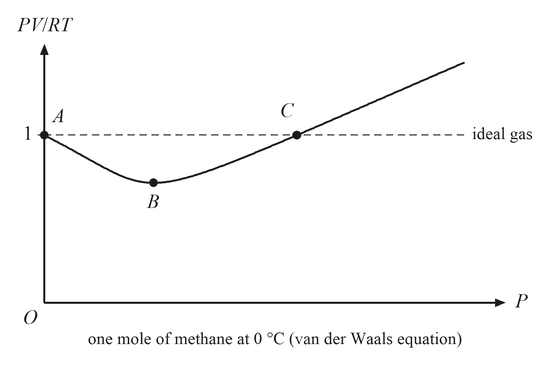
(a) Why does the curve start at at A?
(b) Between A and C, . Which van der Waals correction is responsible, and why?
(c) What is true at C, and why does rise above 1 beyond C?
- 501 mark
Question 50
The van der Waals constant is for ammonia and for helium. Which gas is the easier to liquefy, and why?
- 512 marks
Question 51
“Hydrogen escapes from the Earth’s atmosphere more readily than oxygen” why?
- 522 marks
Question 52
Why does the temperature of a gas increase when it is suddenly compressed?
- 531 mark
Question 53
A closed vessel contains equal number of molecules of hydrogen and oxygen. A fine hole is made in the vessel. Which gas will leak rapidly?
- 541 mark
Question 54
Given sample of of hydrogen and of oxygen, both are at N.T.P, which sample has a larger number of molecules?
- 552 marks
Question 55
If the number of molecules of a gas in a closed vessel is doubled, what happens to (i) the pressure of the gas, (ii) the total kinetic energy and (iii) the r.m.s. velocity of the gas?
- 563 marks
Question 56
An electric bulb of volume 250 cc was sealed off at a pressure of mm of Hg at 27°C. Calculate the number of air molecules now present in the bulb. Avogadro number /g mol.
- 573 marks
Question 57
In a cubical vessel of side one metre, a mixture of gases containing 22 g of carbon dioxide, 8 g of oxygen and 14 g of nitrogen are taken. Find the pressure exerted by the mixture if the temperature is 30°C.
- 583 marks
Question 58
A bulb contains air at atmospheric pressure and at 40°C temperature. The maximum pressure bulb can withstand is 2 atmosphere. Calculate the temperature of air when the bulb is on the point of bursting.
- 593 marks
Question 59
The pressure inside an electric bulb is mm of Hg at a temperature of 25°C. If the volume of the bulb is , find the number of molecules contained in it.
- 603 marks
Question 60
A vessel is filled with a gas at a pressure of 76 cm of Hg at some temperature. The mass of the gas is increased by 50% by introducing more gas in the vessel at the same temperature. Calculate the new pressure of the gas.
- 613 marks
Question 61
A container has 11 g of and 7 g of at 290 K. What is the density of the mixture if pressure of the mixture is 1 atmosphere? .
- 623 marks
Question 62
Find the average value and rms value of the numbers 1, 2, 3, −1, −2 and −3.
- 633 marks
Question 63
Three gas molecules have velocities , , . Calculate rms velocity and average velocity.
- 643 marks
Question 64
Calculate the rms velocity of oxygen at STP. Given, density of oxygen is .
- 653 marks
Question 65
A cubical vessel of side 15 cm contains oxygen gas at 27°C. How long does it take a typical molecule to cross the container?
- 663 marks
Question 66
The density of gas at 0°C and at a pressure of is . Calculate the root mean square velocity of its molecules at 0°C and 30°C. Assume the pressure to remain constant.
- 673 marks
Question 67
Calculate the temperature to which a gas at 0°C be heated so that the rms speed of its molecules be doubled, keeping other factors constant.
- 683 marks
Question 68
What is the temperature at which rms velocity of a gas is half its value at 0°C, if the pressure is kept constant?
- 693 marks
Question 69
Find the temperature at which the r.m.s. velocity is equal to the escape velocity from the surface of the Earth for hydrogen. Escape velocity km/s.
- 703 marks
Question 70
The r.m.s. velocity of oxygen molecules at 273 K is 460 m/s. Find the r.m.s. velocity of argon at 40°C.
- 713 marks
Question 71
The rms speed of helium on the surface of the Sun is 6.01 km/s. Make an estimate of the surface temperature of the Sun.
- 723 marks
Question 72
At what temperature is the rms speed of an atom in a nitrogen gas cylinder equals to the rms speed of an oxygen gas atom at 23°C? Atomic mass of nitrogen is 14 and that of oxygen is 16.
- 733 marks
Question 73
Calculate the temperature at which the rms velocity of oxygen molecules will be 2 km/s. Given, .
- 743 marks
Question 74
The kinetic energy of translation of an oxygen molecule at a particular temperature of J. Calculate the temperature. Boltzmann's constant J/K.
- 753 marks
Question 75
Find the temperature at which an oxygen molecule may escape from the surface of the Earth, if the escape velocity is 11.2 km/s. Mass of oxygen molecule kg. J/K.
- 763 marks
Question 76
Calculate the K.E. per mole of oxygen at 27°C. Given , .
- 773 marks
Question 77
A flask contains hydrogen and helium in the ratio 2:1 by mass. The temperature of the mixture is 27°C. Obtain the ratio of rms speeds of the molecules of the two gases. Atomic mass of hydrogen , molecular mass of helium .
- 783 marks
Question 78
Calculate the total kinetic energy of 0.002 kg of helium at 200 K.
- 793 marks
Question 79
At certain pressure and 127°C temperature, the mean kinetic energy of hydrogen molecules is J. What is the mean kinetic energy of hydrogen molecules at the same pressure and temperature 27°C?
- 803 marks
Question 80
Calculate the rms speed of smoke particles of mass kg in their Brownian motion at NTP.
- 813 marks
Question 81
A vessel is filled with a gas at a pressure of 76 cm of mercury at a certain temperature. The mass of the gas is increased by 50% by introducing more gas in the vessel at the same temperature. Find out the resultant pressure of the gas.
- 823 marks
Question 82
A gas molecule at the surface of the Earth happens to have the rms speed for that gas at 0°C. Suppose it went straight up without colliding with other molecules, how high would it rise? Mass of the molecule is kg. Boltzmann's constant .
- 833 marks
Question 83
A vessel contains a mixture of helium and argon gas in equilibrium at 423 K. Calculate the average kinetic energy of each gas molecule.
- 841 mark
Question 84
Volume, pressure and temperature of an ideal gas are , and respectively. If mass of its molecule is , then its density is ( = Boltzmann's constant)
- 851 mark
Question 85
If the pressure and the volume of certain quantity of ideal gas are halved, then its temperature
- 861 mark
Question 86
On , pressure measured by barometer is . What will be pressure at ?
- 871 mark
Question 87
The relationship between pressure and the density of a gas expressed by Boyle's law, holds true
- 881 mark
Question 88
Kinetic theory of gases provides a base for
- 891 mark
Question 89
Which law states that effect of pressure is same for all portions?
- 901 mark
Question 90
Two balloons are filled, one with pure He gas and the other by air, respectively. If the pressure and temperature of these balloons are same, then the number of molecules per unit volume is
- 911 mark
Question 91
A tyre kept outside in sunlight burst off after sometime because of
- 921 mark
Question 92
Mean free path of a gas molecule is
- 931 mark
Question 93
At what temperature will the rms speed of oxygen molecules become just sufficient for escaping from the Earth's atmosphere
(Given: mass of oxygen molecule and Boltzmann's constant )
- 941 mark
Question 94
Cooking gas containers are kept in a lorry moving with uniform speed. The temperature of the gas molecules inside will
- 951 mark
Question 95
The amount of heat energy required to raise the temperature of of Helium at NTP, from to is
- 961 mark
Question 96
The molar specific heats of an ideal gas at constant pressure and volume are denoted by and , respectively. If and is the universal gas constant, then is equal to
- 971 mark
Question 97
The average kinetic energy of hydrogen molecules of is . At the same temperature, the average kinetic energy of oxygen molecules will be
- 981 mark
Question 98
Pressure of an ideal gas is increased by keeping temperature constant. What is the effect on kinetic energy of molecules?
- 991 mark
Question 99
A mixture of 2 moles of helium gas (atomic mass ) and 1 mole of argon gas (atomic mass ) is kept at in a container. The ratio of their rms speeds , is close to
- 1001 mark
Question 100
For a given gas at pressure, rms speed of the molecule is at . At pressure and at , the rms speed of the molecules will be
- 1011 mark
Question 101
A cylinder with fixed capacity of contains helium gas at STP. The amount of heat needed to raise the temperature of the gas by is [Given that ]
- 1021 mark
Question 102
Increase in temperature of a gas filled in a container would lead to
- 1031 mark
Question 103
An ideal gas in a closed container is slowly heated. As its temperature increases, which of the following statements are true?
-
The mean free path of the molecules decreases
-
The mean collision time between the molecules decreases
-
The mean free path remains unchanged
-
The mean collision time remains unchanged.
-
- 1041 mark
Question 104
A gas mixture consists of 3 moles of oxygen and 5 moles of argon at temperature . Assuming the gases to be ideal and the oxygen bond to be rigid, the total internal energy (in units of ) of the mixture is
- 1051 mark
Question 105
Consider a gas of triatomic molecules as shown in the given figure. The molecules are assumed to be triangular and made of massless rigid rods whose vertices are occupied by atoms. The internal energy of a mole of the gas at temperature is

- 1061 mark
Question 106
A bullet of mass , travelling with a speed of , strikes a fixed wooden target. One half of its kinetic energy is converted into heat in the bullet while the other half is converted into heat in the wood. The rise of temperature of the bullet if the specific heat of its material is close to
- 1071 mark
Question 107
The mean free path for a gas, with molecular diameter and number density can be expressed as
- 1081 mark
Question 108
In a dilute gas at pressure and temperature , the mean time between successive collisions of a molecule varies with as
- 1091 mark
Question 109
The average thermal energy for a mono-atomic gas is ( is Boltzmann constant and , absolute temperature)
- 1101 mark
Question 110
On the basis of kinetic theory of gases, the gas exerts pressure because its molecules
- 1111 mark
Question 111
Given below are two statements
Statement I: In a diatomic molecule, the rotational energy at a given temperature obeys Maxwell's distribution.
Statement II: In a diatomic molecule, the rotational energy at a given temperature equals the translational kinetic energy for each molecule.
In the light of the above statements, choose the correct answer from the options given below
- 1121 mark
Question 112
A diatomic gas, having and , is heated at constant pressure. The ratio
- 1131 mark
Question 113
If one mole of the polyatomic gas is having two vibrational modes and is the ratio of molar specific heats for polyatomic gas , then the value of is
- 1141 mark
Question 114
What will be the average value of energy along one degree of freedom for an ideal gas in thermal equilibrium at a temperature ( is Boltzmann constant)?
- 1151 mark
Question 115
Consider a mixture of gas molecule of types , and having masses . The ratio of their root mean square speeds at normal temperature and pressure is
- 1161 mark
Question 116
If the rms speed of oxygen molecules at is . Find the rms speed of hydrogen molecules at
- 1171 mark
Question 117
For a gas in a state and in a state , and are the temperatures in two different states and respectively. Then
- 1181 mark
Question 118
The rms speed of the molecules of Hydrogen, Oxygen and Carbon dioxide at the same temperature are , and , respectively, then
- 1191 mark
Question 119
A cylindrical container of volume contains one mole of hydrogen and two moles of carbon dioxide. Assume the temperature of the mixture is . The pressure of the mixture of gases is [Take gas constant as ]
- 1201 mark
Question 120
Match column-I and column-II and choose the correct match from the given choices
Column-I Column-II 1. Root mean square speed of gas molecule P. 2. Pressure exerted by ideal gas Q. 3. Average kinetic energy of a molecule R. 4. Total internal energy of 1 mole of a diatomic gas S. - 1211 mark
Question 121
The volume occupied by the molecules contained in water at STP, if the intermolecular forces vanish away is,
- 1221 mark
Question 122
The temperature of a gas is . To what temperature the gas should be heated so that the rms speed is increased by 3 times?
- 1231 mark
Question 123
The relation between root mean square speed and most probable speed for the molar mass of oxygen gas molecule for the temperature of will be
- 1241 mark
Question 124
According to kinetic theory of gases,
-
The motion of the gas molecules freezes at .
-
The mean free path of gas molecules decreases if the density of molecules is increased.
-
The mean free path of gas molecules increases if temperature is increased keeping pressure constant.
-
Average kinetic energy per molecule per degree of freedom is (for monoatomic gases).
Choose the most appropriate answer from the options given below.
-
- 1251 mark
Question 125
The root mean square velocity of molecules of gas is
- 1261 mark
Question 126
The average kinetic energy of a molecule of the gas is
- 1271 mark
Question 127
An ideal gas is in thermodynamic equilibrium. The number of degrees of freedom of a molecule of a gas is . The internal energy of one mole of the gas is and the speed of sound in the gas is . At a fixed temperature and pressure, which of the following is the correct option?