
Opening your dashboard
Class 11 Physics Chapter 13: Elasticity Solutions
47 textbook questions with step-by-step answers, free to read, for ISC 2026-27.
Get talked through Ch 13, not just shown the answer
Reading a finished solution is not the same as being able to do it. The AI tutor takes one question at a time and works it with you, in your own words, until you can.
- Ask it out loud, in your own words
- It gives you the next step, not the answer
- Stuck on part (ii)? Start there
47 questions with solutions
1–5 marks · Mixed difficulty
The first 45 solutions are on this page. This chapter is a long one, so the rest open on their own page to keep this one quick to load.
- 11 mark
Question 1
Hooke's law essentially defines
Solve with AIAnswer
(A) stress
(B) strain
(C) yield point
- Correct
(D) elastic limit
Answer: (D) Elastic limit
Concept: Hooke's law states that, within the elastic limit, stress is directly proportional to strain. The law holds only up to a certain stress; beyond it the graph of stress against strain stops being a straight line.
Step 1 — See what the law depends on. Hooke's law is true only up to a limiting stress. This limit marks the end of the region in which the body behaves elastically, so the law is tied to the elastic limit.
Step 2 — Check the other choices. Stress and strain are defined on their own, before Hooke's law relates them, and the yield point lies beyond the region in which the law holds.
- (A) Stress is defined as the restoring force per unit area; this definition does not come from Hooke's law, which only relates stress to strain.
- (B) Strain is defined as the change in dimension divided by the original dimension; Hooke's law uses this definition but does not create it.
- (C) The yield point lies beyond the elastic limit, in the plastic region, where stress is no longer proportional to strain.
Note: strictly, what Hooke's law gives is a constant ratio of stress to strain (the modulus of elasticity), and it holds up to the proportional limit, which for most metals almost coincides with the elastic limit; of the four options, the elastic limit is the one the law is tied to.
Therefore, the answer is (D), the elastic limit.
- 21 mark
Question 2
The dimensional formula for modulus of rigidity is
Solve with AIAnswer
(A)
(B)
(C)
(D)
- Correct
(E)
Answer: (E)
Concept: The modulus of rigidity is the shearing stress divided by the shearing strain. A strain is a ratio of two like quantities (or an angle in radians), so it has no dimensions, and the modulus has the dimensions of stress, that is, force per unit area.
Step 1 — Write the dimensions of force. Force is mass times acceleration:
Step 2 — Divide by the dimensions of area. Area has dimensions , so
- (A) does not even contain the that every force-based quantity has.
- (B) is not the dimension of any pressure or stress; stress always has .
- (C) is the dimensional formula of the coefficient of viscosity, not of a modulus.
- (D) is the dimension of force itself; it has not been divided by area.
Therefore, the dimensional formula of the modulus of rigidity is , option (E).
- 31 mark
Question 3
A ball falling in a lake of 200 m depth shows a decrease of 0.1% in its volume at the bottom. What is the Bulk modulus of the material of the ball?
Solve with AIAnswer
- Correct
(A)
(B)
(C)
(D)
Answer: (A)
Concept: The bulk modulus is the increase in pressure on a body divided by the fractional decrease in its volume that this causes:
Here is the increase in pressure and is the fractional decrease in volume.
Step 1 — Find the extra pressure at the bottom. At a depth the water adds a pressure . We take the density of the lake water as and :
Step 2 — Write the volume strain. A decrease of 0.1% means
Step 3 — Find the bulk modulus. We divide the pressure by the volume strain:
- (B) A bulk modulus as small as would mean that the extra pressure of gives a volume strain of , which is impossible; the strain here is only .
- (C) This shows the same value as option (B), so it fails for the same reason.
- (D) With the same pressure would give a volume strain of , again impossible.
Note: Options (B) and (C) are printed with the same value.
Therefore, the bulk modulus of the material of the ball is , option (A).
- 41 mark
Question 4
On stretching a wire, the elastic energy stored per unit volume is
Solve with AIAnswer
- Correct
(A)
(B)
(C)
(D)
Answer: (A)
Concept: The energy stored in a stretched wire per unit volume (the energy density) is
Here is the stretching force, the area of cross-section, the length of the wire and its extension.
Step 1 — Write the stress and the strain. The stress is the force per unit area and the strain is the extension per unit length:
Step 2 — Multiply and halve. We put these into the formula for the energy density:
- (B) has the unit (that of energy), not ; it multiplies by the area where it should divide by the volume.
- (C) has the unit , which is not an energy per unit volume either.
- (D) has the unit of energy, not energy per unit volume; the energy of the whole wire is , with the extension, not the length.
Therefore, the elastic energy stored per unit volume is , option (A).
- 51 mark
Question 5
Which of the following affects the elasticity of a substance
(a) hammering and annealing
(b) change in temperature
(c) impurity in substance
(d) all of these
Solve with AIWritten solution
Solution:
Concept: The elastic properties of a solid (its moduli and its elastic limit) depend on its interatomic forces and on the arrangement of its crystal grains, so anything that changes these changes its elasticity.
Step 1 — Hammering and annealing. Hammering or rolling a metal breaks its crystal grains into smaller ones and raises its elastic limit. Annealing (heating and then cooling slowly) lets larger grains grow and lowers the elastic limit. So (a) affects elasticity.
Step 2 — Change in temperature. A rise in temperature weakens the interatomic forces, so the moduli of elasticity of most materials decrease. So (b) affects elasticity.
Step 3 — Impurities. Adding a small amount of another element changes the elastic properties; for example, a little carbon added to iron to make steel raises its elastic limit greatly. So (c) affects elasticity.
Step 4 — Choose the answer. All three factors affect elasticity, so the complete answer is (d). Option (b), change in temperature, is also a true statement on its own, but it leaves out the other two factors.
Note: the book's answer is change in temperature alone; this is true, but hammering, annealing and impurities affect elasticity as well, so (d) "all of these" is also correct and is the complete answer.
Therefore, the elasticity of a substance is affected by all of these, (d); option (b) is also correct but incomplete.
- 61 mark
Question 6
Energy of a stretched wire is
Solve with AIAnswer
(A) Half of load × Strain
(B) Load × Strain
(C) Stress × Strain
- Correct
(D) Half of stress × Strain
Answer: (D) Half of stress × Strain
Concept: The work done in stretching a wire is stored in it as elastic energy:
Dividing by the volume of the wire gives the energy stored per unit volume, .
Step 1 — Find the energy per unit volume. The volume of a wire of length and area is . We divide the stored energy by it:
Step 2 — Match an option. This is option (D).
- (A) Strain has no unit, so half of load × strain has the unit of force (newton), not of energy.
- (B) Load × strain is also a force, and it misses the factor as well.
- (C) Stress × strain is twice the energy per unit volume; the factor comes from the force growing steadily from zero.
Note: strictly, half of stress × strain is the energy stored per unit volume; the energy of the whole wire is half of load × extension. Reading "energy" as energy per unit volume, option (D) is the only one that fits.
Therefore, the answer is (D), half of stress × strain.
- 71 mark
Question 7
Let and represent Young's modulus for glass and rubber respectively. It is said that glass is more elastic than rubber. Therefore, it follows
Solve with AIAnswer
(A)
(B)
- Correct
(C)
(D)
Answer: (C)
Concept: In physics, a more elastic material is one that shows a smaller strain for the same stress, so it has a larger modulus of elasticity.
Step 1 — Translate "more elastic". For the same stress, glass is strained much less than rubber. Since , glass has the larger Young's modulus.
Step 2 — Write the relation. So .
- (A) Equal moduli would mean the two materials are equally elastic, which contradicts the statement.
- (B) would make rubber the more elastic material, the reverse of what is given.
- (D) A zero ratio would need glass to have no stiffness at all (a Young's modulus of zero), which is not the case.
Therefore, , option (C).
- 81 mark
Question 8
A wire of length and cross-sectional area is made of a material of Young's modulus . If the wire is stretched by an amount , the work done is
Solve with AIAnswer
- Correct
(A)
(B)
(C)
(D)
Answer: (A)
Concept: The force needed to stretch a wire grows steadily from zero, so the work done is half the final force times the extension:
Step 1 — Find the final force. From , the force that produces an extension is:
Step 2 — Find the work done. We put this force and the extension into the formula:
- (B) has the unit , not joule, so it cannot be a work.
- (C) is half the final force, a force in newtons; it has not been multiplied by the extension.
- (D) is twice the correct value; it takes the final force as acting through the whole extension and leaves out the factor .
Therefore, the work done is , option (A).
- 91 mark
Question 9
When an elastic material with Young's modulus is subjected to a stretching stress , the elastic energy stored per unit volume of the material is
Solve with AIAnswer
(A)
(B)
- Correct
(C)
(D)
Answer: (C)
Concept: The energy stored per unit volume is , and within the elastic limit .
Step 1 — Write the strain. With stress , Hooke's law gives:
Step 2 — Find the energy per unit volume. We put this strain into the energy formula:
- (A) has the unit , not ; it multiplies by where it should divide.
- (B) has the unit ; again is in the numerator instead of the denominator.
- (D) is half the strain, a pure number; it leaves out the stress that multiplies the strain.
Therefore, the energy stored per unit volume is , option (C).
- 101 mark
Question 10
The following four wires are made of the same material. Which of these will have the largest extension when the same tension is applied?
Solve with AIAnswer
- Correct
(A) length 50 cm and diameter 0.5 mm
(B) length 100 cm and diameter 1 mm
(C) length 200 cm and diameter 2 mm
(D) length 300 cm and diameter 3 mm
Answer: (A) Length 50 cm and diameter 0.5 mm
Concept: For a wire of length and diameter under a tension , the extension is
Step 1 — Find what changes. All the wires are of the same material and carry the same tension, so and are the same. The extension is therefore proportional to .
Step 2 — Work out for each wire. With in centimetres and in millimetres, wire (A) gives:
In the same way, the other wires give:
Step 3 — Choose the largest. Wire (A) has the largest value of , so it stretches the most.
- (B) Its is 100, half that of wire (A), so it stretches half as much.
- (C) Its is 50, a quarter of that of wire (A).
- (D) Its is only about 33.3, the smallest of all, even though it is the longest wire.
Therefore, the wire of length 50 cm and diameter 0.5 mm has the largest extension, option (A).
- 111 mark
Question 11
“Water is more elastic than air”. Why?
Solve with AIWritten solution
Solution:
Concept: For a change of volume, elasticity is measured by the bulk modulus ; its reciprocal is the compressibility.
Step 1 — Compare the compressibilities. Air is very easily compressed, while water hardly changes its volume even under a large pressure. So air has a much larger compressibility than water.
Step 2 — Compare the bulk moduli. A larger compressibility means a smaller bulk modulus. The bulk modulus of water is about , while that of air at atmospheric pressure is only about .
Therefore, water is more elastic than air because its bulk modulus is far larger (it is much less compressible).
- 121 mark
Question 12
What is the Young's modulus of a rigid body?
Solve with AIWritten solution
Solution:
Concept: Young's modulus is .
Step 1 — Apply it to a rigid body. A perfectly rigid body does not change its size or shape under any force, so its strain is zero for any stress. Dividing a finite stress by a strain that tends to zero gives a value that grows without limit.
Therefore, the Young's modulus of a perfectly rigid body is infinite.
- 131 mark
Question 13
‘Bridges are declared unsafe after a long use’. Why?
Solve with AIWritten solution
Solution:
Concept: Repeated alternating strains over a long time cause elastic fatigue: a material slowly loses its elastic strength.
Step 1 — Apply it to a bridge. As traffic passes, a bridge is loaded and unloaded again and again for years. This makes it fatigued, so it can fail at a stress smaller than the one it could safely bear when new.
Therefore, bridges are declared unsafe after long use because repeated alternating strains cause elastic fatigue and the bridge loses its elastic strength.
- 141 mark
Question 14
Is it possible that the restoring force is not equal and opposite to the applied force?
Solve with AIWritten solution
Solution:
Concept: Within the elastic limit, a deformed body in equilibrium sets up internal restoring forces that are equal and opposite to the applied force.
Step 1 — Look beyond the elastic limit. If the applied force takes the body beyond its elastic limit, the interatomic forces can no longer grow enough to balance it. The body yields: it goes on deforming plastically and may break, so the restoring force is then less than the applied force.
Therefore, yes; this happens when the applied force takes the body beyond its elastic limit.
- 151 mark
Question 15
A spring balance shows wrong readings after using for a long time. Why?
Solve with AIWritten solution
Solution:
Concept: A spring that is stretched and released many times suffers elastic fatigue and loses some of its elastic strength.
Step 1 — Apply it to the balance. A fatigued spring stretches more for a given load than when its scale was marked, so its readings are wrong.
Therefore, the spring balance shows wrong readings because of elastic fatigue of its spring.
- 161 mark
Question 16
Arrange the following materials in the order of increasing elasticity: steel, copper, glass and rubber.
Solve with AIWritten solution
Solution:
Concept: The larger the Young's modulus of a material, the more elastic it is.
Step 1 — Compare the Young's moduli. Approximate values are: rubber about , glass about , copper about and steel about .
Step 2 — Put them in order. Arranging from the smallest modulus to the largest gives the order of increasing elasticity.
Therefore, the order of increasing elasticity is rubber, glass, copper, steel.
- 171 mark
Question 17
The breaking force for a wire is N. What is the breaking force for two parallel wires of this size?
Solve with AIWritten solution
Solution:
Concept: Breaking force = breaking stress × area of cross-section.
Step 1 — Find the total area. Two identical wires side by side share the load equally, so together they act like one wire with twice the area of cross-section. The breaking stress of the material is unchanged.
Step 2 — Find the breaking force. Twice the area at the same breaking stress needs twice the force.
Therefore, the breaking force for the two parallel wires is N.
- 181 mark
Question 18
A cable is cut to half of its original length. Why does this change have no effect on the maximum load that it can support?
Solve with AIWritten solution
Solution:
Concept: The maximum load a cable can support is its breaking stress times its area of cross-section.
Step 1 — See what cutting changes. Cutting the cable changes only its length. The breaking stress depends only on the material, and the area of cross-section stays the same.
Therefore, the maximum load is unchanged, because the breaking stress and the area of cross-section, and hence their product, do not depend on the length of the cable.
- 192 marks
Question 19
Distinguish between elasticity and plasticity.
Solve with AIWritten solution
Solution:
Concept: Both properties describe what a body does after the deforming force is removed.
Step 1 — Define elasticity. If a body regains its original size and shape when the deforming force is removed, it is called an elastic body, and the property is called elasticity. Examples: steel, quartz, a rubber band.
Step 2 — Define plasticity. If a body does not regain its original size and shape when the deforming force is removed, it is called a plastic body, and the property is called plasticity. Examples: clay, putty, plasticine.
Therefore, an elastic body recovers its original size and shape after the deforming force is removed, while a plastic body keeps its new size and shape.
- 202 marks
Question 20
Define strain. Name the three types of strain.
Solve with AIWritten solution
Solution:
Concept: Strain measures how much a body is deformed, compared with its original size.
Step 1 — Define strain. Strain is the ratio of the change in a dimension of a body to its original dimension:
It is a ratio of like quantities, so it has no unit.
Step 2 — Name the three types. There are three types of strain. (i) Linear (longitudinal) strain, , the change in length per unit length. (ii) Volume strain, , the change in volume per unit volume. (iii) Shearing strain, the angle (in radians) through which a line originally perpendicular to the fixed face turns.
Therefore, strain is the change in dimension divided by the original dimension, and its three types are linear strain, volume strain and shearing strain.
- 212 marks
Question 21
Define stress. Give its dimensional formula.
Solve with AIWritten solution
Solution:
Concept: When a body is deformed, internal restoring forces are set up in it; in equilibrium they are equal and opposite to the applied force.
Step 1 — Define stress. Stress is the restoring force per unit area set up inside a deformed body:
Its SI unit is , or pascal (Pa).
Step 2 — Find its dimensions. Force has dimensions and area has dimensions , so:
Therefore, stress is the restoring force per unit area, and its dimensional formula is .
- 222 marks
Question 22
What is the difference between tensile stress and volume stress?
Solve with AIWritten solution
Solution:
Concept: The kind of stress depends on how the deforming force acts on the body; the figure shows tensile stress on a bar in (a) and volume stress on a sphere in (b).
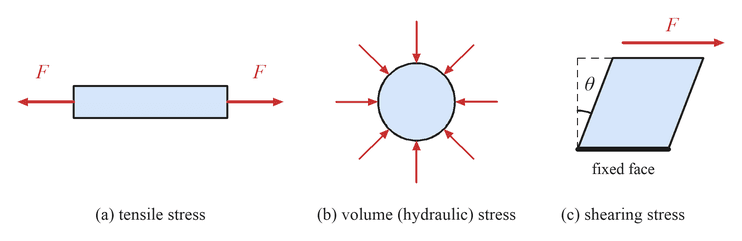
Step 1 — Describe tensile stress. Tensile stress is set up when equal and opposite forces pull on the two ends of a body, at right angles to its cross-section. It is the force per unit area of cross-section, and it changes the length of the body.
Step 2 — Describe volume stress. Volume (hydraulic) stress is set up when a force acts normally and uniformly over the whole surface of a body. It is equal to the change in pressure, and it changes the volume of the body without changing its shape.
Therefore, tensile stress acts along one direction and changes the length of a body, while volume stress acts normally over the whole surface and changes only its volume.
- 232 marks
Question 23
How should we apply a force on a body to produce shearing stress?
Solve with AIWritten solution
Solution:
Concept: A shearing stress is a tangential force per unit area; it changes the shape of a body without changing its volume.
Step 1 — Apply the force along a face. The force must act tangentially, that is, along (parallel to) the surface on which it acts, while the opposite face is held fixed. In the figure, acts along the upper face of the block, and the side turns through the angle to .
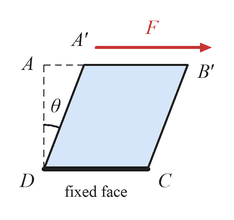
Therefore, to produce shearing stress the force must be applied tangentially to the surface of the body, with the opposite face fixed.
- 242 marks
Question 24
What is the condition under which Hooke's law holds good?
Solve with AIWritten solution
Solution:
Concept: Hooke's law states that stress is directly proportional to strain.
Step 1 — State the condition. The law holds only while the deformation is small, that is, within the elastic limit. Beyond it the graph of stress against strain is no longer a straight line.
Note: strictly, the law holds up to the proportional limit, which for most metals lies very close to the elastic limit.
Therefore, Hooke's law holds good within the elastic limit.
- 252 marks
Question 25
What is compressibility?
Solve with AIWritten solution
Solution:
Concept: The bulk modulus measures how strongly a body resists compression.
Step 1 — Define compressibility. The reciprocal of the bulk modulus is called compressibility:
It is the fractional decrease in volume per unit increase in pressure, and its SI unit is ().
Therefore, compressibility is the reciprocal of the bulk modulus.
- 262 marks
Question 26
What is an elastomer?
Solve with AIWritten solution
Solution:
Concept: Some materials can be stretched to many times their length and still return to their original state, although they do not obey Hooke's law.
Step 1 — Define the term. A substance that can be elastically stretched to large values of strain is called an elastomer. Rubber is an example; the elastic tissue of the aorta in our body is another.
Therefore, an elastomer is a substance that can be stretched elastically to large values of strain, such as rubber.
- 272 marks
Question 27
Which is more elastic, steel or rubber? Why?
Solve with AIWritten solution
Solution:
Concept: In physics, the more elastic material is the one with the larger modulus of elasticity, that is, the one that shows a smaller strain for the same stress.
Step 1 — Compare equal wires under equal loads. For a steel wire and a rubber wire of the same size under the same load, the stress is the same, but the steel wire stretches far less than the rubber wire.
Step 2 — Compare Young's moduli. Since , the smaller strain gives steel the larger Young's modulus (about against about for rubber).
Therefore, steel is more elastic than rubber, because its Young's modulus is much larger.
- 282 marks
Question 28
Define energy density.
Solve with AIWritten solution
Solution:
Concept: When a body is deformed within its elastic limit, the work done on it is stored as elastic potential energy.
Step 1 — Define energy density. The elastic energy stored per unit volume of a deformed body is called its energy density.
Step 2 — Give its value. For a stretched wire the energy density is:
Its SI unit is .
Therefore, energy density is the elastic energy stored per unit volume, equal to half of stress × strain.
- 292 marks
Question 29
Write down the expression for the elastic potential energy of a stretched wire.
Solve with AIWritten solution
Solution:
Concept: The force needed to stretch a wire grows steadily from zero to its final value, so the average force is half the final force.
Step 1 — Write the energy. A wire stretched by an extension under a final force stores the energy:
Step 2 — Write it in terms of Young's modulus. We put , for a wire of length and area , into this expression:
Therefore, the elastic potential energy of a stretched wire is , that is, .
- 302 marks
Question 30
Define Poisson's ratio.
Solve with AIWritten solution
Solution:
Concept: When a wire is stretched, it becomes longer and at the same time thinner.
Step 1 — Name the two strains. The linear (longitudinal) strain is the change in length per unit length, . The lateral strain is the decrease in diameter per unit diameter, , at right angles to the force.
Step 2 — Define the ratio. Within the elastic limit, the ratio of the lateral strain to the linear strain is a constant for a material, called its Poisson's ratio:
Here both strains are taken as sizes (magnitudes): the length increases while the diameter decreases, so Poisson's ratio of ordinary materials is a positive number. (Written with signs, .) It has no unit, and for most materials it lies between about 0.2 and 0.4 (about 0.3 for most metals).
Therefore, Poisson's ratio is the ratio of lateral strain to linear strain within the elastic limit.
- 312 marks
Question 31
What is meant by ultimate strength of a material?
Solve with AIWritten solution
Solution:
Concept: On the stress–strain curve of a wire, the stress rises to a highest value before the wire thins and breaks.
Step 1 — Define the term. The ultimate strength (tensile strength) of a material is the maximum stress it can bear before it fractures.
Therefore, ultimate strength is the greatest stress a material can withstand before breaking.
- 322 marks
Question 32
A solid is (i) stretched and (ii) compressed. What happens to its potential energy?
Solve with AIWritten solution
Solution:
Concept: The atoms of a solid sit at the normal spacing at which their mutual potential energy is a minimum. Any change of this spacing, either way, raises the potential energy.
Step 1 — Stretching (part i). When the solid is stretched, the interatomic distance increases beyond the normal spacing. Work is done against the attractive forces, so the potential energy increases.
Step 2 — Compression (part ii). When the solid is compressed, the interatomic distance decreases below the normal spacing. Work is done against the repulsive forces, so the potential energy again increases.
Therefore, the potential energy of the solid increases in both cases, (i) when it is stretched and (ii) when it is compressed.
- 332 marks
Question 33
Why do we prefer steel to copper in the manufacture of spring?
Solve with AIWritten solution
Solution:
Concept: A spring must give a large restoring force and must return to its original shape after each use.
Step 1 — Compare Young's moduli. Young's modulus of steel is larger than that of copper, so steel is more elastic and gives a larger restoring force for the same deformation.
Step 2 — Compare the elastic limits. Steel also has a higher elastic limit, so a steel spring returns to its shape even after large loads, while a copper spring would take a permanent set.
Therefore, steel is preferred because it is more elastic than copper (larger Young's modulus and higher elastic limit).
- 342 marks
Question 34
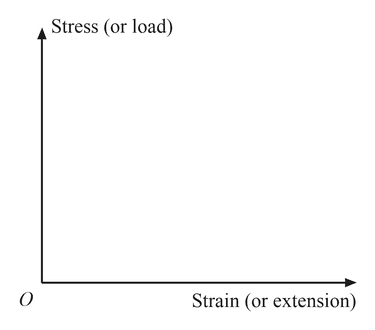
Represent graphically the variation of stress with strain (or extension with load) in an elastic body. On the graph, mark (a) Hooke's law region, (b) elastic limit, (c) yield point and (d) breaking point.
 Solve with AI
Written solution
Solution:
Concept: When a wire is loaded gradually until it breaks and its stress is plotted against its strain, the graph is first a straight line (Hooke's law), then curves through the elastic limit and the yield point, rises to a greatest stress and finally falls to the breaking point.
Step 1 — Draw the graph. The figure shows the stress–strain graph of a metal wire, with strain along the x-axis and stress along the y-axis.
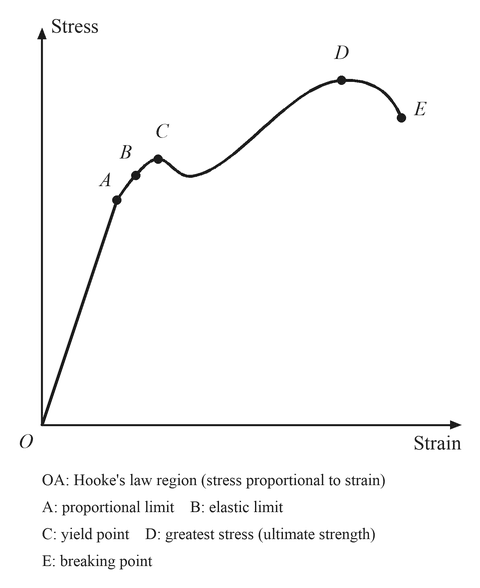
Step 2 — Mark the Hooke's law region (a). From to the graph is a straight line, so stress is proportional to strain. is the Hooke's law region, and is the proportional limit.
Step 3 — Mark the elastic limit (b). Up to the point , the wire returns to its original length when the load is removed. is the elastic limit.
Step 4 — Mark the yield point (c). At the wire begins to flow: its extension increases even without much increase of load. is the yield point, and the region beyond it is the plastic region.
Step 5 — Mark the breaking point (d). The stress rises to its greatest value at ; after that the wire thins at some point and breaks at . is the breaking point.
Therefore, on the graph is the Hooke's law region, is the elastic limit, is the yield point and is the breaking point.
- 352 marks
Question 35
Why are bridges declared unsafe after a long use?
Solve with AIWritten solution
Solution:
Concept: A material subjected to repeated alternating strains for a long time suffers elastic fatigue.
Step 1 — Find the repeated strain. As vehicles pass over it, a bridge is loaded and unloaded again and again for years.
Step 2 — State the effect. These repeated strains cause elastic fatigue, so the bridge slowly loses its elastic strength and could fail under a load it once carried safely.
Therefore, after long use a bridge loses its elastic strength through elastic fatigue, so it is declared unsafe.
- 362 marks
Question 36
A wire stretches by a certain amount under a load. If the load and the radius are both increased to four times, find the stretch caused in the wire.
Solve with AIWritten solution
Solution:
Concept: For a wire of length , radius and Young's modulus under a load , the stretch is
Step 1 — Write the new stretch. The load becomes and the radius becomes , while and stay the same:
Step 2 — Simplify. Since :
Therefore, the new stretch is one-fourth of the original stretch, .
- 372 marks
Question 37
What is elastic after-effect?
Solve with AIWritten solution
Solution:
Concept: Real bodies do not always recover at once when the deforming force is removed.
Step 1 — Describe the effect. On the removal of the deforming force, even within the elastic limit, most solids take some time to regain their original condition.
Step 2 — Define the term. This delay in recovering the original condition is called the elastic after-effect. Glass shows a large after-effect; quartz and phosphor bronze show very little.
Therefore, elastic after-effect is the delay in a body's return to its original condition after the deforming force is removed.
- 382 marks
Question 38
What is elastic hysteresis?
Solve with AIWritten solution
Solution:
Concept: When the stress on some substances (such as rubber) is increased and then decreased, the strain does not follow the stress at once.
Step 1 — Define the term. The lagging of strain behind stress during loading and unloading is called elastic hysteresis.
Step 2 — Describe the graph. The stress–strain curves for loading and unloading do not coincide; they enclose a loop, and the area of the loop is the energy per unit volume turned into heat in one cycle.

Therefore, elastic hysteresis is the lagging of strain behind stress, shown by a closed loop on the stress–strain graph.
- 393 marks
Question 39
What is deforming force? Distinguish between elasticity and plasticity. Give examples for elastic and plastic bodies. Explain elastic behaviour of solids using the spring–ball model.
Solve with AIWritten solution
Solution:
Concept: A solid keeps its size and shape because its atoms are held at fixed average positions by interatomic forces; a deforming force disturbs these positions, and the interatomic forces try to restore them.
Step 1 — Define deforming force. A force which, applied to a body that is not free to move, changes its size, its shape or both, by changing the relative positions of its molecules, is called a deforming force. It may be a tensile (stretching) force, a normal force or a tangential force.
Step 2 — Distinguish elasticity and plasticity. If a body regains its original size and shape when the deforming force is removed, it is called an elastic body and the property is elasticity. If it does not regain its original size and shape, it is called a plastic body and the property is plasticity.
Step 3 — Give examples. Elastic bodies: steel, quartz, a rubber band (quartz fibre is the nearest approach to a perfectly elastic body). Plastic bodies: clay, putty, plasticine (putty is nearly perfectly plastic).
Step 4 — Describe the spring–ball model. In this model, the atoms of a solid are pictured as balls and the interatomic forces between neighbouring atoms as springs joining the balls, as in the figure.

Step 5 — Explain elastic behaviour with the model. When a deforming force acts, the balls are displaced from their equilibrium positions, so the springs are stretched or compressed. The springs then exert restoring forces on the balls. When the deforming force is removed, these restoring forces bring the balls back to their original positions, so the body regains its size and shape. Within limits, the restoring force of a spring is proportional to its change in length, which is why stress is proportional to strain (Hooke's law).
Therefore, a deforming force changes the size or shape of a body; an elastic body (steel, quartz) recovers when it is removed while a plastic body (clay, putty) does not; and in the spring–ball model the stretched or compressed interatomic "springs" pull the atoms back to their places, which explains elasticity.
- 403 marks
Question 40
Define stress and strain. Explain the three types of strain and the three types of stress.
Solve with AIWritten solution
Solution:
Concept: A deformed body sets up internal restoring forces; the restoring force per unit area is the stress, and the fractional change in its dimensions is the strain.
Step 1 — Define stress. Stress is the restoring force per unit area set up inside a deformed body. In equilibrium it equals the applied force per unit area:
Its SI unit is (Pa).
Step 2 — Define strain. Strain is the ratio of the change in a dimension of a body to its original dimension. It has no unit.
Step 3 — Explain the three types of strain. Linear (longitudinal) strain is produced by a stretching force: , the change in length per unit length. Volume strain is produced by a force acting normally over the whole surface: , the change in volume per unit volume. Shearing strain is produced by a tangential force: it is the angle (in radians) through which a line originally perpendicular to the fixed face is turned.
Step 4 — Explain the three types of stress. The figure shows the three ways in which the deforming force can act.
(a) Tensile (or compressive) stress: equal and opposite forces act along the length, at right angles to the cross-section; it equals the force per unit area of cross-section and changes the length.
(b) Volume (hydraulic) stress: the force acts normally and uniformly over the whole surface; it equals the change in pressure and changes the volume without changing the shape.
(c) Shearing (tangential) stress: the force acts along a face while the opposite face is fixed; it equals the tangential force per unit area and changes the shape without changing the volume.
Therefore, stress is the restoring force per unit area and strain is the fractional change in dimension; the three strains are linear, volume and shearing strain, produced respectively by tensile, volume and shearing stress.
- 413 marks
Question 41
What is the elastic limit? Describe an experiment to study Hooke's law.
Solve with AIWritten solution
Solution:
Concept: Hooke's law states that, within the elastic limit, stress is directly proportional to strain. For a wire of fixed length and area , this means the extension is proportional to the load .
Step 1 — Define the elastic limit. The elastic limit is the maximum stress that can be applied to a body without causing a permanent deformation; up to it, the body returns to its original size and shape when the force is removed.
Step 2 — Set up the apparatus. A long, straight wire of uniform cross-section is hung from a rigid support. A weight hanger is attached to its lower end, and a pointer fixed to the wire moves against a fixed scale (in practice a vernier is used to read small extensions), as in figure (a).
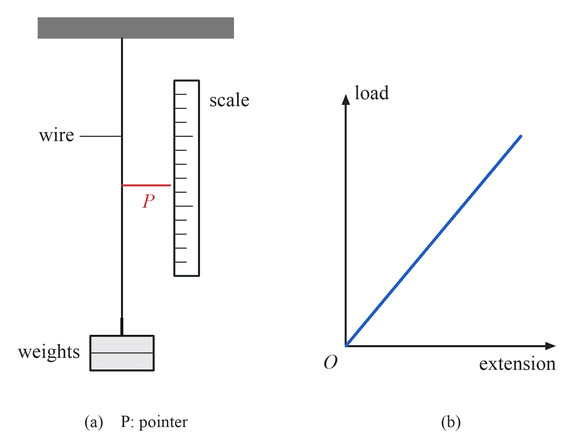
Step 3 — Take the readings. First a small load is hung to keep the wire straight and the pointer reading is noted. Equal loads are then added one at a time, and after each the new reading is noted; the extension for each load is the difference from the first reading. The loads are then removed one at a time and the readings repeated, and the mean extension for each load is found. The total load is kept well below the elastic limit.
Step 4 — Draw the graph. A graph of load against extension is a straight line through the origin, as in figure (b). So .
Step 5 — Draw the conclusion. Since and are constant for the wire, dividing the load by and the extension by keeps the proportion :
So stress is proportional to strain. If the experiment is repeated with wires of the same material but different lengths and thicknesses, it also shows that, for a given load, the extension is proportional to the length of the wire and inversely proportional to its area of cross-section.
Therefore, the elastic limit is the greatest stress a body can bear without permanent deformation, and the straight-line graph of load against extension for a loaded wire verifies Hooke's law (stress ∝ strain within the elastic limit).
- 423 marks
Question 42
What are elastic constants? Define them.
Solve with AIWritten solution
Solution:
Concept: Within the elastic limit, the ratio of a stress to the strain it produces is a constant for a material. These constants, together with Poisson's ratio, describe its elastic behaviour completely.
Step 1 — Name the elastic constants. Young's modulus , the bulk modulus (or ), the modulus of rigidity (or ) and Poisson's ratio are together called the elastic constants.
Step 2 — Define Young's modulus. Within the elastic limit, Young's modulus is the ratio of longitudinal stress to longitudinal strain:
Step 3 — Define the bulk modulus. Within the elastic limit, the bulk modulus is the ratio of volume stress (change in pressure) to volume strain; the minus sign shows that the volume decreases when the pressure increases:
Step 4 — Define the modulus of rigidity. Within the elastic limit, the modulus of rigidity is the ratio of tangential (shearing) stress to shearing strain :
Step 5 — Define Poisson's ratio. Within the elastic limit, Poisson's ratio is the ratio of lateral strain to longitudinal strain, where is the decrease in diameter and the increase in length:
Both strains are taken as magnitudes, so is a positive number with no unit (about 0.3 for most metals).
These constants are related; for example and .
Therefore, the elastic constants are Young's modulus, the bulk modulus, the modulus of rigidity (each a ratio of stress to the corresponding strain within the elastic limit) and Poisson's ratio (lateral strain divided by longitudinal strain).
- 433 marks
Question 43
Derive an expression for the work done in stretching a wire. Obtain an expression for strain energy and energy density.
Solve with AIWritten solution
Solution:
Concept: As a wire is stretched, the force needed grows in proportion to the extension (Hooke's law), so the work done is the area under the force–extension graph. Within the elastic limit this work is stored in the wire as strain energy.
Step 1 — Write the force at extension x. Consider a wire of length and area of cross-section , made of a material of Young's modulus . When its extension is , Young's modulus gives:
Step 2 — Write the work for a small extra extension. For a further small extension , the force is nearly constant, so the work done is:
On the force–extension graph this is the area of the thin strip of width .
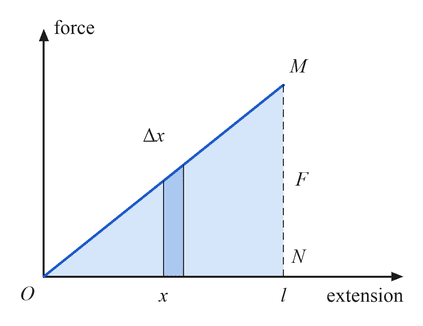
Step 3 — Add up the work. The total work done in stretching the wire from zero to an extension is the sum (integral) of these small amounts:
Since is the final stretching force :
This is the area of the triangle in the figure.
Step 4 — Obtain the strain energy. Within the elastic limit, this work is stored in the wire as elastic potential energy, called strain energy:
Step 5 — Obtain the energy density. The volume of the wire is . We divide the strain energy by it:
This energy per unit volume is the energy density; its SI unit is .
Therefore, the work done in stretching a wire is (equal to ); it is stored as strain energy , and the energy density is .
- 445 marks
Question 44
State Hooke's law. A metallic wire of Young's modulus is stretched by suspending a load from it. If the linear strain produced in it is , obtain an expression for the elastic potential energy, in terms of and , stored in unit volume of the wire.
Solve with AIWritten solution
Solution:
Concept: Within the elastic limit, stress = × strain. The work done in stretching a wire is × force × extension, and it is stored as elastic potential energy.
Step 1 — State Hooke's law. Within the elastic limit, the stress in a body is directly proportional to the strain:
For stretching, the constant is Young's modulus .
Step 2 — Write the stress. Let the wire have length and area of cross-section . The linear strain is , so Hooke's law gives:
Step 3 — Write the force and the extension. The stretching force is the stress times the area, and the extension is the strain times the length:
Step 4 — Find the stored energy. The force grows steadily from zero to , so the work done, which is stored as elastic potential energy, is:
Step 5 — Divide by the volume. The volume of the wire is , so the energy stored per unit volume is:
This is the area of the triangle under the stress–strain line, of base and height .
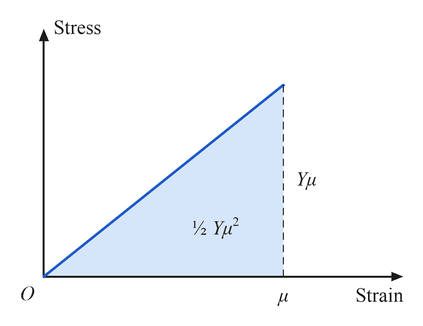
Therefore, Hooke's law states that stress is proportional to strain within the elastic limit, and the elastic potential energy stored per unit volume of the wire is .
- 455 marks
Question 45
(i) What is stress? Explain the different types.
(ii) Draw a labelled graph of tensile stress against tensile strain for a metal wire upto the breaking point. Show on your graph the region in which Hooke's law is obeyed.
What is the significance of the area between the graph and the strain axis within the Hooke's law region?
Solve with AIWritten solution
Solution:
Concept: Stress is the internal restoring force per unit area of a deformed body. For a metal wire loaded until it breaks, the stress–strain graph is straight only at first; the area under the straight part gives the energy stored per unit volume.
Step 1 — Define stress (part i). When a deforming force acts on a body, internal restoring forces are set up in it. The restoring force per unit area is called stress; in equilibrium it equals the applied force per unit area, . Its SI unit is (Pa).
Step 2 — Explain the types of stress (part i). The figure shows the three types.
(a) Tensile stress: equal and opposite pulls act along the length of a bar, normal to its cross-section, and increase its length (pushes give compressive stress, which decreases the length). (b) Volume (hydraulic) stress: a force acts normally and uniformly over the whole surface; it equals the change in pressure and changes the volume without changing the shape. (c) Shearing stress: a tangential force acts along one face while the opposite face is fixed; it changes the shape without changing the volume.
Step 3 — Draw the graph (part ii). The figure shows tensile stress against tensile strain for a metal wire loaded until it breaks.
From to the graph is a straight line: this is the region in which Hooke's law is obeyed. is the elastic limit, the yield point, the point of greatest stress, and the breaking point.
Step 4 — Find the area within the Hooke's law region. Let the stress be when the strain is , on the straight part. The area between the line and the strain axis is a triangle:
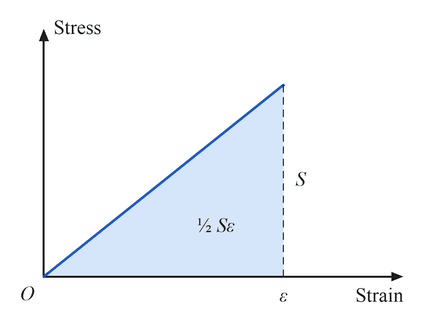
Step 5 — Interpret the area. For a wire of length and area stretched by under a final force , the work done is . Dividing by the volume gives:
This is exactly the area of the triangle, so the area between the straight part of the graph and the strain axis is the work done per unit volume, stored in the wire as elastic potential energy.
Therefore, (i) stress is the restoring force per unit area, of three types: tensile (or compressive), volume and shearing; (ii) on the stress–strain graph Hooke's law holds on the straight part , and the area between this part and the strain axis is the work done (elastic energy stored) per unit volume of the wire.
- 465 marks
Question 46
(a) State Hooke's law and describe with the help of a diagram, the behaviour of a copper wire which hangs vertically and is loaded with a gradually increasing load until it finally breaks. On the diagram, mark the points (i) elastic limit and (ii) yield point.

(b) Distinguish between Young's modulus, bulk modulus and the modulus of rigidity.
- 475 marks
Question 47
Define stress, strain and Young's modulus of an elastic material. Describe an experiment for measuring the Young's modulus of a material in the form of a wire.
What Class 11 Physics Ch 13 covers
The sections of the chapter, in the order the book takes them. Every question above comes from one of these.
- 01Elastic Behaviour of Solids
- 02Stress and Strain
- 03Hooke's Law
- 04Moduli of Elasticity
- 05Stress-Strain Diagram
- 06Brittle, Ductile and Malleable Solids and Elastomers
More ways to study this chapter
The same chapter asked three other ways. Practise it, revise it, and see what the board has set on Ch 13 before.
Class 11 Physics Ch 13 questions students ask
How many questions are there in Class 11 Physics Ch 13?
47 questions. Every one is solved step by step on this page.
Are these Class 11 Physics solutions free?
Yes. Every question and its full working is free to read, with no account needed.
Can I download the Class 11 Physics Ch 13 solutions as a PDF?
There is no PDF to download. Every solution is on this page instead, which means it is searchable, always the current syllabus, and readable on a phone. Use your browser's print option if you want it on paper.