
Opening your dashboard
Class 11 Physics Chapter 13 Elasticity: Competency-Based Questions (CBQ)
40 questions on Chapter 13, each worked through on its own page with the AI tutor. Class 11 Physics, ICSE 2026-27.
40 questions
1–5 marks · Mixed difficulty
- 11 mark
Question 1
Competency: Analysis & Evaluation
Glass is usually thought of as stiff and easily broken. Yet an optical fibre of glass only thick can be coiled into a loop across in a cable joint without breaking, while a glass rod thick snaps long before it can be bent that far.
Assertion (A): A thin glass fibre can be bent into a much tighter curve than a thick glass rod without breaking.
Reason (R): When a rod or fibre is bent into an arc of a given radius, the strain in its outer surface is proportional to its thickness, so a thinner fibre is strained much less.
- 24 marks
Question 2
Competency: Application
A physics club builds a ball-and-spring model of a metal wire to see where elasticity comes from. In the model the atoms sit in straight rows along the wire, neighbouring atoms in a row are apart, and each pair of neighbours is joined by a spring (the interatomic bond) of force constant . The rows are packed side by side in a square pattern, so each row takes up an area of the cross-section. The wire has a cross-sectional area of and carries a load of . (Hypothetical data.)
(a) How many rows of atoms pass through the cross-section of the wire?
(b) Find the force on each row, the stretch of each bond and the strain of the wire.
(c) Find Young's modulus predicted by the model and show that it equals . Use the model to explain why the wire returns to its original length when the load is removed.
- 34 marks
Question 3
Competency: Application
A sports-science class studies the thigh bone (femur) of a student. The strong outer wall of the bone's shaft is a tube whose cross-sectional area is , and the shaft is long. For this bone, take the compressive strength (the stress at which it breaks when squeezed) as and Young's modulus as . Take , and let one femur carry the whole weight of the body when the student stands on one leg. (Hypothetical data.)
(a) Find the compressive stress in the femur when the student stands still on one leg.
(b) On landing from a jump on one leg, the force on the femur briefly reaches times the body's weight. Find the stress now, and how many times smaller it is than the compressive strength.
(c) Find the strain in the femur during the landing and by how much its shaft becomes shorter.
- 41 mark
Question 4
Competency: Analysis & Evaluation
In a tug of war, two teams pull on the two ends of a rope, and each team pulls with a force of . The rope does not move. The rope is in diameter; treat its cross-section as a full circle. (Hypothetical data.) The tensile stress in the middle of the rope is about
- 51 mark
Question 5
Competency: Analysis & Evaluation
A thick book lies on a table. Its bottom cover is held fixed by friction, and a hand pushes its top cover sideways, parallel to the table, so that the pages slide a little over one another.
Assertion (A): A small shearing strain like this changes the volume of the book but leaves its shape unchanged.
Reason (R): Under a shearing stress, the face on which the force acts slides parallel to the fixed opposite face, while the distance between the two faces stays the same.
- 64 marks
Question 6
Competency: Application
A weighbridge for trucks stands on four identical load cells, one under each corner. Each load cell is a short solid steel cylinder of diameter that carries its share of the load along its axis. A strain sensor glued to the side of one cylinder measures how much it is compressed. When a loaded truck stands in the middle of the bridge, so that the four cells share its weight equally, the sensor's reading increases by a compressive strain of compared with the empty bridge. For the steel, , and it obeys Hooke's law up to a stress of . Take . (Hypothetical data.)
(a) Find the extra stress in each cylinder caused by the truck.
(b) Find the mass of the truck.
(c) The makers allow a working stress of only one-third of . Ignoring the stress due to the bridge's own weight, find the greatest truck mass the bridge may weigh, and explain why its readings can be trusted only while the steel obeys Hooke's law.
- 71 mark
Question 7
Competency: Analysis & Evaluation
A light rigid bar long hangs from a rigid support by two vertical wires, one at each end. The wires are of the same steel and have the same length, but wire P has a diameter of and wire Q a diameter of . A load is to be hung from the bar so that the bar stays horizontal, which needs the two wires to stretch by equal amounts. Both wires stay within the limit of proportionality. (Hypothetical data.)

Where must the load be hung?
- 84 marks
Question 8
Competency: Application
A railway engineer checks the steel of a long welded rail without cutting a sample from it. The engineer taps one end of a length of rail with a hammer, and a sensor at the other end picks up the sound pulse later. A sound pulse travels along a long thin rod with speed , where is Young's modulus and the density; treat the rail as such a rod. The density of the steel is . (Hypothetical data.)
(a) Find the speed of the pulse in the rail.
(b) Find Young's modulus of the steel.
(c) Aluminium has and . Find the speed of the pulse in an aluminium rod, and explain why it is almost the same as in steel although aluminium's Young's modulus is only about one-third of steel's.
- 91 mark
Question 9
Competency: Analysis & Evaluation
A student blocks the outlet of a bicycle pump and pushes the piston in very slowly, so that the trapped air stays at room temperature. The student finds that the air is harder to squeeze further once it is already at a higher pressure.
Assertion (A): For a gas compressed slowly at constant temperature, the bulk modulus is equal to the pressure of the gas.
Reason (R): A gas is far easier to compress than a liquid or a solid.
- 101 mark
Question 10
Competency: Analysis & Evaluation
A block of fruit jelly (a gel that is mostly water) is turned out on a plate. When the plate is given a light sideways tap, the top of the block sways back and forth while its base stays on the plate. When a sealed plastic bag full of the same jelly is squeezed hard all over, the jelly hardly changes its volume. Which statement best describes the elasticity of the jelly?
- 114 marks
Question 11
Competency: Analysis & Evaluation
A tensile-testing machine pulls a mild-steel test bar slowly until it breaks. Its stress–strain curve is a straight line up to the limit of proportionality, at a stress of and a strain of . The bar yields at a stress of , and the greatest stress, , is reached at a strain of . (Hypothetical data.)
(a) Find Young's modulus of the steel.
(b) A tie rod of this steel, long with a cross-sectional area of , is designed so that its stress never exceeds half the stress at the limit of proportionality. Find the greatest pull it may carry and its extension under that pull.
(c) Find the strain that Hooke's law would predict at the greatest stress, and compare it with the measured strain. What does this show about the bar between its yield point and its greatest stress?
- 121 mark
Question 12
Competency: Analysis & Evaluation
In a laboratory test, a mild-steel bar is stretched slowly while the machine draws its stress–strain curve. Just after the elastic limit, the curve becomes almost flat for a while.
Assertion (A): Just beyond the yield point, a mild-steel bar goes on stretching with hardly any increase in stress.
Reason (R): Beyond the yield point, the bar still obeys Hooke's law, but with a much smaller Young's modulus.
- 131 mark
Question 13
Competency: Analysis & Evaluation
A glazier cuts a sheet of window glass by running a hard steel wheel firmly along a ruler to make a fine scratch on one face. The glazier then bends the sheet gently, so that the scratched face is stretched, and the sheet breaks cleanly along the scratch. The best explanation is that
- 141 mark
Question 14
Competency: Analysis & Evaluation
A teacher bends a stick of blackboard chalk until it snaps, and then holds the two broken pieces together again.
Assertion (A): When a stick of chalk is bent until it breaks, it snaps suddenly, and the two broken pieces fit back together almost exactly.
Reason (R): Chalk is a brittle solid, so it undergoes hardly any permanent (plastic) change of shape before it fractures.
- 154 marks
Question 15
Competency: Analysis & Evaluation
In a demonstration, a teacher wearing safety gloves and goggles dips a rubber band into liquid nitrogen at . Before cooling, the band (unstretched length ) can be stretched to several times its length and springs back; for small strains its Young's modulus is about . After cooling it is stiff, with a Young's modulus of about , and when it is struck with a hammer it shatters into pieces like glass. (Hypothetical data.)
(a) Classify the rubber at room temperature and after cooling as an elastomer, a ductile material or a brittle material, giving one reason for each.
(b) A small tensile stress of is applied to the band at each temperature. Find the strain and the extension in each case, and how many times larger the strain is at room temperature.
(c) Explain, in terms of the long chain molecules of rubber, why the cold rubber behaves so differently.
- 164 marks
Question 16
Competency: Application
A student finds Young's modulus of a brass wire with an optical lever instead of a micrometer. The wire, long and in diameter, hangs from a rigid support and has a clamp at its lower end. A small mirror is fixed on a stand whose front legs rest on a fixed shelf and whose back leg rests on the clamp, a distance behind the front legs. A lamp's narrow beam is reflected by the mirror on to a vertical scale a distance away, as shown. When an extra is hung from the wire, the clamp moves down by the wire's extension , the stand tilts about its front legs through a small angle (in radians), and the light spot on the scale moves up by . Take . (Hypothetical data.)
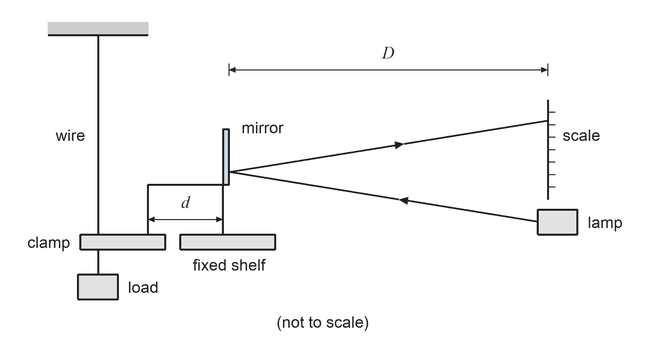
(a) Explain why the reflected beam turns through when the mirror turns through , and show that the spot moves through .
(b) Find the extension of the wire.
(c) Find Young's modulus of the brass, and the factor by which the optical lever magnifies the extension.
- 171 mark
Question 17
Competency: Analysis & Evaluation
In a Searle's experiment on a brass wire long and in diameter, a student records these extensions. (Hypothetical data.)
Load (kg) 1 2 3 4 5 Extension (mm) 0.79 1.49 2.18 2.87 3.57 The student's graph of extension against load is a straight line, but it does not pass through the origin: it cuts the extension axis at about .

Taking , which value of Young's modulus should the student report?
- 181 mark
Question 18
Competency: Analysis & Evaluation
Before a Searle's experiment, a student measures the diameter of the experimental wire with a screw gauge at five places along its length and, at each place, in two directions at right angles to each other. The student uses the mean of all ten readings.
Assertion (A): Measuring the diameter at several places, and in two directions at right angles at each place, gives a more reliable value of the wire's area of cross-section.
Reason (R): In the formula , the radius of the wire appears squared.
- 194 marks
Question 19
Competency: Application
When a sprinter pushes off from the ground, the sprinter's Achilles tendon, which joins the calf muscle to the heel, is stretched like a spring and stores elastic energy that helps the next stride. Take the tendon as a uniform cord long with a cross-sectional area of and a Young's modulus of , and assume that it obeys Hooke's law. During push-off the tension in the tendon reaches . (Hypothetical data.)
(a) Find the stress, the strain and the extension of the tendon.
(b) Find the elastic energy stored in the tendon.
(c) Find the energy stored per unit volume, and check it using .
- 201 mark
Question 20
Competency: Analysis & Evaluation
A steel wire () and a copper wire () have the same length and the same diameter. Each is fixed between two rigid clamps and stretched by the same small amount, , within its elastic limit.
Assertion (A): The copper wire stores more elastic energy than the steel wire.
Reason (R): For the same extension, the elastic energy stored in a wire is proportional to its Young's modulus, since .
- 214 marks
Question 21
Competency: Analysis & Evaluation
A sports-equipment company tests two foam strips for a helmet lining. Each strip is long and wide, and each is stretched lengthwise by , well within its elastic range. The width of the ordinary foam strip P decreases by . The width of strip Q, made of an auxetic foam with inward-folded (re-entrant) cells, increases by . (Hypothetical data.)
(a) Find Poisson's ratio for each foam.
(b) Assuming that the thickness of each strip changes in the same proportion as its width, find the fractional change in the volume of each strip.
(c) A plug of auxetic foam is pushed into a hole so that it fits snugly. Explain why it is harder to pull out than a plug of ordinary foam.
- 221 mark
Question 22
Competency: Analysis & Evaluation
An electrician pulls a length of copper wire tight between two hooks, stretching it slightly but staying within its elastic limit. Poisson's ratio for copper is about .
Assertion (A): A copper wire that is stretched within its elastic limit becomes slightly thinner.
Reason (R): When any wire is stretched, its volume stays exactly the same, so its extra length must be made up by a smaller cross-section.
- 231 mark
Question 23
Competency: Application
A strain gauge is a fine metal wire glued to a machine part; when the part stretches, the wire stretches with it, and the change in the wire's resistance shows the strain. The resistance of the wire is , where is the resistivity, the length and the area of cross-section. In a test, the gauge wire, whose Poisson's ratio is , is stretched by a strain of . Assume that does not change. (Hypothetical data.) The resistance of the wire increases by about
- 244 marks
Question 24
Competency: Application
Concrete is strong when squeezed but cracks easily when stretched. In a prestressed concrete beam for a metro viaduct, four steel strands, each of cross-sectional area , run along the whole length of the beam. They are placed symmetrically about the centre of the beam's cross-section, which is wide and deep. Before the concrete is poured, the strands are pulled until the stress in them is . When the concrete has set, the strands are released, and they squeeze the beam along its length. For the strands . Concrete cracks when its tensile stress exceeds about . Ignore the small loss of stress in the strands when the concrete shortens. (Hypothetical data.)
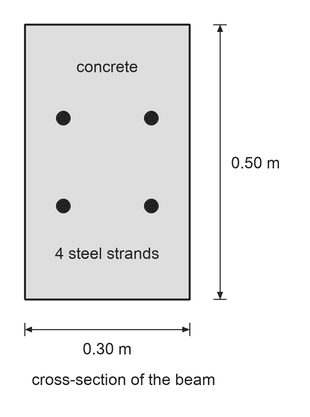
(a) By how much must each strand be stretched?
(b) Find the total squeezing force on the concrete and the compressive stress it produces. Take the whole cross-section of the beam as concrete.
(c) When a train passes, bending would produce a tensile stress of in the bottom of a beam without prestress. Find the stress in the bottom of the prestressed beam, and say whether the concrete cracks there.
- 251 mark
Question 25
Competency: Analysis & Evaluation
For a film, a model-maker builds a statue of an elephant standing on four legs. The model-maker then builds a giant version of the same statue, made of the same material and exactly times as large in every length. Compared with the compressive stress in the legs of the small statue, the stress in the legs of the giant statue is
- 263 marks
Question 26
The breaking stress of a material is . Find the greatest length of a wire that could hang vertically without breaking? Density of material = .
- 273 marks
Question 27
A steel wire of length 1 m and diameter 0.8 mm is kept stretched between two rigid supports. What additional stretching force will experience when its temperature falls by 30 K? (Take and for steel.)
- 283 marks
Question 28
To one end of a steel wire of unstretched length 3 m and cross-section area , a small ball of mass 150 g is attached. The other end of the wire is fixed and the ball is allowed to revolve in a horizontal circle. If the ball makes 600 revolutions per minute, find the radius of the uniform circular motion. for steel = Pa.
- 293 marks
Question 29
A steel wire and copper wire of the same diameters and of length 1 m and 2 m respectively are connected end to end and a force is applied. The increase in length of the combination is 0.01 m. Calculate the elongation produced in the individual wires. Given that of copper is and that of steel is .
- 303 marks
Question 30
The maximum stress that can be applied to the material of a wire used to suspend an elevator is . If the mass of the elevator is 900 kg and it moves up with an acceleration of , what is the minimum diameter of the wire?
- 313 marks
Question 31
What pressure is required to prevent the expansion of a copper block, if it is heated from 30°C to 40°C? Coefficient of linear expansion of copper is /K and bulk modulus = .
- 321 mark
Question 32
Competency: Analysis
A farmer draws water from a well deep. The bucket full of water has a mass of and hangs from a uniform nylon rope that passes over a pulley at the top of the well. The rope has a mass of per metre, and of it hangs below the pulley when the bucket is at the bottom. The bucket is lifted off the bottom and raised slowly at a steady speed. Take . (Hypothetical data.)
Just after the bucket leaves the bottom, where is the tensile stress in the hanging rope greatest, and how does it compare with the stress at the other end of the hanging part?
- 331 mark
Question 33
Competency: Application
In a workshop's hydraulic press, a pump piston of area pushes oil into a closed system of pipes and a cylinder. With the ram already pressed against the workpiece, the pressure of the trapped oil must rise by . Because the oil is slightly compressible, the pump piston has to travel an extra distance before this pressure is reached. At present of oil, of bulk modulus , is trapped in the system. (Hypothetical data.)
Which one of these changes would make this extra travel of the pump piston the smallest?
- 341 mark
Question 34
Competency: Analysis
Two climbers, P and Q, each of mass , are held by identical nylon climbing ropes. Each slips and falls freely through before the rope becomes tight, and the rope then stretches until the climber comes to rest for a moment. Climber P has of rope between the climber and the anchor, while climber Q, closer to the anchor, has only . Treat each rope as obeying Hooke's law, so that a length of rope stretched by pulls with a force , where for this rope. Take and ignore air resistance. (Hypothetical data.)
Which climber feels the larger greatest pull from the rope?
- 351 mark
Question 35
Competency: Analysis & Evaluation
In a workshop, a hardened steel ball bearing is dropped from a height of , once on to a thick steel plate and once on to a thick lead plate. On the steel plate it bounces back to a large part of its starting height. On the lead plate it hardly bounces at all and leaves a small dent.
Assertion (A): A steel ball dropped from the same height bounces much higher from a thick steel plate than from a thick lead plate.
Reason (R): Lead is a malleable metal, so it regains its original shape quickly when the deforming force is removed.
- 362 marks
Question 36
Competency: Evaluation
A laboratory is choosing the suspension fibre for a sensitive moving-coil galvanometer. The fibre must let the coil come back to zero as soon as the current stops, and it must also carry the current into the coil. Four fibres of the same length are each twisted through , within the elastic limit, held for one minute and released. The twist still left afterwards is recorded. (Hypothetical data.)
Fibre Twist left after release Twist left after release Conducts electricity? Glass No Steel Yes Quartz below below No Phosphor bronze below below Yes (a) Which fibre shows the largest elastic after-effect? Explain what its readings show.
(b) Which fibre should be chosen? Give a reason for rejecting each of the other three.
- 372 marks
Question 37
Competency: Creativity
A student wants to measure Poisson's ratio of the rubber in a wide, flat exercise band, about wide and long. The apparatus available is a clamp stand, a hanger with slotted masses, a metre scale, vernier callipers of least count and a fine marker pen.
(a) Describe how the student should set up the band, what should be measured, and how Poisson's ratio is then worked out.
(b) Poisson's ratio of rubber is close to . For a band wide stretched to a longitudinal strain of , estimate the decrease in width and use it to show that the vernier callipers can measure this change. State one precaution.
- 383 marks
Question 38
Competency: Application
A shop's signboard, of total mass , hangs from a small ring R. The ring is held by two identical steel wires, each long and in diameter, fixed to the ceiling. Each wire makes an angle of with the ceiling, as shown. For the steel, , and Hooke's law holds up to a stress of . Take and ignore the masses of the wires and the ring. (Hypothetical data.)
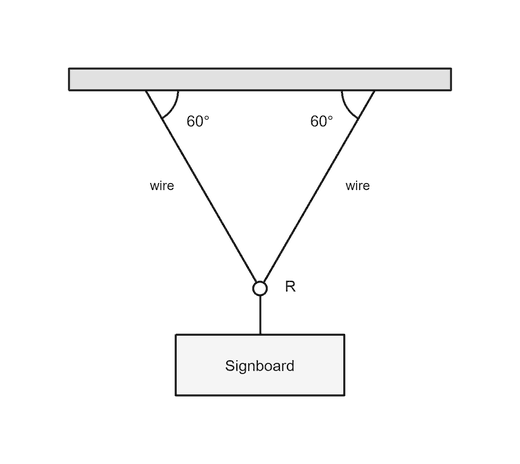
(a) Find the tension in each wire.
(b) Find the stress in each wire, check that Hooke's law applies, and find the extension of each wire.
(c) As the wires stretch, the ring moves straight down. Show that it moves down by , where is the extension of each wire, and find this distance.
- 393 marks
Question 39
Competency: Analysis
Overhead power lines often use a steel-cored aluminium conductor. In one such conductor, a core of steel wires with a total area of cross-section of is surrounded by aluminium strands of total area . The steel and aluminium are clamped together at the ends of each span, so they always have the same length and stretch together. For the steel, ; for the aluminium, . In one span the conductor is pulled with a tension of . (Hypothetical data.)
(a) Find the strain in the conductor.
(b) Find the stress in the steel and in the aluminium, and the fraction of the tension carried by the steel core.
(c) The aluminium may be stressed safely up to and the steel up to . Find the greatest tension this conductor may carry, and compare it with the greatest tension of an all-aluminium conductor of the same total area, .
- 405 marks
Question 40
Competency: Analysis & Evaluation
Case study: Traditional bows in many parts of India are made of bamboo, while the limbs of modern competition bows are built from layers of glass fibre or carbon fibre. When an archer draws a bow, the limbs bend and store elastic energy, which passes to the arrow on release. A limb must never be bent beyond its elastic limit, or it takes a permanent set. For limbs of the same shape and size, the greatest energy a limb can store is proportional to the greatest elastic energy that one cubic metre of its material can hold, and for a light bow the energy per kilogram matters most. An archery club compares four materials. (Hypothetical data.)
Material Young's modulus (Pa) Stress at elastic limit (Pa) Density () Bamboo Spring steel Aluminium alloy Glass-fibre composite (a) Show that the greatest elastic energy that one cubic metre of a material can store without a permanent set is , and find it for each material.
(b) Find the greatest energy per kilogram for each material. Which material is best for a light bow, and how many times as much energy per kilogram does it store as spring steel?
(c) A club member says, "Spring steel must be the best, because it has the largest Young's modulus and the highest elastic limit." Evaluate this claim using the data, and state what combination of properties makes a good bow material.