
Competency: Application
A student finds Young's modulus of a brass wire with an optical lever instead of a micrometer. The wire, long and in diameter, hangs from a rigid support and has a clamp at its lower end. A small mirror is fixed on a stand whose front legs rest on a fixed shelf and whose back leg rests on the clamp, a distance behind the front legs. A lamp's narrow beam is reflected by the mirror on to a vertical scale a distance away, as shown. When an extra is hung from the wire, the clamp moves down by the wire's extension , the stand tilts about its front legs through a small angle (in radians), and the light spot on the scale moves up by . Take . (Hypothetical data.)
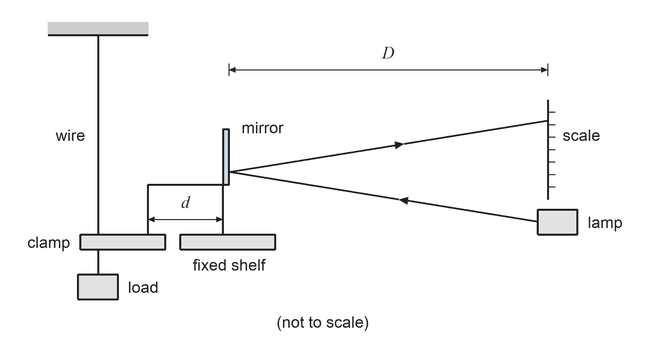
(a) Explain why the reflected beam turns through when the mirror turns through , and show that the spot moves through .
(b) Find the extension of the wire.
(c) Find Young's modulus of the brass, and the factor by which the optical lever magnifies the extension.