Opening your dashboard
Class 11 Physics Chapter 13 Elasticity: Practice Questions
124 questions on Chapter 13, each worked through on its own page with the AI tutor. Class 11 Physics, ICSE 2026-27.
124 questions
1–4 marks · Mixed difficulty
- 11 mark
Question 1
The graph shows how the force between two neighbouring atoms of a solid changes with their separation . A positive means that the atoms repel each other; a negative means that they attract each other.

Which point describes a pair of neighbouring atoms in a solid that is being squeezed slightly?
- 21 mark
Question 2
Which of these observations shows a body behaving elastically?
- 33 marks
Question 3
A steel wire long carries a tensile stress of and stays within its elastic limit. Young's modulus of steel is . Treat the iron atoms as lying in straight rows along the wire, with neighbouring atoms apart when the wire is unstretched. (Hypothetical data.)
(i) Find the strain in the wire.
(ii) By how much does the separation of two neighbouring atoms along the wire increase?
(iii) How many atomic spacings fit along the wire? Use your answers to find the total extension of the wire, and check it against strain × length.
- 41 mark
Question 4
The forces between neighbouring atoms that make a solid elastic are mainly
- 53 marks
Question 5
A small block has its lower face, of area , glued to a fixed metal plate. A cord pulls the block with a force of directed at above the plate, as shown. (Hypothetical data.)
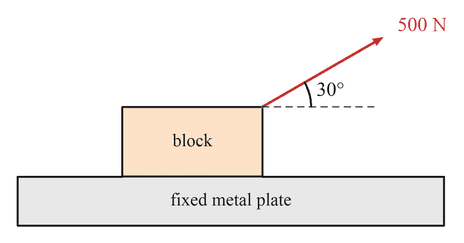
Assuming that the force is spread evenly over the glued face, find
(i) the normal (tensile) stress on the glue, and
(ii) the shearing (tangential) stress on the glue.
- 61 mark
Question 6
A rubber exercise band is long when slack and long when it is stretched. (Hypothetical data.) The tensile strain in the band is
- 72 marks
Question 7
A rectangular rubber eraser high has its base glued to a desk. A finger pushes its top face sideways, parallel to the desk, so that the top face moves while the base stays fixed. (Hypothetical data.)
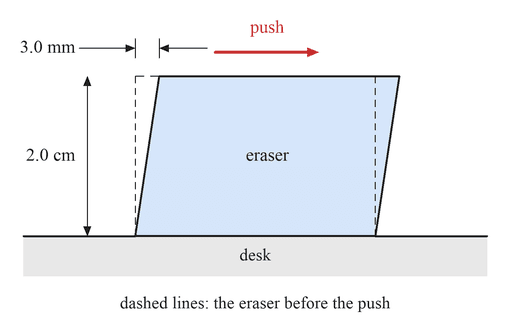
(i) Find the shearing strain in the eraser.
(ii) Express the angle of shear in degrees.
- 83 marks
Question 8
A brass cube with edges long is placed in a chamber filled with oil, and the oil pressure is raised. Each edge of the cube becomes shorter. (Hypothetical data.)
(i) Find the linear strain of one edge.
(ii) Find the volume strain of the cube, first exactly and then by using .
(iii) Explain why the cube stays a cube.
- 91 mark
Question 9
A solid steel rod of diameter and a steel tube of outer diameter and inner diameter carry the same tensile force. The ratio is
- 103 marks
Question 10
A punch press makes a round hole of diameter in a mild-steel sheet thick, as shown. The steel tears when the shearing stress on the cut reaches . (Hypothetical data.)
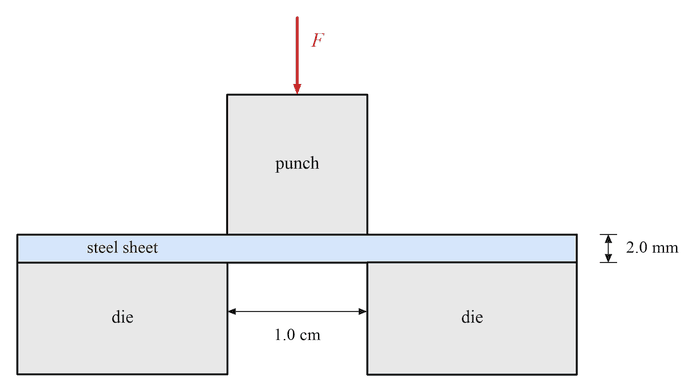
(i) Which surface of the punched-out disc carries the shearing stress? Find its area.
(ii) Find the least force the punch must exert.
- 113 marks
Question 11
A student hangs loads on a long metal wire and measures its extension each time. (Hypothetical data.)
Load (N) 0 10 20 30 40 50 60 Extension (mm) 0 0.42 0.84 1.26 1.68 2.20 3.10 (i) Up to what load do the readings show that the wire obeys Hooke's law? Give your reason.
(ii) Find the extension for a load of .
(iii) Explain why Hooke's law cannot be used to predict the extension for a load of .
- 121 mark
Question 12
Within its elastic limit, a stretched wire behaves like a stiff spring that obeys . A steel wire is long and has a cross-sectional area of ; for steel, . (Hypothetical data.) The force constant of this wire is
- 131 mark
Question 13
Wires P and Q are made of the same metal and have the same cross-sectional area, but P is twice as long as Q. Both are loaded within their limit of proportionality, and for each wire a graph is made with load on the vertical axis and extension on the horizontal axis. The ratio is
- 143 marks
Question 14
An aluminium block of mass hangs from a steel wire long and in diameter. The whole arrangement is then lowered until the block is completely under water in a beaker, with the same of wire holding it, as shown. (Hypothetical data.)
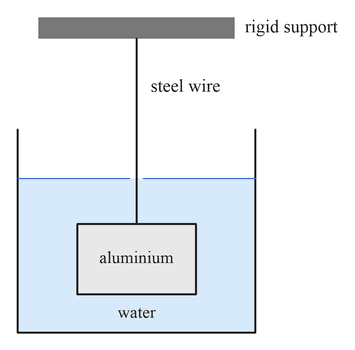
Take and the elastic limit as for the steel, the density of aluminium as , the density of water as and . The water pushes up on the block with a force equal to the weight of the water the block displaces (Archimedes' principle).
(i) Find the extension of the wire when the block hangs in air.
(ii) Find the extension when the block is under water.
(iii) Explain, using Hooke's law, why the extension falls in the same ratio as the tension.
- 152 marks
Question 15
The scale of a spring balance is marked with equal spacings for equal steps of load, and the balance carries a label giving the largest load it may be used for.
(i) Use Hooke's law to explain why equal steps of load can be marked at equal spacings.
(ii) Explain why the balance may read wrongly afterwards if it is once loaded far beyond the labelled limit.
- 163 marks
Question 16
Two identical sealed syringes each hold : one is full of air at atmospheric pressure and the other is full of water. In each, the plunger is pushed slowly to raise the pressure inside by , the temperature staying constant. Take the bulk modulus of the air under these conditions as and that of water as . (Hypothetical data.)
(i) Find the decrease in volume of the air.
(ii) Find the decrease in volume of the water.
(iii) Hydraulic car brakes must be kept free of air bubbles. Use your answers to explain why.
- 171 mark
Question 17
A flexible joint is made by bonding a rubber block between two parallel metal plates. With the lower plate fixed, a sideways force on the upper plate of a joint whose rubber has thickness and face area moves the upper plate sideways by a small distance . A second joint, of the same rubber, has thickness and face area . Assume that the rubber obeys Hooke's law for these small shifts. Under the same sideways force , the upper plate of the second joint moves by
- 182 marks
Question 18
Name the modulus of elasticity that decides each of the following, and name the kind of strain produced:
(i) how much a guitar string stretches when it is tightened with the tuning peg;
(ii) how much the oil in a hydraulic jack is squeezed when the jack lifts a car;
(iii) how far the top of a rubber bearing under a bridge beam moves sideways when the beam expands on a hot day, while the base of the bearing stays fixed;
(iv) how much a concrete pillar shortens under the weight of the floors it supports.
- 193 marks
Question 19
The graph shows the straight (Hooke's law) parts of the stress–strain graphs of two wires, P and Q, made of different metals. (Hypothetical data.)
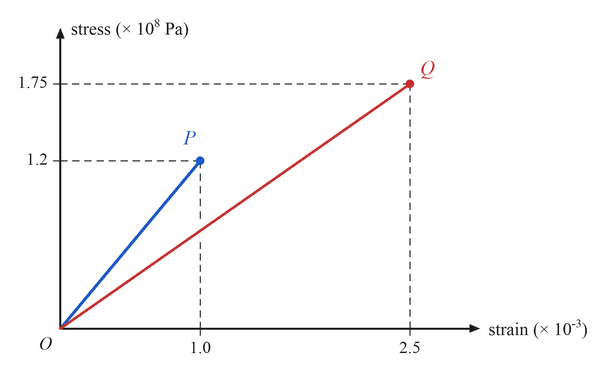
Metal steel copper brass aluminium (Pa) (i) Find Young's modulus of each wire from the graph.
(ii) Use the table to name the metal of each wire.
(iii) Wire Q is long. Find its extension at the end of the straight part of its graph.
- 203 marks
Question 20
A fish hangs from a nylon fishing line in diameter. An angler compares it with a steel wire of the same diameter and length carrying the same fish. Young's modulus is for the nylon and for the steel. Assume that both stay within their elastic limits. (Hypothetical data.)
(i) How many times as much does the nylon line stretch as the steel wire?
(ii) What diameter of nylon line would stretch no more than the steel wire under the same load?
- 211 mark
Question 21
Young's modulus of copper is . In C.G.S. units () this is
- 221 mark
Question 22
The figure shows the stress–strain graph of a metal wire. OP is straight, P is the limit of proportionality and Q is the elastic limit. The wire is loaded until its state is at point R, and then the load is slowly removed.
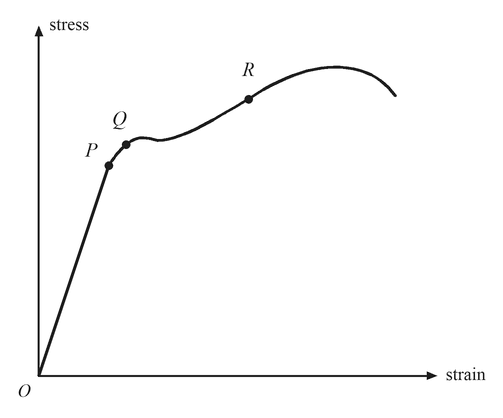
Which statement is correct?
- 233 marks
Question 23
A copper wire long is stretched beyond its elastic limit until the stress in it is and its strain is . The load is then removed slowly. On unloading, the stress–strain graph is a straight line parallel to the first straight part of the loading graph, whose gradient is Young's modulus, . (Hypothetical data.)
(i) Find the strain that is recovered on unloading.
(ii) Find the permanent strain.
(iii) Find the permanent increase in the length of the wire.
- 243 marks
Question 24
In a tensile test, a metal wire of diameter is pulled with a force of . At one place the wire has begun to neck (thin down locally), and its diameter there is only , as shown. (Hypothetical data.)
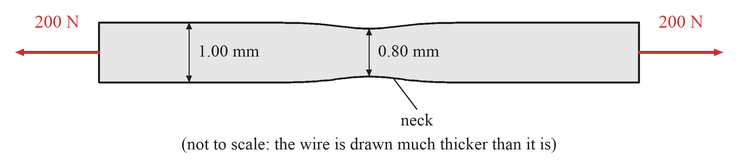
(i) Find the stress in the normal part of the wire and at the neck.
(ii) By what factor is the stress at the neck larger?
(iii) Using the stress–strain diagram of a metal wire, explain why the wire goes on thinning at the neck and finally breaks there.
- 251 mark
Question 25
Two wires are made of the same metal in the same condition (both annealed in the same way); one has diameter and the other . Each is stretched until it breaks, and the stress–strain graphs of the two wires are drawn on the same axes. Compared with the thinner wire's graph, the thicker wire's graph is
- 261 mark
Question 26
With every heartbeat the wall of the aorta is stretched by a large amount, and it springs back to its original size when the heart relaxes. Its stress–strain graph is not a straight line. Which description fits the material of the aorta wall?
- 273 marks
Question 27
Three samples , and are tested by stretching them slowly until they break. (Hypothetical data.)
Sample Behaviour in the test Obeys Hooke's law up to a strain of and snaps at that strain, with no permanent stretch before it breaks. Obeys Hooke's law up to a strain of ; beyond that it stretches a great deal and keeps a permanent stretch when unloaded; it breaks at a strain of . Returns fully to its original length after strains as large as (its length made six times the original); its stress–strain graph is not a straight line anywhere. (a) Classify each sample as brittle, ductile or an elastomer, giving a reason for each.
(b) Which sample would you choose to draw into a thin wire? Explain.
- 283 marks
Question 28
In a fatigue-testing machine, a rubber strip of volume is stretched and released times every second. In each cycle the loop enclosed by its loading and unloading stress–strain curves has an area of . The density of the rubber is and its specific heat capacity is . (Hypothetical data.)
(a) What does the area of the loop represent?
(b) How much heat is produced in the strip every second?
(c) If no heat escaped, by how much would the temperature of the strip rise in one minute?
- 291 mark
Question 29
A goldsmith beats a small piece of gold into a leaf only about thick, and a factory pulls copper through smaller and smaller holes to make thin wire. The properties of the metals used in these two processes are respectively
- 302 marks
Question 30
Bridge designers use a ductile material such as mild steel, rather than a brittle material such as cast iron, for the members of a bridge that are pulled (in tension). Give two reasons, based on how each kind of material behaves when it is overloaded.
- 314 marks
Question 31
In a Searle's experiment, the experimental steel wire is long and its mean diameter, measured with a screw gauge, is . The micrometer screw readings, taken with the bubble of the spirit level at the centre, are given below for loads put on the hanger and then removed. Take . (Hypothetical data.)
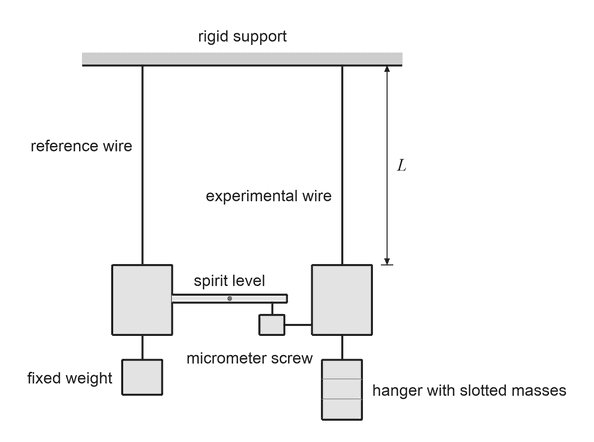
Load on hanger (kg) 0 1 2 3 4 5 Reading, load increasing (mm) 3.10 3.72 4.35 4.97 5.60 6.22 Reading, load decreasing (mm) 3.12 3.74 4.36 4.99 5.61 6.22 (a) Find the mean reading for each load and the extension produced by the load.
(b) Calculate the Young's modulus of the steel.
(c) Why are readings taken both while loading and while unloading?
- 321 mark
Question 32
A Searle's experiment uses two steel wires, each long, hanging from the same support. During the experiment the room warms up by . Steel expands by of its length for each degree Celsius. (Hypothetical data.) Why does this warming not spoil the measured extension?
- 333 marks
Question 33
In finding Young's modulus by , a student measures the length of a brass wire as with a metre scale (error ), its diameter as with a screw gauge (error ), and the extension as with the micrometer (error ). Take the load and as exact. (Hypothetical data.) The largest possible fractional error in a product or quotient is the sum of the fractional errors of its factors, each multiplied by the power to which that factor is raised.
(a) Find the largest possible percentage error in .
(b) Which measurement needs the most care? How is this care taken in the experiment?
- 341 mark
Question 34
In a Searle's experiment the student is told to turn the micrometer screw always in the same direction (for example, always forwards) when bringing the bubble of the spirit level back to the centre. This precaution avoids
- 352 marks
Question 35
Show by calculation why Searle's experiment uses a long, thin wire and not a short, thick rod. Find the extension produced by a load in (a) a steel wire long and in diameter, and (b) a steel rod long and in diameter. The micrometer reads to . Take for steel and . (Hypothetical data.)
- 361 mark
Question 36
Two wires of the same material and the same length have diameters of and . (Hypothetical data.) Equal loads are hung from them, and both stay within the elastic limit. The ratio of the elastic energy stored in the thinner wire to that stored in the thicker wire is
- 373 marks
Question 37
A steel wire long with an area of cross-section of hangs from a rigid support with a load of . The load is slowly increased to , the wire staying within its elastic limit. Take and . (Hypothetical data.)
(a) Find the extensions of the wire with the and the loads.
(b) Find the extra work done in stretching the wire from the first extension to the second.
- 381 mark
Question 38
A steel column in a building is tall and has a cross-sectional area of . It carries a compressive load of from the floors above, well within its elastic limit. Young's modulus of steel is . (Hypothetical data.) The elastic energy stored in the compressed column is about
- 393 marks
Question 39
A mass is hung from a steel wire and lowered gently by hand until it hangs at rest. The wire is then stretched by . Take . (Hypothetical data.)
(a) Find the loss of gravitational potential energy of the mass and the elastic energy stored in the wire.
(b) Explain why the two answers to (a) are different.
(c) If the mass were instead attached to the unstretched wire and simply let go, what would be the greatest extension of the wire? (Ignore energy losses and stay within the elastic limit.)
- 401 mark
Question 40
The load on a wire is increased by , and the wire stays within its elastic limit. By about what percentage does the elastic energy stored in the wire increase?
- 413 marks
Question 41
A copper wire long and in diameter is stretched so that its length increases by . Poisson's ratio for copper is . (Hypothetical data.)
(a) Find the longitudinal strain and the decrease in the diameter of the wire.
(b) Find the fractional change in the volume of the wire. Does the volume increase or decrease?
- 421 mark
Question 42
Natural rubber has a Poisson's ratio very close to . This means that when a rubber cord is stretched slightly,
- 431 mark
Question 43
A cork can be pushed into the neck of a bottle much more easily than a rubber stopper of the same size and shape. The best explanation is that cork
- 443 marks
Question 44
For a sample of copper wire, the modulus of rigidity is measured as and Poisson's ratio as . (Hypothetical data.)
(a) Find its Young's modulus .
(b) Find its bulk modulus .
(c) Check your answers with the relation .
- 453 marks
Question 45
A short steel cylinder long and in diameter is squeezed in a press by a force of along its axis, staying within its elastic limit. For steel, and Poisson's ratio is . (Hypothetical data.)
(a) By how much does the cylinder become shorter?
(b) By how much does its diameter change? Does it become wider or narrower?
- 463 marks
Question 46
A wooden plank long, wide and thick rests on supports at its two ends, and a load of acts at its middle, as shown. The sag at the middle is , where is the load, the distance between the supports, the breadth and the depth (vertical thickness) of the plank. For the wood, . Ignore the weight of the plank. (Hypothetical data.)
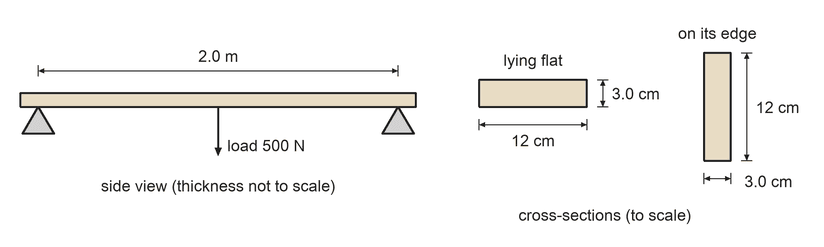
(a) Find the sag when the plank lies flat.
(b) Find the sag when the plank is turned to stand on its edge.
(c) Explain why beams in buildings are laid with their larger dimension vertical.
- 471 mark
Question 47
Steel girders for bridges and buildings are usually made with an I-shaped cross-section rather than as solid rectangular bars of the same mass. The main reason is that the I-section
- 483 marks
Question 48
The rock at the base of a mountain must not be stressed beyond its elastic limit; otherwise it would begin to flow and the mountain would sink. Treat a mountain as a uniform column of rock of height . Take the elastic limit of the rock as and its density as . (Hypothetical data.)
(a) Show that the stress at the base of the column is .
(b) Estimate the greatest possible height of a mountain on the earth ().
(c) Estimate the greatest height for the same rock on Mars ().
- 493 marks
Question 49
A crane must lift loads of up to tonnes (). Its rope is made of many steel wires, each in diameter, with a breaking stress of . For safety, the rope must be able to hold five times the greatest load. Take . (Hypothetical data.)
(a) Find the breaking force of one wire.
(b) Find the least number of wires the rope needs.
(c) Give two reasons why such a rope is made of many thin wires rather than as one solid steel rod of the same total area.
- 501 mark
Question 50
A wooden shelf resting on supports at its two ends sags by at its middle when a pot of plants is placed there. (Hypothetical data.) A second shelf is cut from the same plank but is twice as long, and the same pot is placed at its middle. Using and ignoring the weight of the shelves, the sag of the second shelf is
- 512 marks
Question 51
Which is more elastic, steel or rubber? Why?
- 522 marks
Question 52
The stress versus strain graphs for two materials and are shown in the given figures. (The graphs are drawn to the same scale.)
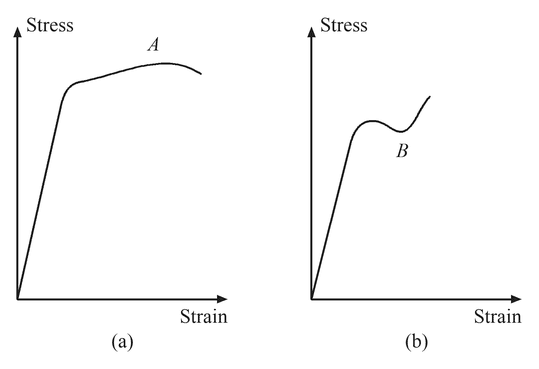
(a) Which material has greater Young's modulus?
(b) Which material is more ductile?
(c) Which is more brittle?
(d) Which of the two is the strong material?
- 532 marks
Question 53
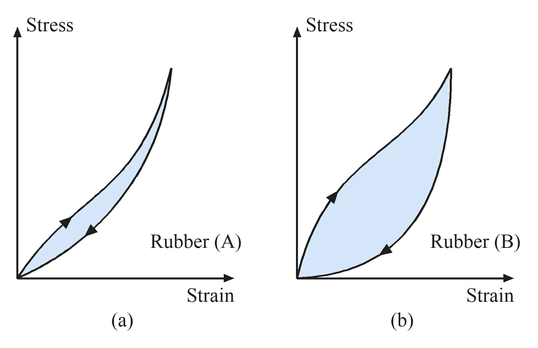
Two different types of rubbers are found to have the stress–strain graph shown below.
(a) In which significant ways do these curves differ from the stress–strain curve of a metal wire shown in figures in Question 2? (In Question 2, the graph of each material is a straight line from the origin up to its elastic limit, followed by a curved plastic region before the material breaks.)
(b) A heavy machine is to be installed in a factory. To absorb vibrations of the machine, a block of rubber is placed between the machinery and the floor. Which of the two rubbers and would you prefer to use for this purpose? Why?
(c) Which of the two rubber materials , would you choose for a car tyre [Figs. (a) and (b)]?
- 541 mark
Question 54
Which modulus determines the stretching of a coiled spring?
- 552 marks
Question 55
What is elastic after-effect?
- 561 mark
Question 56
What is the effect of temperature on elasticity?
- 571 mark
Question 57
A spring is made of steel and not of copper, why?
- 582 marks
Question 58
What is elastic fatigue?
- 592 marks
Question 59
A spring balance which is used for a long time shows wrong readings. Why?
- 601 mark
Question 60
What is rigidity modulus of a liquid?
- 612 marks
Question 61
What happens to the (i) extension and (ii) maximum load a wire can bear when the wire is cut in half?
- 621 mark
Question 62
Where does the work done go during the stretching of a wire?
- 633 marks
Question 63
A wire of length 15 m and diameter 4 mm elongates 0.3 mm when stretched by weight of 2.20 kg. Calculate the Young's modulus of the material of the wire.
- 643 marks
Question 64
A wire one square centimetre area of cross-section is stretched by a force to double its original length. Calculate the force. Young's modulus = 90 GPa. Assume that the wire does not break.
- 653 marks
Question 65
How much will a 30 m steel tape 1 cm wide and 0.05 cm thick stretch under a pull of a force of 300 N if Young's modulus of steel is .
- 663 marks
Question 66
Find the stress to be applied to a steel wire to stretch it by 0.025% of its original length. for steel is 90 GPa.
- 673 marks
Question 67
A uniform wire 6 m long weighing 0.04 kg elongates by 0.8 mm when stretched by a load of 1 kg. If its density is 8.9 g/cc, find the Young's modulus of the material.
- 683 marks
Question 68
Find the percentage increase in length of a wire subjected to a stress of . Young's modulus of the material of the wire = 100 GPa.
- 693 marks
Question 69
How much a hollow cylindrical pillar of height 6 m and external diameter 28 cm and internal diameter 22 cm will contract under a load of 60000 kg? Given Young's modulus of the material to be .
- 703 marks
Question 70
Two wires made of the same material are subjected to force in the ratio of 1:2. Their lengths are in the ratio 8:1 and diameters in the ratio 2:1. Find the ratio of their extension.
- 713 marks
Question 71
A wire elongates by 9 mm when a load of 10 kg is suspended from it. What is the elongation when its radius is doubled, if all other quantities are same as before?
- 723 marks
Question 72
For steel, the breaking stress is and the density is . Calculate the maximum length of a steel wire which can be suspended without breaking under its own weight. Given .
- 733 marks
Question 73
A uniform wire of steel of length 2.5 m and of density weighs 0.05 kg. When stretched by a force of 10 kgwt, the length increases by 2 mm. Calculate the Young's modulus for steel.
- 743 marks
Question 74
Two parallel wires and are fixed to a rigid support at the upper ends and are subjected to the same load at the lower ends. The lengths of the wire are in the ratio 4:5 and their radius are in the ratio 4:3. The increase in length of the wire is 1 mm. Calculate the increase in length of the wire .
- 753 marks
Question 75
Calculate the force required to increase the length of wire of cross-sectional area by 50%, if the Young's modulus of the material of the wire is Pa.
- 763 marks
Question 76
A uniform wire of length 6 m and a cross-sectional area is stretched by a force of 600 N. If the Young's modulus of the material of the wire , calculate (i) stress, (ii) strain and (iii) increase in length of the wire.
- 773 marks
Question 77
Artificial diamond is made by subjecting carbon in the form of graphite to a pressure of at a high temperature. Assuming that the natural diamond formed at similar high pressure within the earth, calculate its original volume if the mass of the diamond before cutting was 150 g. The density of diamond = . Bulk modulus = .
- 783 marks
Question 78
A sphere contracts in volume by 0.1% when taken to bottom of the sea 1 km deep. Find the bulk modulus of the material of the sphere. Density of sea water = .
- 793 marks
Question 79
When a body having a volume of is pressed by a pressure of , its volume decreases by . Calculate the bulk modulus of the body.
- 803 marks
Question 80
The volume of a solid is under 2 atm pressure. Find the change in volume when subjected to a pressure of 102 atm. Bulk modulus of the material = .
- 813 marks
Question 81
On taking a solid ball of rubber from the surface to the bottom of a lake of 200 m depth, the reduction in the volume of ball is 0.1%. The density of water of the lake is . Calculate the value of bulk modulus elasticity of rubber. .
- 823 marks
Question 82
What is the decrease in volume of one litre of water when a pressure of 10 atm is applied? Given that the compressibility of water is .
- 833 marks
Question 83
Find the pressure required to prevent the expansion of a copper block if it is heated from 40°C to 50°C. Coefficient of linear expansion of copper is /°C and bulk modulus = .
- 843 marks
Question 84
A cube of soft rubber of face area whose lower face is fixed is sheared through an angle 2° by a force of N acting tangential to the upper face. Calculate the rigidity modulus of the material.
- 853 marks
Question 85
A square aluminium of side 50 cm and thickness 5 cm is subjected to a shearing force of magnitude N. The lower edge is riveted to the floor. How much is the upper edge displaced if shear modulus of aluminium is ?

- 863 marks
Question 86
A metallic cube whose side is 10 cm is subjected to a shearing force of 100 kg. The top face is displaced through 0.25 cm with respect to the bottom. Calculate the shearing stress, strain and shear modulus.
- 873 marks
Question 87
A tangential force equal to the weight of 500 kg is applied to the opposite face of a cube of aluminium of side 10 cm has its one face fixed. Find the shearing strain produced. Rigidity modulus of aluminium is .
- 883 marks
Question 88
A uniform wire of length 10 m and diameter 0.8 mm stretches 5 mm under a certain force. If the change in diameter is m, calculate the Poisson's ratio.
- 893 marks
Question 89
The Young's modulus of a material is and its bulk modulus is . What is its Poisson's ratio?
- 903 marks
Question 90
Calculate the Poisson's ratio for steel. Given that the Young's modulus is and rigidity modulus is .
- 913 marks
Question 91
A wire 4 m long 0.3 mm diameter is stretched by a force of 8 kgwt. If the extension in the length amounts to 1.5 mm, calculate the energy stored in the wire.
- 923 marks
Question 92
Find the maximum energy per unit volume that can be stored in a metal wire when stretched, if its breaking stress is and Young's modulus of the material is .
- 933 marks
Question 93
A weight of 110 N is suspended from the ceiling by an aluminium wire of length 2 m and radius 1 mm. Calculate (i) the extension produced and (ii) the elastic energy stored in the wire. [The Young's modulus of aluminium is .]
- 943 marks
Question 94
A 94.2 cm long sitar string of 1 mm diameter is tuned by stretching it 1.0 cm. Calculate (i) the tension and (ii) the work done in stretching the wire. (Young's modulus of the material of the wire is .)
- 951 mark
Question 95
Two wires are made of the same material and have the same volume. However wire 1 has cross-sectional area and wire 2 has cross-sectional area . If the length of wire 1 increases by on applying force , how much force is needed to stretch wire 2 by the same amount?
- 961 mark
Question 96
One end of a horizontal thick copper wire of length and radius is welded to an end of another horizontal thin copper wire of length and radius . When the arrangement is stretched by applying forces at two ends, the ratio of the elongation in the thin wire to that in the thick wire is
- 971 mark
Question 97
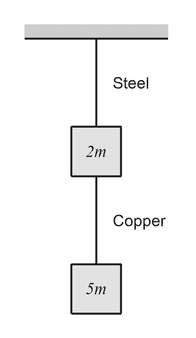
If the ratios of diameters, lengths and Young's modulus of steel and copper wires shown in the given figure are , and respectively, then the corresponding ratio of increase in their lengths would be
- 981 mark
Question 98
Young's modulus of perfectly rigid body material is
- 991 mark
Question 99
In steel, the Young's modulus and the strain at the breaking point are and respectively. The stress at the breaking point for steel is therefore
- 1001 mark
Question 100
The Young's modulus of a metal is and its breaking stress is . In case of longitudinal strain, the maximum energy that can be stored per cubic metre of this metal is approximately (assume )
- 1011 mark
Question 101
A wire suspended vertically from one of its ends is stretched by attaching a weight of to the lower end. The weight stretches the wire by . Then the elastic energy stored in the wire is
- 1021 mark
Question 102
The elastic energy stored per unit volume in a stretched wire is
- 1031 mark
Question 103
The approximate depth of an ocean is . The compressibility of water is and density of water is . What fractional compression of water will be obtained at the bottom of the ocean?
- 1041 mark
Question 104
Choose the wrong statement.
- 1051 mark
Question 105
An external pressure is applied on a cube at so that it is equally compressed from all sides. is the bulk modulus of the material of the cube and is its coefficient of linear expansion. Suppose we want to bring the cube to its original size by heating. The temperature should be raised by
- 1061 mark
Question 106
The average depth of Indian ocean is about . The fractional compression, of water at the bottom of the ocean (given that the bulk modulus of the water is and ) is
- 1071 mark
Question 107
The bulk modulus of a spherical object is ''. If it is subjected to uniform pressure '', the fractional decrease in radius is
- 1081 mark
Question 108
The Young's modulus of steel is twice that of brass. Two wires of same length and of same area of cross section, one of steel and another of brass are suspended from the same roof. If we want the lower ends of the wires to be at the same level, then the weights added to the steel and brass wires must be in the ratio of
- 1091 mark
Question 109
A rod of length at room temperature and uniform area of cross section , is made of a metal having coefficient of linear expansion . It is observed that an external compressive force , is applied on each of its ends, prevents any change in the length of the rod, when its temperature rises by K. Young's modulus, for this metal is
- 1101 mark
Question 110
A boy's catapult is made of rubber cord which is long, with diameter of cross-section and of negligible mass. The boy keeps a stone weighing on it and stretches the cord by by applying a constant force. When released, the stone flies off with a velocity of . Neglect the change in the area of cross-section of the cord while stretched. The Young's modulus of rubber is closest to
- 1111 mark
Question 111
A steel wire having a radius of , carrying a load of , is hanging from a ceiling. Given that , what will be the tensile stress that would be developed in the wire
- 1121 mark
Question 112
The elastic limit of brass is . What should be the minimum diameter of a brass rod if it is to support a load without exceeding its elastic limit?
- 1131 mark
Question 113
When a block of mass is suspended by a long wire of length , the length of the wire becomes . The elastic potential energy stored in the extended wire is
- 1141 mark
Question 114
An object of mass is suspended at the end of a massless wire of length and area of cross-section, . Young's modulus of the material of the wire is . If the mass is pulled down slightly, its frequency of oscillation along the vertical direction is
- 1151 mark
Question 115
A wire of length , area of cross section is hanging from a fixed support. The length of the wire changes to when mass is suspended from its free end. The expression for Young's modulus is
- 1161 mark
Question 116
The length of metallic wire is when tension in it is . It is when the tension is . The original length of the wire will be
- 1171 mark
Question 117
Two wires of same length and radius are joined end to end and loaded. The Young's moduli of the materials of the two wires are and . The combination behaves as a single wire then its Young's modulus is
- 1181 mark
Question 118
A uniform heavy rod of weight , cross-sectional area and length is hanging from a fixed support. Young's modulus of the material of the rod is . Neglecting the lateral contraction, find the elongation of rod due to its own weight.
- 1191 mark
Question 119
The bulk modulus of a liquid is . The pressure required to reduce the volume of liquid by is
- 1201 mark
Question 120
The force required to increase the length of a wire to twice the original length is (Given that the cross-section of the wire is and Young's modulus is )
- 1211 mark
Question 121
A long wire having cross-sectional area and Young's modulus is subjected to a load of , then this elongation in the wire will be
- 1221 mark
Question 122
Given below are two statements; one is labelled as Assertion and the other is labelled as Reason.
Assertion: Steel is used in the construction of buildings and bridges.
Reason: Steel is more elastic and its elastic limit is high.
In the light of the above statements, choose the most appropriate answer from the options given below.
- 1231 mark
Question 123
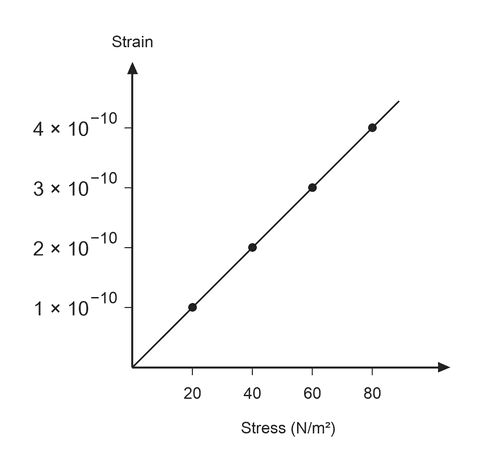
The elastic behaviour of a material for linear stress and linear strain is shown in the given figure. The energy density for a linear strain of is ______ . Assume that the material is elastic upto the linear strain of .
- 1241 mark
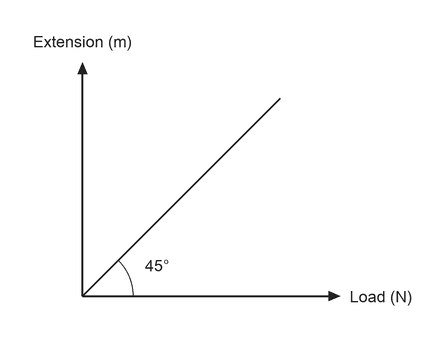
Question 124
As shown in the given figure, in an experiment to determine the Young's modulus of a wire, the extension-load curve is plotted. The curve is a straight line passing through the origin and makes an angle of with the load axis. The length of the wire is and its diameter is . The Young's modulus is found to be . The value of is ______.