Solution:
Concept: When a wire is loaded gradually, its stress–strain graph shows in turn the Hooke's law region, the elastic limit, the yield point and plastic flow, the greatest stress and the breaking point. Copper is ductile, so its plastic region is long.
Step 1 — State Hooke's law (part a). Within the elastic limit, the stress in a body is directly proportional to the strain produced in it.
Step 2 — Draw the diagram (part a). As the load on the copper wire is increased, the stress (load per unit area) and the strain (extension per unit length) are noted and plotted.
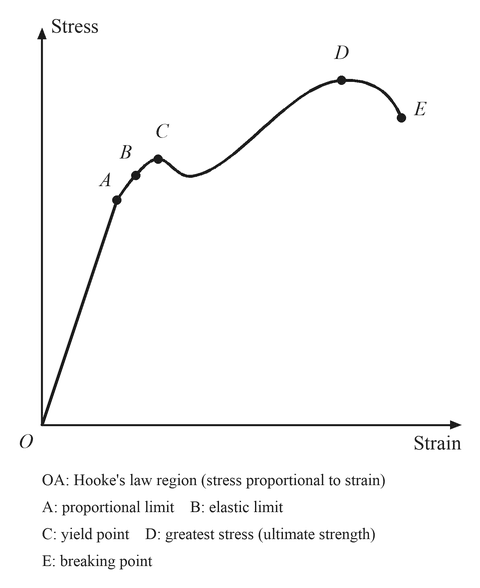
Step 3 — Describe the elastic part. From O to A the graph is a straight line: the extension is proportional to the load, so Hooke's law is obeyed. Up to the point B, the elastic limit, the wire returns to its original length when the load is removed.
Step 4 — Describe the yield and the plastic region. Beyond B the wire no longer recovers fully; if unloaded, it keeps a permanent set. At the yield point C the wire begins to flow, stretching even without much increase of load. Being ductile, copper then stretches a great deal in this plastic region while the stress rises slowly to its greatest value at D.
Step 5 — Describe the breaking. Beyond D the wire becomes thinner at some place (a "neck"); the stress there is larger because the area is smaller, the wire elongates rapidly at that place, and it finally breaks at E.
Step 6 — Mark the points. On the diagram, (i) the elastic limit is the point B and (ii) the yield point is the point C.
Step 7 — Distinguish the three moduli (part b). Each modulus is the ratio of a stress to the strain it produces, within the elastic limit, but for a different kind of deformation.
Young's modulus Y: longitudinal stress divided by longitudinal strain, Y=ΔL/LF/A; it concerns a change of length and exists only for solids.
Bulk modulus K: volume stress (change in pressure) divided by volume strain, K=−ΔV/VΔP; it concerns a change of volume without a change of shape and exists for solids, liquids and gases.
Modulus of rigidity n: shearing stress divided by shearing strain θ, n=θF/A; it concerns a change of shape without a change of volume and exists only for solids (it is zero for fluids).
Therefore, (a) Hooke's law says stress is proportional to strain within the elastic limit; the loaded copper wire obeys it along OA, has its elastic limit at B and its yield point at C, flows plastically to the greatest stress at D and breaks at E; (b) Young's modulus, the bulk modulus and the modulus of rigidity are the stress-to-strain ratios for changes of length, volume and shape respectively.

