Solution:
Concept: Stress is the internal restoring force per unit area of a deformed body. For a metal wire loaded until it breaks, the stress–strain graph is straight only at first; the area under the straight part gives the energy stored per unit volume.
Step 1 — Define stress (part i). When a deforming force acts on a body, internal restoring forces are set up in it. The restoring force per unit area is called stress; in equilibrium it equals the applied force per unit area, AF. Its SI unit is N m−2 (Pa).
Step 2 — Explain the types of stress (part i). The figure shows the three types.
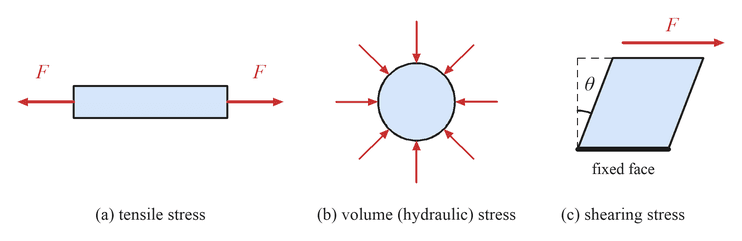
(a) Tensile stress: equal and opposite pulls act along the length of a bar, normal to its cross-section, and increase its length (pushes give compressive stress, which decreases the length). (b) Volume (hydraulic) stress: a force acts normally and uniformly over the whole surface; it equals the change in pressure and changes the volume without changing the shape. (c) Shearing stress: a tangential force acts along one face while the opposite face is fixed; it changes the shape without changing the volume.
Step 3 — Draw the graph (part ii). The figure shows tensile stress against tensile strain for a metal wire loaded until it breaks.
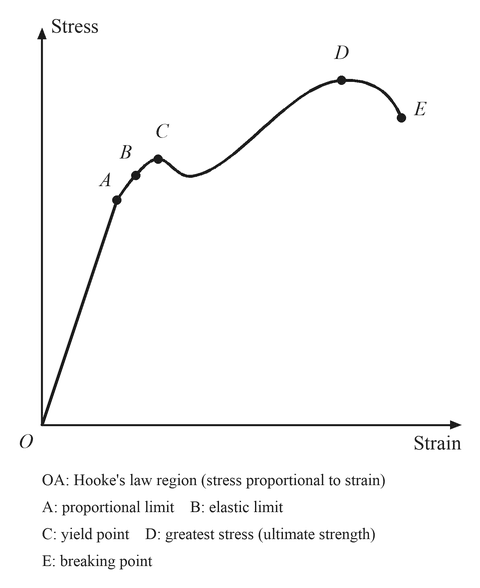
From O to A the graph is a straight line: this is the region in which Hooke's law is obeyed. B is the elastic limit, C the yield point, D the point of greatest stress, and E the breaking point.
Step 4 — Find the area within the Hooke's law region. Let the stress be S when the strain is ε, on the straight part. The area between the line and the strain axis is a triangle:
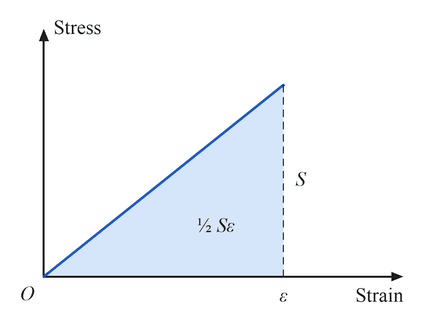
area=21×S×ε
Step 5 — Interpret the area. For a wire of length L and area A stretched by l under a final force F, the work done is 21Fl. Dividing by the volume AL gives:
ALW=21×AF×Ll
ALW=21×S×ε
This is exactly the area of the triangle, so the area between the straight part of the graph and the strain axis is the work done per unit volume, stored in the wire as elastic potential energy.
Therefore, (i) stress is the restoring force per unit area, of three types: tensile (or compressive), volume and shearing; (ii) on the stress–strain graph Hooke's law holds on the straight part OA, and the area between this part and the strain axis is the work done (elastic energy stored) per unit volume of the wire.
