Solution:
Concept: Within the elastic limit, stress = Y × strain. The work done in stretching a wire is 21 × force × extension, and it is stored as elastic potential energy.
Step 1 — State Hooke's law. Within the elastic limit, the stress in a body is directly proportional to the strain:
strainstress=constant
For stretching, the constant is Young's modulus Y.
Step 2 — Write the stress. Let the wire have length L and area of cross-section A. The linear strain is μ, so Hooke's law gives:
stress=Yμ
Step 3 — Write the force and the extension. The stretching force is the stress times the area, and the extension is the strain times the length:
F=YμA
l=μL
Step 4 — Find the stored energy. The force grows steadily from zero to F, so the work done, which is stored as elastic potential energy, is:
U=21Fl
U=21×YμA×μL
U=21Yμ2AL
Step 5 — Divide by the volume. The volume of the wire is AL, so the energy stored per unit volume is:
u=ALU
u=21Yμ2
This is the area of the triangle under the stress–strain line, of base μ and height Yμ.
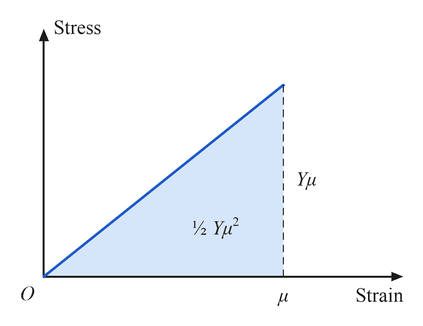
Therefore, Hooke's law states that stress is proportional to strain within the elastic limit, and the elastic potential energy stored per unit volume of the wire is 21Yμ2.
