
Question 475 marksMedium
Define stress, strain and Young's modulus of an elastic material. Describe an experiment for measuring the Young's modulus of a material in the form of a wire.
Confirming your payment
Sign up now and get 250 free tokens.
Elasticity · Question 47 of 47
Define stress, strain and Young's modulus of an elastic material. Describe an experiment for measuring the Young's modulus of a material in the form of a wire.
Solution:
Concept: Young's modulus of a wire is found by measuring the extension produced by a known load in a wire of known length and radius ; Searle's apparatus measures the small extension accurately.
Step 1 — Define stress, strain and Young's modulus. Stress is the restoring force per unit area set up in a deformed body, . Strain is the change in a dimension divided by the original dimension; for a wire it is . Young's modulus is the ratio of longitudinal stress to longitudinal strain within the elastic limit:
Step 2 — Describe the apparatus. In Searle's apparatus two wires and of the same material, length and thickness hang from the same rigid support. is the experimental wire and the reference (compensating) wire. Frames and hang from the lower ends of and . A constant dead weight on frame keeps wire taut, and frame carries a hanger for the slotted weights. A spirit level is hinged on frame , and its other end rests on the tip of a micrometer screw carried by frame .
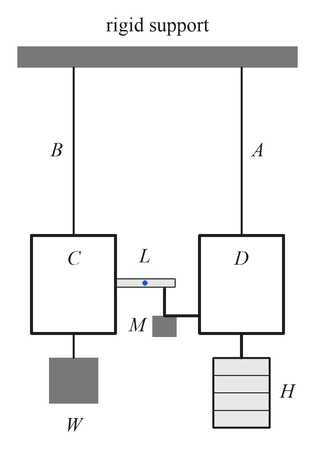
Step 3 — Explain the reference wire. If the support yields a little, both frames move down equally, and if the temperature changes, both wires expand or contract equally. Using the level between the two wires therefore removes both errors.
Step 4 — Take the readings. The wires are loaded and unloaded a few times to remove kinks. The micrometer is adjusted until the bubble of the spirit level is at the centre, and its reading is noted. A load (say 0.5 kg) is put on the hanger; wire stretches, frame moves down and the level tilts. The micrometer is turned until the bubble is central again, and the new reading is noted; the difference is the extension for that load. Equal loads are added one by one, then removed one by one, readings being taken each time, and the mean extension for a load is found.
Step 5 — Measure the wire. The length of wire is measured with a metre scale, and its radius with a screw gauge at several places in two perpendicular directions.
Step 6 — Calculate Young's modulus. The force is and the area of cross-section is , so:
Step 7 — Note the precautions. The wire must be free of kinks; the micrometer must always be turned in one direction to avoid back-lash error; the load must stay well within the elastic limit; after each change of load one should wait for the wire to settle; and the diameter must be measured at several points.
Therefore, stress is force per unit area, strain is extension per unit length, Young's modulus is their ratio within the elastic limit, and Searle's method gives it as from the measured load, length, radius and extension of the wire.