
Question 403 marksMedium
Define stress and strain. Explain the three types of strain and the three types of stress.
Confirming your payment
Sign up now and get 250 free tokens.
Elasticity · Question 40 of 47
Define stress and strain. Explain the three types of strain and the three types of stress.
Solution:
Concept: A deformed body sets up internal restoring forces; the restoring force per unit area is the stress, and the fractional change in its dimensions is the strain.
Step 1 — Define stress. Stress is the restoring force per unit area set up inside a deformed body. In equilibrium it equals the applied force per unit area:
Its SI unit is (Pa).
Step 2 — Define strain. Strain is the ratio of the change in a dimension of a body to its original dimension. It has no unit.
Step 3 — Explain the three types of strain. Linear (longitudinal) strain is produced by a stretching force: , the change in length per unit length. Volume strain is produced by a force acting normally over the whole surface: , the change in volume per unit volume. Shearing strain is produced by a tangential force: it is the angle (in radians) through which a line originally perpendicular to the fixed face is turned.
Step 4 — Explain the three types of stress. The figure shows the three ways in which the deforming force can act.
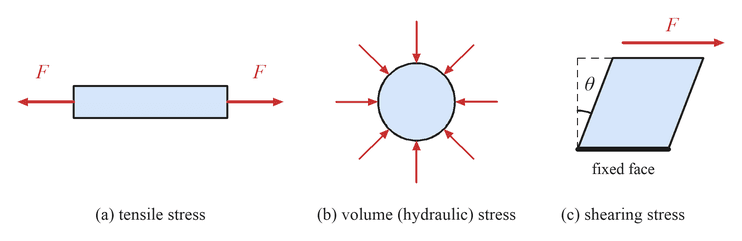
(a) Tensile (or compressive) stress: equal and opposite forces act along the length, at right angles to the cross-section; it equals the force per unit area of cross-section and changes the length.
(b) Volume (hydraulic) stress: the force acts normally and uniformly over the whole surface; it equals the change in pressure and changes the volume without changing the shape.
(c) Shearing (tangential) stress: the force acts along a face while the opposite face is fixed; it equals the tangential force per unit area and changes the shape without changing the volume.
Therefore, stress is the restoring force per unit area and strain is the fractional change in dimension; the three strains are linear, volume and shearing strain, produced respectively by tensile, volume and shearing stress.