
Opening your dashboard
Class 11 Maths Chapter 12: Basic Concepts of Points and Their Coordinates Solutions
32 textbook questions with step-by-step answers, free to read, for ISC 2026-27.
Get talked through Ch 12, not just shown the answer
Reading a finished solution is not the same as being able to do it. The AI tutor takes one question at a time and works it with you, in your own words, until you can.
- Ask it out loud, in your own words
- It gives you the next step, not the answer
- Stuck on part (ii)? Start there
32 questions with solutions
3 marks · Mixed difficulty
The first 12 solutions are on this page. This chapter is a long one, so the rest open on their own page to keep this one quick to load.
- 13 marks
Question 1
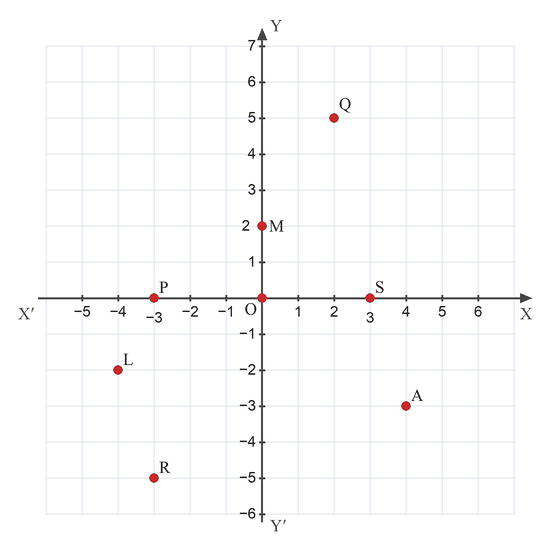
Find the coordinates of the points shown on the graph in the figure below.
(i)
(ii)
(iii)
(iv)
(v)
(vi)
(vii)
(viii)
Solve with AIWritten solution
Solution:
Concept: The co-ordinates of a point are written . The abscissa is its signed distance from the -axis (positive to the right of , negative to the left). The ordinate is its signed distance from the -axis (positive above , negative below). Each small square of the graph is unit.
Step 1 — Read each point. For every point we count the squares from the -axis along the -direction to get the abscissa, then count the squares from the -axis to get the ordinate, giving each count the sign of its direction.
(i) Point lies on the -axis, units to the left of . Its abscissa is and its ordinate is .
(ii) Point is units to the right of the -axis and units above the -axis.
(iii) Point is the origin, where the axes cross, so both distances are zero.
(iv) Point is units to the left of the -axis and units below the -axis, so both co-ordinates are negative.
(v) Point lies on the -axis, units to the right of .
(vi) Point is units to the right of the -axis and units below the -axis.
(vii) Point is units to the left of the -axis and units below the -axis.
(viii) Point lies on the -axis, units above , so its abscissa is and its ordinate is .
Watch out: A point on the -axis has ordinate , and a point on the -axis has abscissa ; do not write as .
Therefore, , , , , , , and .
- 23 marks
Question 2
Plot the points , , , , on the graph paper.
Solve with AIWritten solution
Solution:
Concept: To plot , start at the origin , move units along the -axis (right if , left if ), then move units parallel to the -axis (up if , down if ), and mark the point.
Step 1 — Draw the axes. We draw the -axis and the -axis at right angles and take one small square as unit on each axis.
Step 2 — Plot each point. We apply the rule above to each point in turn.
- : move units right and then units up; the point is in the first quadrant.
- : move units left and then units down; the point is in the third quadrant.
- : move units left and then units up; the point is in the second quadrant.
- : do not move along the -axis and go units up; the point lies on the -axis.
- : move units left and do not move up or down; the point lies on the -axis.
Step 3 — Check the plot. The finished graph is shown below; each point sits at the crossing of its two grid lines.

Watch out: The first number always goes along the -axis; is on the -axis, not on the -axis.
Therefore, the five points are plotted as shown: in quadrant I, in quadrant II, in quadrant III, on the -axis and on the -axis.
- 33 marks
Question 3
Where will a point lie if
(i) its ordinate is zero,
(ii) its abscissa is zero?
Solve with AIWritten solution
Solution:
Concept: The ordinate of a point is its distance from the -axis, and the abscissa is its distance from the -axis.
(i)
Step 1 — Use the meaning of the ordinate. An ordinate of zero means the point is at zero distance from the -axis, so the point is of the form and lies on the -axis.
The point lies on the -axis.
(ii)
Step 1 — Use the meaning of the abscissa. An abscissa of zero means the point is at zero distance from the -axis, so the point is of the form and lies on the -axis.
The point lies on the -axis.
Therefore, (i) the point lies on the -axis; (ii) the point lies on the -axis.
- 43 marks
Question 4
Where will a point lie if
(i) the abscissa equals the ordinate;
(ii) the positive abscissa equals the negative of the positive ordinate?
Solve with AIWritten solution
Solution:
Concept: The line makes with both axes: it bisects the angle (quadrant I) and, produced through , the angle (quadrant III). The line bisects the angles (quadrant II) and (quadrant IV).
(i)
Step 1 — Write the condition. The abscissa equals the ordinate, so the point is for some number ; all such points lie on the line .
Step 2 — Find the quadrants. If both co-ordinates are positive, so the point is in quadrant I; if both are negative, so it is in quadrant III; gives the origin. A point in quadrant II or IV has co-ordinates of opposite signs, so they can never be equal.
The point lies on the line , the bisector of the angles between the axes in quadrants I and III.
(ii)
Step 1 — Read the condition. We read it as: the abscissa is positive and equals the negative of the ordinate , so with .
Step 2 — Find the sign of the ordinate. We rearrange the condition to make the ordinate the subject:
Since , the ordinate is negative. A positive abscissa with a negative ordinate puts the point in quadrant IV, on the line .
The point lies in the fourth quadrant, on the bisector of the angle .
Note: In (i) the printed answer says "in any quadrant"; equal co-ordinates are possible only in quadrants I and III (or at ), because in quadrants II and IV the co-ordinates have opposite signs. In (ii) the words "positive ordinate" mean the size of the ordinate: if the ordinate itself were positive, would make negative, which the question rules out.
Therefore, (i) the point lies on the angle bisector of the axes (in quadrant I or III); (ii) the point lies in the fourth quadrant, on the angle bisector of the axes.
- 53 marks
Question 5
Find the mid-points of the lines joining
(i) ,
(ii) ,
(iii) ,
(iv) ,
Solve with AIWritten solution
Solution:
Concept: The mid-point formula: the mid-point of the join of and is
Each co-ordinate of the mid-point is the average of the corresponding co-ordinates of the two ends.
(i) and
Step 1 — Average the co-ordinates. We add the abscissae and halve, then add the ordinates and halve:
Mid-point .
(ii) and
Step 1 — Average the co-ordinates. We use the same formula with these ends:
Mid-point .
(iii) and
Step 1 — Average the co-ordinates. We use the formula again:
Mid-point .
(iv) and
Step 1 — Average the co-ordinates. We use the formula once more:
Mid-point .
Therefore, the mid-points are (i) , (ii) , (iii) , (iv) .
- 63 marks
Question 6
Find the mid-points of the sides of a triangle whose vertices are , , .
Solve with AIWritten solution
Solution:
Concept: The mid-point formula: the mid-point of the join of and is
Each co-ordinate of the mid-point is the average of the corresponding co-ordinates of the two ends.
Step 1 — Mid-point of . We call it and average the co-ordinates of and :
Step 2 — Mid-point of . We call it and average the co-ordinates of and :
Step 3 — Mid-point of . We call it and average the co-ordinates of and :
Step 4 — Check on a graph. The figure shows the triangle with the three mid-points; each one sits halfway along its side.
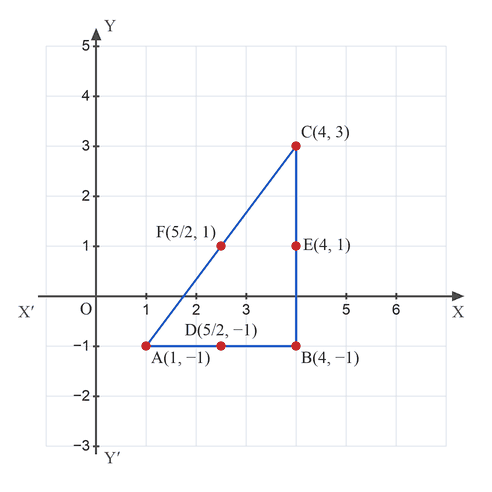
Therefore, the mid-points of , and are , and .
- 73 marks
Question 7
Find the centre of a circle if the end points of a diameter are and .
Solve with AIWritten solution
Solution:
Concept: The centre of a circle is the mid-point of every diameter, so it is found with the mid-point formula .
Step 1 — Average the abscissae. We add the abscissae of and and halve:
Step 2 — Average the ordinates. We add the ordinates and halve:
Therefore, the centre of the circle is .
- 83 marks
Question 8
If is the mid-point of , find the coordinates of:
(i) if the coordinates of and are and and
(ii) if the coordinates of and are , .
Solve with AIWritten solution
Solution:
Concept: If is the mid-point of and , then , so ; in the same way . An unknown end is therefore "twice the mid-point minus the known end".
(i)
Step 1 — Find the abscissa of . We let and use :
Step 2 — Find the ordinate of . We use :
.
(ii)
Step 1 — Find the abscissa of . We let and use :
Step 2 — Find the ordinate of . We use :
.
Step 3 — Check. We take the mid-point of each pair again; both give the mid-point stated in the question:
Therefore, (i) ; (ii) .
- 93 marks
Question 9
Find the distance between each of the following pairs of points:
(i) ,
(ii) ,
(iii) ,
(iv) ,
Solve with AIWritten solution
Solution:
Concept: The distance formula: the distance between and is
It comes from Pythagoras' theorem in the right triangle whose legs are the difference of the abscissae and the difference of the ordinates.
(i) and
Step 1 — Find the differences. We subtract the abscissae and then the ordinates:
Step 2 — Apply the formula. We square, add and take the square root:
Distance units.
(ii) and
Step 1 — Find the differences. We subtract the abscissae and then the ordinates:
Step 2 — Apply the formula. We square, add and take the square root:
Distance units.
(iii) and
Step 1 — Use the distance from the origin. For a point and the origin the distance is :
Distance units.
(iv) and
Step 1 — Find the differences. We subtract the abscissae and then the ordinates:
Step 2 — Apply the formula. We square, add and take the square root:
Distance units.
Therefore, the distances are (i) , (ii) , (iii) , (iv) units.
- 103 marks
Question 10
Find the radius of the circle that has its centre at and passes through .
Solve with AIWritten solution
Solution:
Concept: The radius is the distance from the centre to any point on the circle, found with .
Step 1 — Find the differences. We subtract the co-ordinates of the centre from those of :
Step 2 — Apply the distance formula. We square, add and take the square root:
Therefore, the radius of the circle is units.
- 113 marks
Question 11
Find the lengths of the sides of the triangle whose vertices are , and .
Solve with AIWritten solution
Solution:
Concept: The distance formula: the distance between and is
It comes from Pythagoras' theorem in the right triangle whose legs are the difference of the abscissae and the difference of the ordinates.
Step 1 — Draw the triangle. The figure shows the three vertices joined; we now find each side with the distance formula.
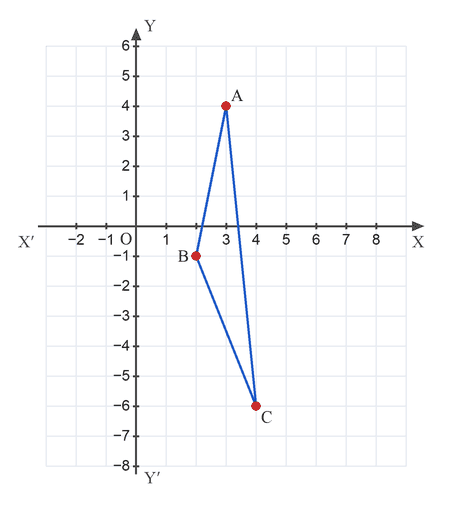
Step 2 — Side . We put and in the formula:
Step 3 — Side . We put and in the formula:
Step 4 — Side . We put and in the formula:
Therefore, , and units.
- 123 marks
Question 12
The vertices of are , and . Find the length of the median to
(i) ,
(ii) ,
(iii) .
Solve with AIWritten solution
Solution:
Concept: A median of a triangle joins a vertex to the mid-point of the opposite side. The median to therefore joins to the mid-point of . We find the mid-point with and the length with .
(i) Median to
Step 1 — Find the mid-point of . We average the co-ordinates of and :
Step 2 — Find . From to the differences are and :
Median to units.
(ii) Median to
Step 1 — Find the mid-point of . We average the co-ordinates of and :
Step 2 — Find . From to the differences are and :
Median to units.
(iii) Median to
Step 1 — Find the mid-point of . We average the co-ordinates of and :
Step 2 — Find . From to the differences are and :
Median to units.
Step 3 — See the medians. The figure shows the three medians , and ; they meet at one point , the centroid of the triangle.

Therefore, the medians to , and are , and units long.
- 133 marks
Question 13
A circle has its centre at the origin and a radius of . State whether each of the following points is on, outside or inside the circle: , , .
- 143 marks
Question 14
A line is of length , and one end is at the point . If the ordinate of the other end be , prove that the abscissa will be or .
- 153 marks
Question 15
Find the coordinates of the point which divides internally the join of the points
(i) and in the ratio
(ii) and in the ratio
- 163 marks
Question 16
Find the coordinates of the point which divides externally the join of the points
(i) and in the ratio
(ii) and in the ratio
- 173 marks
Question 17
Find the coordinates of the points of trisection of the line joining the points and .
- 183 marks
Question 18
The line joining the points and is divided into four equal parts, find the coordinates of the points of section.
- 193 marks
Question 19
In what ratio does the point divide the join of and ?
- 203 marks
Question 20
In what ratio is the line joining the points
(i) and divided by the -axis;
(ii) and divided by the -axis?
- 213 marks
Question 21
Find the ratio in which the axes divide the line joining the points and .
- 223 marks
Question 22
Show by using section formula that the points , and are collinear.
- 233 marks
Question 23
Find the centroid of the triangle whose angular points are , and respectively.
- 243 marks
Question 24
If ; and and is , find and .
- 253 marks
Question 25
Find the coordinates of the in-centre of the triangle whose vertices are , and .
- 263 marks
Question 26
Find the area of the triangle whose vertices are
(i) , and
(ii) , and
(iii) , and
- 273 marks
Question 27
Find the area of the quadrilateral whose vertices are
(i) , , and
(ii) , , and
- 283 marks
Question 28
Show that the following points are collinear:
(i) , and
(ii) , and
- 293 marks
Question 29
If , and are collinear, find .
- 303 marks
Question 30
If the area of the quadrilateral whose angular points , , , taken in order are , , and be zero, find the value of .
- 313 marks
Question 31
, , are the points , and respectively. , , , are the mid-points of , , respectively. Prove that .
- 323 marks
Question 32
The straight lines , , and intersect in the three points , , and . Find the area of the triangle . What is the value of the area if ?
What Class 11 Maths Ch 12 covers
The sections of the chapter, in the order the book takes them. Every question above comes from one of these.
- 01Coordinates, Quadrants and Plotting of Points
- 02Distance and Mid-point Formulae
- 03Section Formulae: Internal and External Division
- 04Centroid and Incentre of a Triangle
- 05Area of a Triangle and a Quadrilateral
- 06Collinearity of Three Points
More ways to study this chapter
The same chapter asked three other ways. Practise it, revise it, and see what the board has set on Ch 12 before.
Class 11 Maths Ch 12 questions students ask
How many questions are there in Class 11 Maths Ch 12?
32 questions. Every one is solved step by step on this page.
Are these Class 11 Maths solutions free?
Yes. Every question and its full working is free to read, with no account needed.
Can I download the Class 11 Maths Ch 12 solutions as a PDF?
There is no PDF to download. Every solution is on this page instead, which means it is searchable, always the current syllabus, and readable on a phone. Use your browser's print option if you want it on paper.