
Opening your dashboard
Class 11 Maths Chapter 12 Basic Concepts of Points and Their Coordinates: Practice Questions
50 questions on Chapter 12, each worked through on its own page with the AI tutor. Class 11 Maths, ICSE 2026-27.
50 questions
1–4 marks · Mixed difficulty
- 11 mark
Question 1
If and , then the point lies in the
- 21 mark
Question 2
The distance of the point from the -axis is
- 32 marks
Question 3
Plot the point on a graph. Then write down the coordinates of the following points and plot them:
(a) , the mirror image of in the -axis;
(b) , the mirror image of in the -axis;
(c) , the point for which the origin is the mid-point of .
Name the quadrant in which each of , , and lies.
- 43 marks
Question 4
A point satisfies both conditions and .
(a) In which quadrant does lie? Give a reason.
(b) Find all such points with integer coordinates that are at a distance of units from the origin.
- 52 marks
Question 5
For how many integer values of does the point lie in the first quadrant? List these values of .
- 61 mark
Question 6
The point on the -axis that is equidistant from and is
- 73 marks
Question 7
Show that the points , and are the vertices of an isosceles right-angled triangle. At which vertex is the right angle?
- 83 marks
Question 8
Find the point that is equidistant from the three points , and , and find this common distance. (The point is the circumcentre of triangle .)
- 91 mark
Question 9
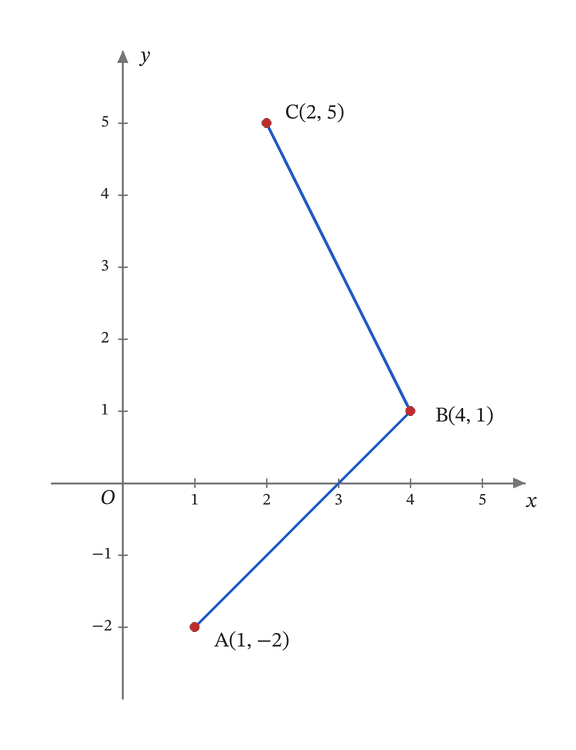
, and are three vertices of a parallelogram , taken in order. Using the fact that the diagonals of a parallelogram bisect each other, the fourth vertex is
- 102 marks
Question 10
The mid-point of a segment is . The end lies on the -axis and the end lies on the -axis. Find the coordinates of and , and the length of .
- 112 marks
Question 11
The mid-point of the segment joining and is . Find the values of and .
- 123 marks
Question 12
The mid-points of the sides , and of a triangle are , and respectively. Find the coordinates of the vertices , and .
- 131 mark
Question 13
The point divides the segment internally in the ratio . If is , then is
- 143 marks
Question 14
Find the ratio in which the line divides the segment joining and . Also find the point of division.
- 151 mark
Question 15
The points and are given. The point lies on produced beyond such that . Then is
- 164 marks
Question 16
The points and are given. The point divides internally, and the point divides externally, both in the ratio .
(a) Find the coordinates of and .
(b) Find the ratio in which divides the segment .
- 171 mark
Question 17
A point divides the segment externally in the ratio , where . Then lies
- 183 marks
Question 18
The points and are given. Find every point on the line for which .
- 191 mark
Question 19
The mid-points of the sides of a triangle are , and . The centroid of the triangle is
- 203 marks
Question 20
In a triangle , the vertex is and the mid-point of is .
(a) Find the centroid of the triangle.
(b) If is , find , and check your answer to part (a).
- 211 mark
Question 21
The incircle of the triangle with vertices , and touches the side at the point . Then is
- 223 marks
Question 22
The vertices of a triangle are , and .
(a) Find the incentre and the centroid of the triangle.
(b) Show that and both lie on the -axis, and find the distance .
- 232 marks
Question 23
Show that the centroid of the triangle with vertices , and lies on the -axis, and write down the centroid.
- 244 marks
Question 24
The vertices of a triangle are , and , and is its centroid. Let , and be the centroids of the triangles , and respectively. Show that the centroid of triangle is itself.
- 251 mark
Question 25
The incentre and the centroid of a triangle are always the same point for
- 261 mark
Question 26
The vertices of a triangle are , and . If the area of the triangle is square units, then the possible values of are
- 273 marks
Question 27
Show that the area of the triangle with vertices , and does not depend on , and find this area.
- 281 mark
Question 28
The points , , and , taken in order, form a rhombus. Using the lengths of its diagonals, the area of the rhombus is
- 293 marks
Question 29
The vertices of a triangle are , and , and is its centroid. Show that the triangles , and have equal areas, each equal to one-third of the area of triangle .
- 301 mark
Question 30
If all three vertices of a triangle have integer coordinates, then the area of the triangle
- 314 marks
Question 31
The vertices of a quadrilateral, taken in order, are , , and .
(a) Find the area of the quadrilateral by splitting it along the diagonal .
(b) Find the ratio in which the diagonal divides the area of .
(c) The diagonal meets the diagonal at . Find the ratio .
- 323 marks
Question 32
The points and are given. Find the relation (or relations) that the coordinates of a point must satisfy if the area of triangle is square units.
- 332 marks
Question 33
Find the relation between and if the points , and are collinear.
- 343 marks
Question 34
Using the distance formula only, show that the points , and are collinear. Also find the ratio in which divides .
- 352 marks
Question 35
The points , and are collinear, where and . Prove that .
- 361 mark
Question 36
The points , and are collinear. The ratio in which divides is
- 374 marks
Question 37
The vertices of a triangle are , and .
(a) Find the point that is equidistant from , and (the circumcentre).
(b) Find the centroid .
(c) The orthocentre of the triangle is . Show that , and are collinear, and find the ratio in which divides .
- 381 mark
Question 38
Which of the following points lies on the line through and ?
- 391 mark
Question 39
For a fixed point , the points , and are
- 401 mark
Question 40
The origin is shifted to the point , the axes remaining parallel to the original axes. The new coordinates of the point are
- 412 marks
Question 41
A point has coordinates . After the origin is moved to a point , with the axes kept parallel, the coordinates of are read as . Where is , and what are the coordinates of in the new system?
- 423 marks
Question 42
Shift the origin to the point , keeping the axes parallel, and find the new form of the equation . What curve does the equation represent?
- 433 marks
Question 43
To what point should the origin be shifted, keeping the axes parallel, so that the equation loses both its first-degree term in and its constant term? Write the new equation.
- 441 mark
Question 44
When the origin is shifted to another point, the axes remaining parallel to the original axes, which of the following changes?
- 454 marks
Question 45
The vertices of a triangle are , and . The origin is shifted to the centroid of the triangle, the axes remaining parallel.
(a) Find the new coordinates of , and .
(b) Show that the new abscissae of , , add up to , and so do their new ordinates.
(c) Verify that the area of the triangle is the same in both systems.
- 462 marks
Question 46
The origin is shifted to the point , the axes remaining parallel. Find the new form of the equation , and explain why the new equation has no constant term.
- 474 marks
Question 47
A school garden is shaped like a triangle. On a site plan, with the gate at the origin and distances in metres, its corners are , and . (Hypothetical data.) A fountain is to be placed at the centroid of the garden.
(a) Find the area of the garden.
(b) Find the position of the fountain on the plan.
(c) Find the length of a straight path from the gate to the fountain, correct to m.
- 481 mark
Question 48
For the triangle with vertices , and , the distance between its centroid and its circumcentre is
- 494 marks
Question 49
The points , , and are the vertices of a quadrilateral , taken in order.
(a) Using mid-points and distances only, show that is a rectangle but not a square.
(b) Find its area.
- 501 mark
Question 50
The origin is shifted to the mid-point of the segment joining and , the axes remaining parallel. The new coordinates of are