Solution:
Concept: The section formula: the point dividing the join of A(x1,y1) and B(x2,y2) internally in the ratio m1:m2 (measured from A) is
(m1+m2m1x2+m2x1, m1+m2m1y2+m2y1)
For division externally in the ratio m1:m2, replace m2 by −m2, which gives
(m1−m2m1x2−m2x1, m1−m2m1y2−m2y1)
(i) A(−4,4), B(1,7), ratio 2:1 externally
Step 1 — Apply the external formula with m1=2, m2=1. We measure the ratio from A:
x=2−12(1)−1(−4)=16=6
y=2−12(7)−1(4)=110=10
Step 2 — Measure the ratio from the other end. Taking m1=1, m2=2 (the ratio 2:1 counted from B) gives
x=1−21(1)−2(−4)=−19=−9
y=1−21(7)−2(4)=−1−1=1
The point is (6,10), or (−9,1) if the ratio is measured from (1,7).
(ii) A(3,4), B(−6,2), ratio 3:2 externally
Step 1 — Apply the external formula with m1=3, m2=2. We measure the ratio from A:
x=3−23(−6)−2(3)=1−24=−24
y=3−23(2)−2(4)=1−2=−2
Step 2 — Measure the ratio from the other end. Taking m1=2, m2=3 gives
x=2−32(−6)−3(3)=−1−21=21
y=2−32(2)−3(4)=−1−8=8
The point is (−24,−2), or (21,8) if the ratio is measured from (−6,2).
Step 3 — See part (i) on a graph. An external point lies on the line AB produced, outside the segment: P(6,10) beyond B and Q(−9,1) beyond A.
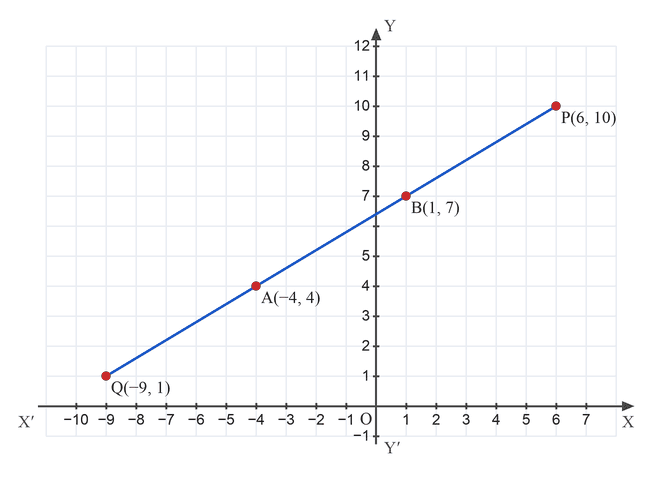
Note: The usual reading measures the ratio from the first point named, so the main answers are (6,10) and (−24,−2).
Therefore, (i) (6,10) or (−9,1); (ii) (−24,−2) or (21,8).
