Solution:
Concept: The section formula: the point dividing the join of A(x1,y1) and B(x2,y2) internally in the ratio m1:m2 (measured from A) is
(m1+m2m1x2+m2x1, m1+m2m1y2+m2y1)
For division externally in the ratio m1:m2, replace m2 by −m2, which gives
(m1−m2m1x2−m2x1, m1−m2m1y2−m2y1)
(i) A(8,9), B(−7,4), ratio 2:3
Step 1 — Apply the formula with m1=2, m2=3. We measure the ratio from the first point A, so x1=8, y1=9, x2=−7, y2=4:
x=2+32(−7)+3(8)=5−14+24=2
y=2+32(4)+3(9)=58+27=7
Step 2 — Measure the ratio from the other end. If the ratio 2:3 is measured from B instead (that is, 3:2 from A), we get
x=53(−7)+2(8)=−1
y=53(4)+2(9)=6
The point is (2,7), or (−1,6) if the ratio is measured from (−7,4).
(ii) A(1,−2), B(4,7), ratio 1:2
Step 1 — Apply the formula with m1=1, m2=2. We measure the ratio from A:
x=1+21(4)+2(1)=36=2
y=1+21(7)+2(−2)=33=1
Step 2 — Measure the ratio from the other end. Taking the ratio from B (that is, 2:1 from A) gives
x=32(4)+1(1)=3
y=32(7)+1(−2)=4
The point is (2,1), or (3,4) if the ratio is measured from (4,7).
Step 3 — See part (i) on a graph. Both points of part (i) lie on the segment, P(2,7) nearer to A and Q(−1,6) nearer to B.
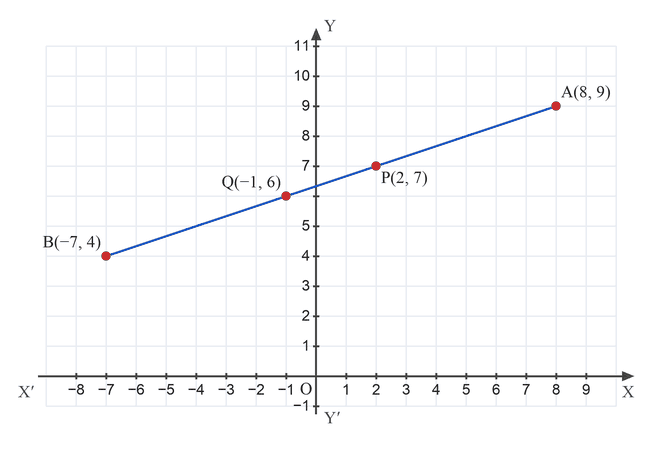
Note: The usual reading measures the ratio from the first point named, so the main answers are (2,7) and (2,1); the second values answer the ratio measured from the other end.
Therefore, (i) (2,7) or (−1,6); (ii) (2,1) or (3,4).
